RESILIENT TAMPA
TRANSFORMING OUR CITY’S TOMORROW

INTRODUCTION 1

Letter from the Mayor
Jane Castor
I am so pleased to release Resilient Tampa: a groundbreaking roadmap that will make our city stronger in the face of our current and future challenges. This document is the culmination of almost 2 years of collaborative effort launched through Transforming Tampa’s Tomorrow (T3). When I took office in May 2019, one of my first actions was to launch T3: a comprehensive strategy to identify solutions across five priority areas for our city. With Resilient Tampa, we are releasing a set of recommendations that brings a critical resilience lens to previous advisory recommendations.
Building a more resilient city has never been more urgent, as Tampa is being tested as never before. The COVID-19 pandemic, a reckoning with racial injustice, housing and growth pressures, and more frequent and intense climate-driven events have presented us with intersecting challenges—with the most vulnerable Tampanians experiencing particularly significant impacts.
But the past year has also brought out the best in our city, and I have seen firsthand how Tampanians across neighborhoods have come together to support one another. Building on efforts like Lift Up Local, residents throughout Tampa have worked together to protect and support their neighbors while beginning the important task of reviving our city’s economy.
This spirit of partnership and coordination will be critical as we work to implement Resilient Tampa and ensure our city comes back stronger than before. This roadmap, organized across four scales—from individual Tampanians, to neighborhoods, to our infrastructure, to City government—includes ambitious goals and tactical actions to which we can all collectively contribute.
To give just a few examples, we will expand support for entrepreneurs, growing small businesses and helping to bring economic opportunity to every Tampanian. We will transform the public realm to create safer and more walkable neighborhoods. We will pilot new nature-based solutions like living shorelines that protect our city from storms while providing environmental benefits and connecting Tampanians with open space. And we will integrate approaches that advance racial equity across our City government, working together to promote equity for all Tampanians.
This roadmap was created thanks to extensive engagement—despite the COVID-19 pandemic—with Tampanians of all backgrounds, and this document reflects their vision for a more resilient city. I want to thank the hundreds of Tampanians who contributed their expertise and perspective to Resilient Tampa, particularly City staff, local nonprofit organizations, community members, and our many other private, philanthropic, and academic partners.
Now, the hard work begins: it is up to us all to roll up our sleeves and continue working together to make this document a reality. Through our continued partnership, we can make our city stronger so that all Tampanians are prepared and thrive no matter what challenges come our way.

Note from the Sustainability and Resilience Officer
Whit Remer
As Tampa’s first Sustainability & Resilience Officer, my mandate is to advance Mayor Castor’s vision for a more resilient city. When I began in this role, Tampa was experiencing years of growth following a recession that hit the city particularly hard – progress now challenged again by the COVID-19 pandemic. The Mayor wanted to understand how housing, transportation, economic and social pressures, and the built environment were holding us back from reaching our full potential, and charged me to work with the community to chart a path forward through Resilient Tampa.
The Mayor established a partnership with Resilient Cities Catalyst (RCC), an internationally recognized group of urban resilience experts, to support the City in developing this resilience roadmap. It quickly became apparent that this process was an incredible opportunity to highlight Tampa’s best traits, but also required some uncomfortable reflection. Furthermore, this process required months of conversations to understand Tampanians’ diverse experiences: what are people feeling in the boardroom, at the dining table, or on the factory floor?
The kickoff meetings for this roadmap occurred during some of the most difficult weeks of the COVID-19 pandemic and social unrest. Some of the early drafts of this document took on dark undertones as jobs vanished, families and individuals faced isolation, and schooling changed. Fortunately, our city already started to recover several months later, as we have experienced some of the highest housing prices in 15 years, a rising stock market, and declining unemployment rates. But as this roadmap shows, these highs and lows have not been experiences shared equally among us.
Delivering this roadmap is not a light responsibility. Our city and the world confronted unprecedented shocks and stresses over the course of 2020–2021. This roadmap identifies steps to ensure we not only bounce back from these and other longstanding challenges, but that we bounce forward – together.
The initiatives in this roadmap are not intended to be easy to accomplish. Nor can they be implemented by one department, one mayor, or even the entire City of Tampa workforce. It is my hope that every Tampanian can find at least one initiative that resonates strongly and sparks an urge to get involved to lift up our community. It will take all of us, partnering together, to make this roadmap a reality and build a stronger, more equitable, and more resilient Tampa.
EXECUTIVE SUMMARY
We are at a critical moment in our city’s history. Tampa is emerging from a year of challenges brought on by the COVID-19 pandemic, extraordinary growth, impacts of a changing climate, and long-standing economic and social inequities. What’s more, across our city, already vulnerable communities are now bearing the brunt of these compounding crises.
From these unprecedented challenges, however, comes the opportunity to build upon our city’s assets and strengths, including recent economic and population growth, vibrant diversity across our neighborhoods, and collaborative partnerships across government, nonprofits, businesses, and philanthropy. With this as our foundation, and with Resilient Tampa laying out a path forward, we have the opportunity to forge a stronger, more inclusive, and more resilient city.
Strengthening Tampa’s resilience means that we must address the simmering challenges that affect Tampanians every day, like a lack of affordable housing, inadequate transportation, and income inequality—increasing opportunity for all city residents. At the same time, we must prepare so that we can bounce back more quickly from inevitable catastrophic events, such as floods and extreme heat, which amplify the impact of underlying stresses. And we must do so in collaboration with our residents and with partners across multiple sectors and scales—government, community-based organizations, the private sector, and beyond. This approach will ensure that we are collectively stronger today and able to thrive in the face of change.
INTRODUCTION
Resilient Tampa lays out a tactical roadmap that builds on Mayor Castor’s pioneering vision for the future through Transforming Tampa’s Tomorrow (T3). This strategic document sets forth concrete actions that address our city’s most pressing challenges at all scales: from individual Tampanians and households, to our diverse and vibrant neighborhoods, to our critical infrastructure, to City government as a whole.

Opportunity for All Tampanians

focuses on acŁons that ensure all Tampanians, at all stages of their lives, benefit from our conŁnued economic growth.
Thriving Neighborhoods

lays out ini�a�ves that build on the diversity and strength of our vibrant communi�es to tackle resilience challenges, from affordability to climate change to connec�vity.
Climate-Ready Infrastructure
outlines acŁons that will reduce our exposure to climate risk, while strengthening our city’s exisŁng and future infrastructure to bounce back from whatever climate-driven challenges come our way.
Growing and Connected City

emphasizes ini�a�ves that harness Tampa’s growth to ensure that our City government can work fairly and efficiently by embedding resilient systems and addressing historic racial dispari�es.
Taken together, the 58 initiatives across Resilient Tampa form an ambitious and forward-looking action plan. This document reflects a collaborative and cross-sectoral process that built on existing work across the City and emphasizes the importance of partnerships. This is an important time for the City of Tampa, and achieving a more inclusive and resilient City will require continued collaboration. Please join us in building a more resilient Tampa. For more information, visit resilience. (www.tampa.gov/resilience)
INTRODUCTION TO RESILIENCE
In many ways, the challenging events of 2020 have vividly demonstrated to us all the value and importance of resilience. As Tampa—like cities across the United States and the globe—grapples with a pandemic, a reckoning with racial justice, and climate impacts of increasing frequency and unprecedented strength, Tampanians and our citywide systems are being tested. What’s more, communities that were already vulnerable are now bearing the brunt of these compounding challenges.
These events underscore both the urgency and the opportunity in building Tampa’s resilience. Resilience is an approach that helps cities leverage their strengths to tackle the complex known and unknown challenges of the 21st century. By building this capacity, Tampa’s families, businesses, neighborhoods, institutions, and systems will strengthen their ability to adapt and thrive in the face of both shocks and stresses.

Shocks include both natural and human-driven disasters,
Resilience is an approach that helps cities leverage their strengths to tackle the complex known and unknown challenges of the 21st century.
such as hurricanes, heatwaves, pandemics, and cyberattacks. While it is critical for Tampa to prepare for these risks by mitigating their impact and building the capacity to bounce back more quickly when they do occur, addressing underlying stresses is equally important. Stresses are the vulnerabilities that afflict Tampa’s communities on an everyday basis, and are amplified in the event of a shock as already-vulnerable communities tend to experience greater impacts during these adverse events. Stresses range from escalating affordability challenges to economic inequality to aging infrastructure. Tackling such stresses will not only foster a more prosperous and thriving city on an everyday basis, it will also strengthen Tampa’s preparedness for future disasters.
Through Resilient Tampa, the City, under Mayor Jane Castor’s leadership, has set forth an ambitious but achievable plan for building resilience by addressing our city’s most urgent shocks and stresses in an integrated way. This tactical roadmap is organized around aspirational visions and goals for our city’s future that span every scale, from individual Tampanians, to neighborhoods, to infrastructure systems, to the city as a whole. To achieve these visions and goals, the chapters of this roadmap specify actions that achieve multiple benefits—addressing multiple shocks and stresses at once and thereby maximizing limited resources.
Fortunately, Resilient Tampa builds upon a strong foundation that will be key to its success. Mayor Castor launched her vision for Transforming Tampa’s Tomorrow (T3) at the outset of her administration in 2019, establishing five advisory teams tasked with tackling Tampa’s most urgent priorities while capitalizing upon the opportunities presented by the city’s economic and population growth. Advisory teams include experts, community members, and City staff, and have incorporated extensive engagement and outreach across Tampa’s neighborhoods in developing community-driven solutions. Teams representing the priority areas of Transportation, Community-Centric Services, Workforce Development, and Housing Affordability have released innovative recommendations that are already having an impact across the city—and the actions described in Resilient Tampa build upon these foundational efforts. This roadmap advances the fifth and final pillar, Sustainability and Resilience, of Mayor Castor’s comprehensive T3 vision.
However, addressing current and future challenges will require more than the City acting alone. This is why T3 and Resilient Tampa underscore the transformative power of partnerships. T3 has already demonstrated how a coordinated effort across sectors can drive innovative new approaches to strengthen Tampa. Similarly, actions throughout Resilient Tampa rely on a multisector, collaborative approach. Many of the actions featured in this roadmap are driven by partners across the business, nonprofit, philanthropy, and academic sectors. Other actions led by the City of Tampa include innovative partnerships with stakeholders outside of government. Taken together, this roadmap and Mayor Castor’s holistic T3 vision showcase how partnerships are already building a stronger and more resilient Tampa.
DEVELOPING RESILIENT TAMPA
Resilient Tampa was developed through a process that combined a variety of data sources and analytical tools to prioritize the city’s most urgent shocks and stresses with widespread community engagement.
The Mayor’s visionary Transforming Tampa’s Tomorrow (T3) strategy, launched in 2019, laid the groundwork for the Resilient Tampa roadmap. Mayor Castor appointed Tampa’s first Sustainability & Resilience Officer (SRO) in May 2020, and charged the SRO with leading the development of Resilient Tampa as a key pillar of T3. The roadmap was designed to build upon and complement existing T3 priority recommendations that have been released across the areas of Transportation, Community-Centric Services, Workforce Development, and Housing Affordability. The City of Tampa also launched an annual survey, reaching over 1,300 Tampanians, to solicit broad feedback on residents’ needs and priorities, which informed the roadmap’s development.
Over the summer of 2020, despite the challenges presented by COVID-19—including the need to prioritize the immediate pandemic response as well as social distancing requirements—the SRO kicked off the roadmap development process with dozens of individual meetings with community leaders and stakeholders across sectors. Through these meetings, conducted virtually due to the pandemic, stakeholders highlighted their most urgent resilience priorities and promising local initiatives, including those led by the City as well as those by partners, that could be built upon or amplified in Resilient Tampa. At a virtual kickoff workshop held in August 2020 with almost 100 participants, including City staff as well as local experts from across sectors and community partners, the Resilient Tampa team consolidated key participant insights on Tampa’s resilience-building opportunities and challenges.
DEVELOPING RESILIENT TAMPA
- May 2019: Mayor Castor launches Transforming Tampa’s Tomorrow (T3), laying the foundation for Resilient Tampa through recommendations across five priority areas for the city
- Summer 2019 – Winter 2020: Nearly 100 community partners, residents, and experts meet over dozens of hours to develop recommendations for T3
- May 2020: Mayor Castor appoints Tampa’s first Sustainability & Resilience Officer
- Summer 2020: Dozens of individual meetings are held with community leaders and stakeholders across sectors
- August 2020: Almost 100 participants take part in a virtual kickoff workshop, including City staff, local experts from across sectors and community partners
- September 2020: Community Input Tool is launched, reaching over 1,720 residents
- Fall 2020: Eight additional virtual workshops identify the most promising tactics to address the identified resilience priority areas
- Winter 2020: Implementable initiatives are co-designed with City of Tampa Staff and Tampanians
- May 2021: Release of Resilient Tampa
In addition, the Resilient Tampa team launched a Community Input Tool in September 2020. This online survey reached over 1,720 residents in both English and Spanish across Tampa’s neighborhoods. The Tool asked Tampanians from diverse backgrounds to share their detailed perspectives on the city’s most urgent resilience priorities, with topics spanning mobility, housing, infrastructure, health and safety, economic opportunity, disaster preparedness, and other areas. Tampanians also shared important insights and ideas about how the city’s assets and strengths can be built upon to make Tampa more resilient.
Results from the Community Input Tool and stakeholder engagement led the Resilient Tampa team to identify the shocks and stresses to be prioritized in Resilient Tampa and directly informed four priority areas ripe for further exploration. With these community-informed priority areas in mind, the team conducted additional analyses leveraging diverse data sets and combined these data-driven insights with results from 8 additional virtual workshops held during the fall of 2020. These workshops were designed to identify the most promising tactics, including both local innovations and global best practices, to address identified resilience priority areas. During these workshops, the team partnered with City staff, community leaders, and local experts to collaboratively develop the visions, goals, and intia-tives that shape Resilient Tampa.









OVERVIEW OF TAMPA’S RESILIENCE OPPORTUNITIES
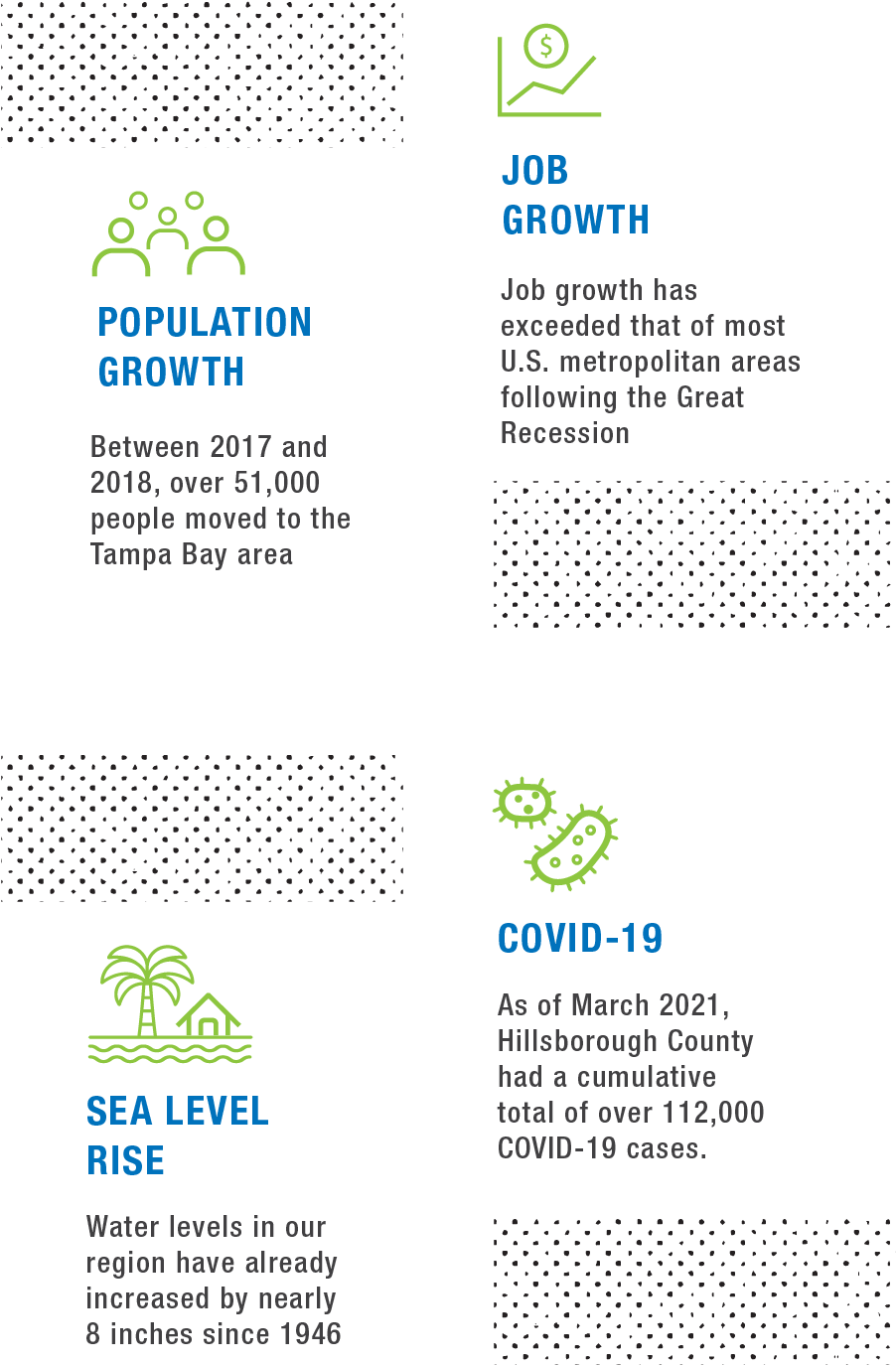
This is an important moment in Tampa’s history: a moment of both significant challenges and significant opportunities. Over the past several years, the city has experienced an unprecedented period of population and economic growth that has brought new vitality and new prosperity to the region. Between 2017 and 2018, over 51,000 people moved to the Tampa Bay area, earning it the ninth spot on the Census’s list of the top 10 metro areas in terms of population growth.1 Simultaneously, Tampa’s job growth following the Great Recession—particularly in the construction, healthcare, and financial services sectors—has exceeded that of most metropolitan areas in the country.2 This growth is only expected to increase as Tampa’s strong economy becomes increasingly attractive to potential future Tampanians.
In addition, the city’s vibrant culture and diversity is an asset highlighted by longtime residents and newcomers alike. A welcoming community from its earliest days, today Tampa’s neighborhoods reflect the diversity of Tampa’s residents, ranging from historic Black and Hispanic communities to more recent refugees welcomed from countries across the globe. Tampanians from diverse cultures and backgrounds bring a unique vitality that will continue to make the city stronger and more resilient.
Of course, COVID-19 and the ensuing economic crisis has taken a toll on our city, as in cities across the globe—impacts that will continue to be felt for years to come. As of March 2021, Hillsborough County had a cumulative total of over 112,000 COVID-19 cases.3 Tragically, the County has lost over 1,500 residents to COVID-19,4 with thousands of survivors experiencing ongoing health impacts and grieving family members grappling with unspeakable loss. Our youngest Tampanians spent months learning remotely, with parents juggling simultaneous roles as caregivers, income earners, and educators, all from home. Simultaneously, our economy has taken a serious blow.
Between March and May of 2020 alone, 1,200 businesses closed due to the pandemic,5 affecting the jobs and livelihoods of thousands of Tampa residents as well as impacting the local goods and services available in Tampa’s neighborhoods.
SELECTED CHALLENGES & OPPORTUNITIES
As a City, we are starting to recover from the pandemic, thanks to the entrepreneurship of Tampanians as well as efforts such as Lift Up Local. In a sign of the economic recovery’s robustness, as of February 2021, employment rates increased by 2.5% compared to January 2020 for the city overall.6 Although Tampa’s economy has started to improve, there is more work to do to ensure an equitable recovery for all residents. The lowest-earning Tampanians continue to be burdened by the economic impacts of COVID-19, with their employment rates in January 2021 down by 15.5% compared to January 2020.7
As our recovery continues, we have the opportunity to channel our recovery into strengthening our City so that we can come back stronger than before. This is important as even before the COVID-19 pandemic posed new challenges to the City’s residents and economy, Tampa was already a city at risk.
Scientists are projecting a 30% increase in hurricane likelihood in the coming decade.
Like many other cities, Tampa faces a series of challenges that may hinder its recent growth, and have been amplified during the pandemic. Climate change poses a serious threat, with storms increasing in terms of both frequency and intensity. Scientists are now projecting significant increases in risks posed by hurricanes over the coming decades, with some projecting a roughly 30% increase in likelihood in the coming decade.8 Tampa also faces the serious health impacts of increasing periods of extreme heat. By the middle of this century, our city has the potential to face a full 4 months at a heat index over 100 degrees, creating unsafe outdoor work conditions for many Tampanians.9 On top of Tampa’s other climate risks, our city is experiencing rising sea levels, placing critical City infrastructure, as well as homes and businesses, at increasing risk of expensive flood damage. Water levels in our region have already increased by nearly 8 inches since 1946. Without bold action, scientists estimate that the region may experience up to an additional 8.5 feet of sea level rise by 2100.10 These shocks threaten vulnerable Tampanians, their homes, their businesses, and their city.
The benefits of recent economic growth have not been felt by all Tampanians. Economic inequality has been exacerbated by a lack of affordable housing, with rising housing costs eclipsing the growth in wages. The average Tampanian spends 56% of their income on essential costs (including housing, transportation, and utilities);11 with that number exceeding 75% for very-low-income Tampanians living in the city’s poorest neighborhoods.12 Without adequate public transportation options, workers are faced with a lack of connectivity between affordable neighborhoods and job centers, contributing to these very affordability pressures. Tampa, along with other jurisdictions across the region, also faces potential lost economic activity, with the greater region ranking last among 19 peer metro areas in labor force participation rate measured by the percentage of its working-age population employed or looking for a job.13 As Tampa continues to grow, these issues will only multiply.
Statistics underscore the compounding impacts of longstanding disparities, disparities that have led some neighborhoods and Tampanians to experience often intersecting vulnerabilities that include environmental, economic, social, and health dimensions. When discussing vulnerable communities, this roadmap considers Tampanians experiencing such inequalities. All of the actions in Resilient Tampa are aimed at reducing these disparities.
The pandemic’s impacts on Black and Hispanic communities also exacerbate longstanding racial inequities that have persisted in Tampa as in other American cities. Tampanians of color are nearly 3
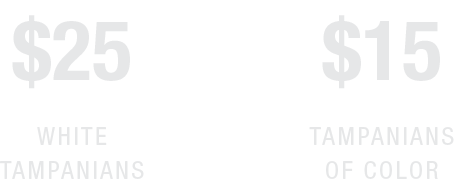
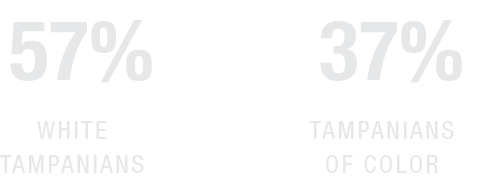
times as likely to live in poverty and are 20 percentage points less likely to own their homes than white Tampanians,14 and earn only 60% of the latter’s median wage.15 According to a recent report, addressing these systemic issues by fostering a more equitable economy would benefit all Tampanians, enhancing the region’s competitiveness and increasing the region’s economy by 20 percent—a $50 billion increase—while growing per capita income by roughly $6,470.16
In addition, a separate report found that advancing racial equity could more than double the average income for Tampanians of color.17
Recommendations released since 2019 as part of Mayor Castor’s T3 effort have begun to address these challenges, resulting in solutions that are already having an impact in neighborhoods across Tampa. Through T3, advisory teams appointed by Mayor Castor have generated recommendations across strategic priority areas including Transportation, Community-Centric Services, Workforce Development, and Housing Affordability, advancing a visionary plan for Tampa’s future. These ideas and the work launched by these teams laid the groundwork for Resilient Tampa, which serves as the final pillar of T3.
As Tampa looks to the future, leveraging the groundbreaking work of T3, our city is positioned to build upon recent growth while working to address longstanding shocks and stresses. The COVID-19 pandemic only makes this work more urgent and critical. Resilient Tampa is a step forward in this process. By focusing on Tampa’s resilience through the lens of the individual, the neighborhood, the built environment, and City government, this roadmap outlines a bold vision for Tampa’s future that will enable all residents to thrive, regardless of the shocks and stresses our city faces.
BUILDING ON T3
| Category | Community-Centric Services | Workforce Development | Housing Affordability |
|---|---|---|---|
| Increase Access to Long-Term Career Pathways for Young Tampanians |  |
 |
|
| Reduce Poverty by Connecting Tampanians to Quality Jobs and Asset-Building Opportunities |  |
 |
 |
| Meet the Critical Needs of Vulnerable Tampanians, Especially Seniors and Veterans |  |
 |
 |
| Increase the Supply of Affordable Housing |  |
 |
|
| Ensure Tampa’s Neighborhoods are Healthy, Safe, and Livable |  |
 |
 |
| Prepare Tampa’s Communities for Current and Future Climate Risks |  |
 |
|
| Reduce Neighborhood Disparities Through Innovative Partnerships and Programs |  |
 |
 |
| Reduce Greenhouse Gas Emissions |  |
 |
|
| Adapt Tampa’s Infrastructure to the Impacts of Climate Change |  |
 |
|
| Invest in World-Class Green and Open Spaces That Mitigate Extreme Heat and Flooding |  |
 |
|
| Grow and Diversify Tampa’s Economy While Ensuring Opportunity for All |  |
 |
|
| Increase Access to and Usage of Tampa’s Regional Transportation Network |  |
 |
|
| Lead the Way, as a City, in Institutionalizing Racial Equity and Resilience |  |
 |
 |
Resilient Tampa builds upon and complements existing T3 priority recommendations across Transportation, Community-Centric Services, Workforce Development, and Housing Affordability. This graphic showcases how goals in the roadmap align with the other pillars of T3.

HOW TO READ AN ACTION

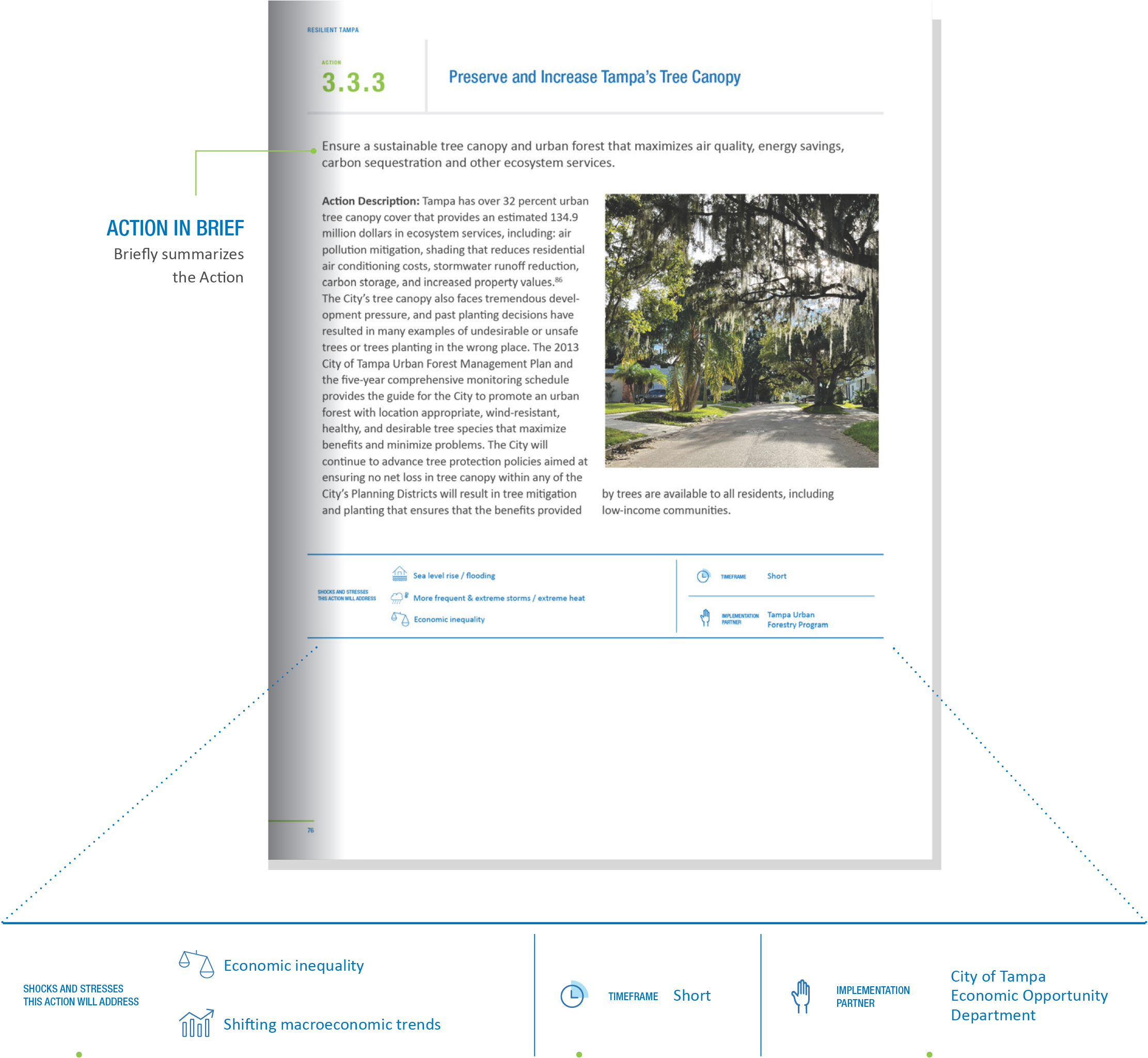
- SHOCKS AND STRESSES
- This outlines the shocks and stresses addressed by the initiative
- TIMEFRAME
- Short term (within 1 year); Medium term (1 to 5 years); Long term (more than 5 years)
- IMPLEMENTATION PARTNER
- Identifies the lead City of Tampa Department or partner that will be involved in the implementation of the initiative

POPULATION18
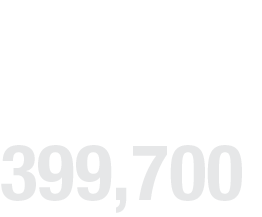
65% LABOR FORCE PARTICIPATION RATE

TRANSPORTATION19

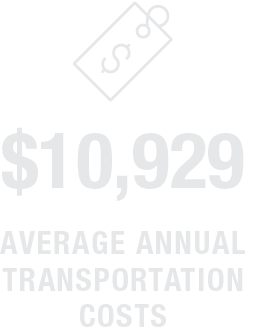
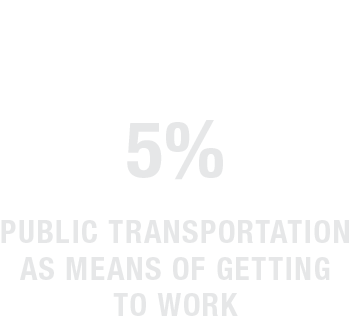
ESSENTIAL COSTS20

RESIDENTIAL OCCUPANCY21
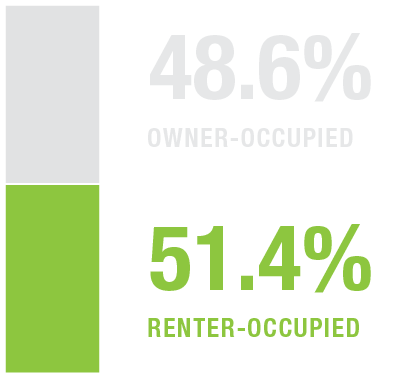
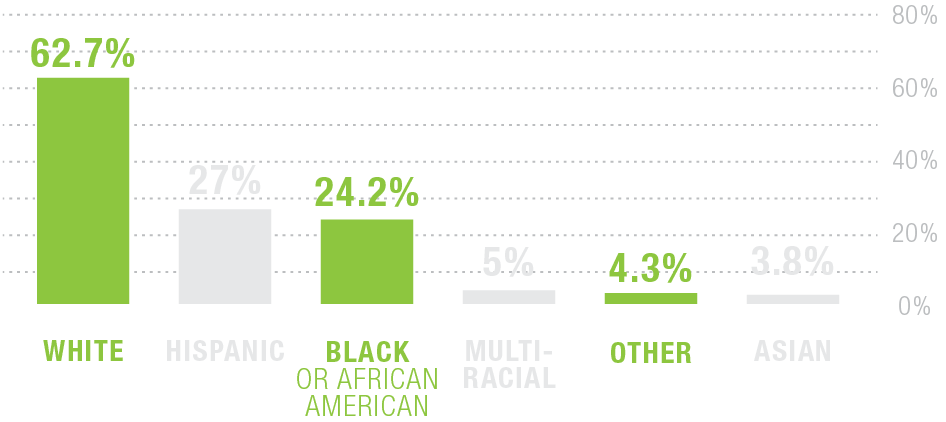
RACIAL MAKEUP22
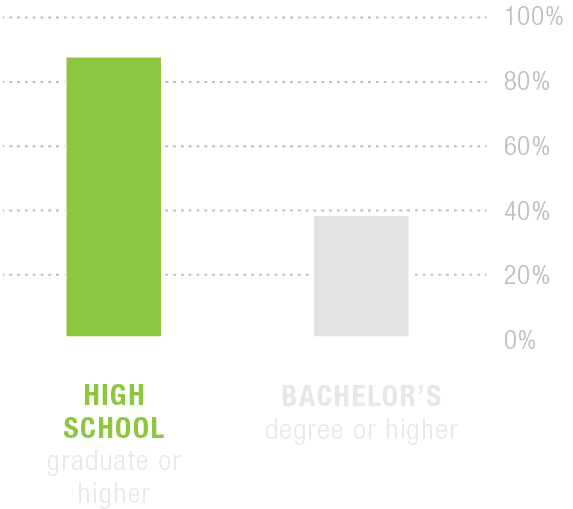
EDUCATION23
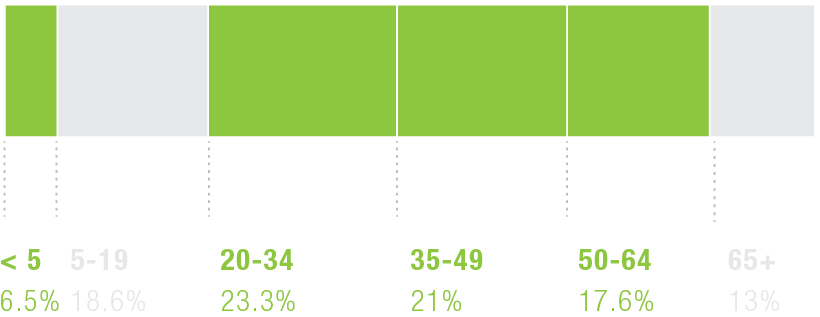
AGE DISTRIBUTION24
STRATEGY STRUCTURE
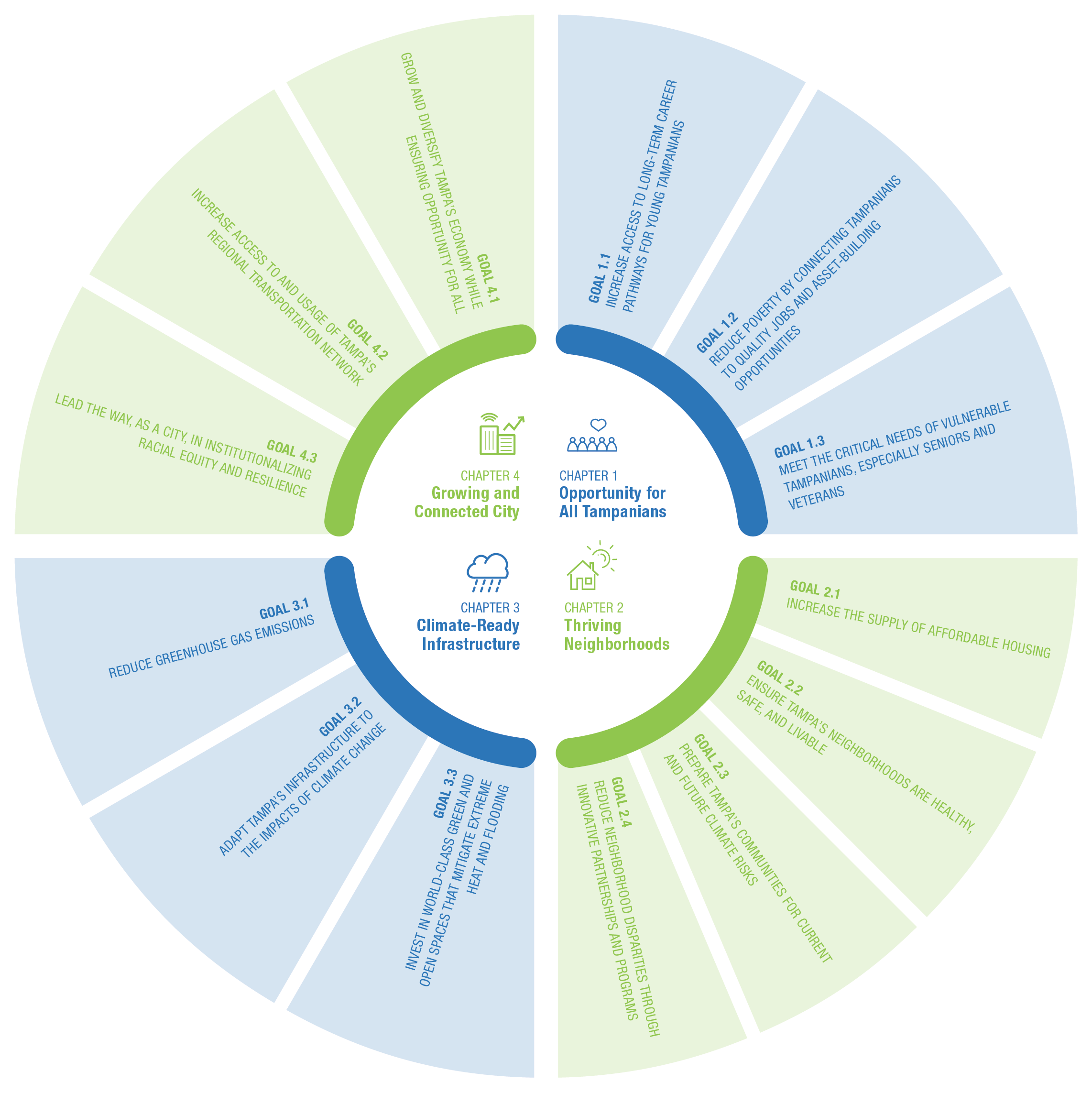
- CHAPTER 1 Opportunity for All Tampanians
- GOAL 1.1 INCREASE ACCESSTO LONG-TERM CAREER PATHWAYS FOR YOUNG TAMPANIANS
- GOAL 1.2 REDUCEPOVERTYBYCONNECTINGTAMPANIANS TOQUALITYJOBSANDASSET-BUILDING OPPORTUNITIES
- GOAL 1.3 MEETTHECRITICALNEEDSOFVULNERABLE TAMPANIANS,ESPECIALLYSENIORSAND VETERANS
- CHAPTER 2 Thriving Neighborhoods
- GOAL 2.1 INCREASETHESUPPLYOFAFFORDABLEHOUSING
- GOAL 2.2 ENSURETAMPA’SNEIGHBORHOODSAREHEALTHY, SAFE,ANDLIVABLE
- GOAL 2.3 PREPARE TAMPA’S COMMUNITIES FOR CURRENT AND FUTURE CLIMATE RISKS
- GOAL 2.4 REDUCENEIGHBORHOODDISPARITIESTHROUGH INNOVATIVEPARTNERSHIPSANDPROGRAMS
- CHAPTER 3 Climate-Ready Infrastructure
- GOAL 3.1 REDUCEGREENHOUSEGASEMISSIONS
- GOAL 3.2 ADAPTTAMPA’SINFRASTRUCTURETO THEIMPACTSOFCLIMATECHANGE
- GOAL 3.3 INVEST IN WORLD-CLASS GREEN AND OPEN SPACES THAT MITIGATE EXTREME HEAT AND FLOODING
- CHAPTER 4 Growing and Connected City
- GOAL 4.1 GROW AND DIVERSIFY TAMPA’S ECONOMY WHILE ENSURING OPPORTUNITY FOR ALL
- GOAL 4.2 INCREASEACCESSTOANDUSAGEOFTAMPA’S REGIONALTRANSPORTATION NETWORK
- GOAL 4.3 LEADTHEWAY,ASACITY,ININSTITUTIONALIZING RACIALEQUITYANDRESILIENCE
CHAPTER 1: OPPORTUNITY FOR ALL TAMPANIANS
- 1.1
- 1.1.1 Launch the Tampa Early Learning Campaign
- 1.1.2 Explore Partnerships Around Children’s Savings Accounts
- 1.1.3 Reduce the Education Gap by Expanding and Promoting Effective Educational Supports
- 1.1.4 Connect Young People to Climate Justice Internships
- 1.1.5 Expand the Stay and Play Program
- 1.1.6 Support Two-Year Community College Completion
- 1.2
- 1.2.1 Cultivate Partnerships for Economic Mobility Through One Tampa
- 1.2.2 Promote Job Training in High-Growth Industries
- 1.2.3 Promote Home Ownership and Explore Innovative Wealth Building Opportunities
- 1.2.4 Expand Support for Small Businesses, Prioritizing Underrepresented Entrepreneurs and Neighborhoods
- 1.3
- 1.3.1 Reduce the Unsheltered Homeless Population
- 1.3.2 Provide Ongoing Support for Homelessness Prevention Programs
- 1.3.3 Promote and Centralize Social Service Resources
- 1.3.4 Connect, Mobilize, and Empower Tampa’s Veteran Community Through Mentorship and Connections to Benefits
- 1.3.5 Expand a Network of Age-Friendly Communities
CHAPTER 2: THRIVING NEIGHBORHOODS
- 2.1
- 2.1.1 Finance Acquisition of Housing and Land Through a Community Land Trust
- 2.1.2 Accelerate the Development of New Affordable Housing Units
- 2.1.3 Pursue Strategies for Expanding Housing That Integrates With Neighborhood Fabric
- 2.1.4 Preserve and Restore More Affordable Housing Units
- 2.2
- 2.2.1 Transform Tampa’s Public Realm Through Vision Zero and Complete Streets
- 2.2.2 Expand the Neighborhood Commercial District Plan Program
- 2.2.3 Expand Community-Led Initiatives that Encourage Alternatives to Cars
- 2.2.4 Leverage Health in All Policies (HiAP) Framework to Drive More Equitable Mobility Initiatives
- 2.2.5 Partner with Community Redevelopment Areas (CRAs) to Foster Vibrant Neighborhoods
- 2.2.6 Nurture Community Gardens that Grow and Distribute Healthy Food
- 2.3
- 2.3.1 Map Neighborhood-Level Vulnerabilities to Support Decision-Making
- 2.3.2 Develop and Deploy an Urban Heat Pilot Program That Targets Vulnerable Neighborhoods
- 2.3.3 Launch a New Climate Risk Education and Communications Campaign
- 2.4
- 2.4.1 Leverage Opportunity Zones to Bring Employment Opportunities to Communities
- 2.4.2 Promote a Community-Based Collective Impact and Service Delivery Model in Priority Neighborhoods
- 2.4.3 Amplify the Innovation District Model Through Partnerships
CHAPTER 3: CLIMATE-READY INFRASTRUCTURE
- 3.1
- 3.1.1 Amplify Existing and Develop New Renewable Energy Financing Options and Programs
- 3.1.2 Measure the Value of Clean Energy and Climate Resilience Solutions
- 3.1.3 Promote Full Electrification of Municipal Operations Vehicles and Regional Transit Fleets
- 3.1.4 Ensure All Municipal Operations Are Powered by 100 Percent Renewable Energy
- 3.2
- 3.2.1 Assess and Fortify Our Critical Infrastructure
- 3.2.2 Incorporate Resilience Guidelines Into the Capital Planning Process
- 3.2.3 Stormwater Systems for a Changing Climate
- 3.2.4 Pilot Nature-Based Solutions Such as Living Shorelines
- 3.2.5 Promote the One Water Plan
- 3.3
- 3.3.1 Leverage Storm Retention Ponds for Social and Environmental Benefits
- 3.3.2 Increase Green Infrastructure by Leveraging Downtown Parking
- 3.3.3 Preserve and Increase Tampa’s Tree Canopy
- 3.3.4 Explore Partnerships to Increase Access to Open Space With Multiple Benefits
CHAPTER 4: GROWING AND CONNECTED CITY
- 4.1
- 4.1.1 Diversify Tampa’s Strong Economic Base
- 4.1.2 Support the Long-Term Recovery of Industries Most Impacted by COVID-19
- 4.1.3 Align Skills with Growing Sector Needs
- 4.1.4 Launch the Collaborative on Economic Mobility
- 4.1.5 Explore Mechanisms to Make Access to Broadband More Equitable
- 4.2
- 4.2.1 Implement New Micro-Mobility Solutions That Expand Transit and Multimodal Options for Tampanians
- 4.2.2 Modernize and Expand the City’s Streetcar System
- 4.2.3 Ensure Equitable Transit Access and Expansion
- 4.3
- 4.3.1 Develop and Implement Tampa’s Climate Action and Equity Plan
- 4.3.2 Deploy More Equitable and Measurable Community Engagement Across City Agencies
- 4.3.3 Incorporate Resilience Guidelines Into City Budget Processes
- 4.3.4 Implement Racial Equity Tools to Ensure Racial Equity is Considered in Policies, Practices, and Partnerships
- 4.3.5 Expand the City’s Toolkit to Advance Resilience Goals in Land Use Decisions
- 4.3.6 Implement Resilient Tampa Through the Resilience Delivery Team
CHAPTER 1
OPPORTUNITY FOR ALL TAMPANIANS
We envision a city where all Tampanians, new and lifelong residents alike, and at all stages of their lives, benefit from our continued economic growth. The initiatives outlined below will help all residents thrive despite challenges that may come their way.
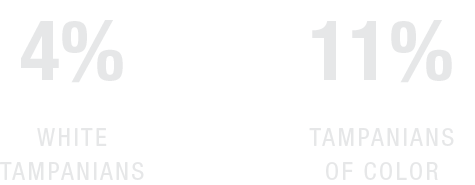
To achieve this vision, Tampa must confront the persistent inequality that continues to create a barrier to opportunity for many residents. Tampa’s recent economic growth has not benefited all residents equally, with inequality along racial lines becoming only more pronounced. Tampanians of color face higher rates of unemployment,25 are 20 percentage points less likely to own their homes,26 and earn on average 60% of the median hourly wage of white Tampanians.27 This inequity also impacts the youngest generation of Tampanians, as Black and Hispanic children in the greater Tampa Bay region are over twice as likely to live in poverty than their white classmates.28
Without action, as the city’s population continues to expand, these inequities will only increase: lifelong Tampanians may be priced out of their neighborhoods, high-quality jobs may become inaccessible for many residents, and the city may be unable to reach its fullest potential.
Now more than ever, we need to commit to ensuring that all Tampanians, especially Tampa’s most vulnerable residents, are supported and have pathways to the opportunities necessary to support themselves, to provide for their families, and to contribute to Tampa’s future. We will shrink our economic and education gaps by building and expanding programs that support young people of color from childhood through the day they graduate. We will pursue public-private partnerships to train Tampanians from all backgrounds and education levels for quality jobs. We will expand upon efforts deployed throughout the pandemic to make sure that Tampanians struggling to meet critical needs—including seniors and veterans—are supported.

Median Hourly Wage by Race

Home Ownership by Race

Unemployment Rate by Race before the COVID-19 Pandemic
1.1 INCREASE ACCESS TO LONG-TERM CAREER PATHWAYS FOR YOUNG TAMPANIANS
ACTION 1.1.1
Launch the Tampa Early Learning Campaign
Launch an early learning campaign that encourages access to voluntary pre-K programs and supports infants in their earliest stages of development.
Action Description: To close the kindergarten readiness gap, the City of Tampa will promote proven programs and resources with brain-building activities for infants to children up to the age of three and increase access to pre-school and pre-kindergarten programs.
According to the 2019 Florida Kindergarten Readiness Screener, only 54% of Hillsborough County children were ready for kindergarten.29 This data does not even take into account the potential effects of COVID-19-related remote schooling for pre-kinder-garteners. Yet, research has shown that kindergarten readiness is a critical milestone in academic success and economic stability. A critical component of the Early Learning campaign is the recognition that all of a child’s early experiences, whether at home or in school settings, are educational. Therefore, the campaign will promote ways for parents to ensure continuous learning in everyday activities, such as increased talking, while also connecting families to early learning educational programs.
FLORIDA KINDERGARTEN READINESS SCREENER DOMAINS30
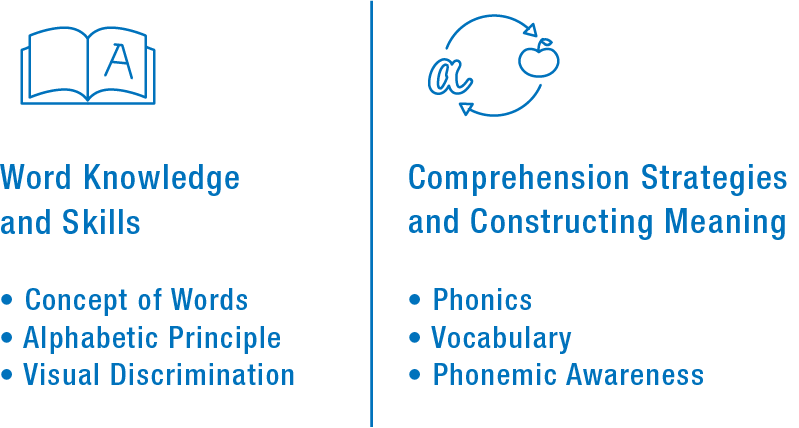
- Word Knowledge and Skills
- Comprehension Strategies and Constructing Meaning
- Concept of Words
- Alphabetic Principle
- Visual Discrimination
- Phonics
- Vocabulary
- Phonemic Awareness

Numbers and Operations
- Early Numeracy
SHOCKS AND STRESSES THIS ACTION WILL ADDRESS
 Economic inequality
 TIMEFRAME Medium
 IMPLEMENTATION PARTNER
ACTION 1.1.2
Explore Partnerships Around Children’s Savings Accounts
Explore a pilot Children’s Savings Account program for kindergarteners to empower families to save and plan for their children’s educational future.
Action Description: The City will explore a Children’s Savings Account (CSA) pilot program for kindergarteners through a unique partnership with financial institutions and philanthropy. This program will help to close Tampa’s educational and economic equity gaps by strategically targeting low-income communities.
High-quality, advanced education is more accessible depending on a family’s financial situation. In Tampa, 50.1% of white residents have a bachelor’s degree or higher, compared to 20% of Hispanic residents and 15% of Black residents.31 Piloting a Children’s Savings Account program in low-income communities could begin to remedy this economic inequity by encouraging family saving and building assets for children in low-income families. These could in turn provide savings towards educational opportunities for children who would otherwise lack the financial resources necessary to access higher education.
In this partnership, philanthropic dollars could be used to fund automatic initial and/or continuing deposits of $50 to $100 in CSAs for children in low-income households. To reach these families, the City could explore adding the CSAs to existing local or statewide social services. Programs could be structured to match or subsidize family savings in these accounts. By first making deposits in kindergarten, the CSA may accumulate meaningful assets over time even if a family does not have the ability to save.
| College Savings Plans32 | CSA | 529 | Florida Prepaid Plan |
|---|---|---|---|
| Family contributions |  |
 |
 |
| Used for tuition |  |
 |
 |
| Used for room and board |  |
 |
 |
| No minimum contribution or payment option |  |
 |
 |
| Designed to be used at a Florida College or State University |  |
||
| Locks in tuition cost at time of plan enrollment |  |
||
| Designed with the potential of being funded, in part, through philanthropic contributions |  |
CHAPTER 1: OPPORTUNITY FOR ALL TAMPANIANS
SHOCKS AND STRESSES THIS ACTION WILL ADDRESS
Economic inequality
TIMEFRAME Medium
IMPLEMENTATION PARTNER
United Way Suncoast and City of Tampa Office of Sustainability and Resilience
ACTION 1.1.3
Reduce the Education Gap by Expanding and Promoting Effective Educational Supports
Open homework centers to shrink the achievement gap while ensuring every Tampa family is aware of key programming available through Hillsborough County Public Schools.
Action Description: The City will open new homework centers in vulnerable neighborhoods to ensure that students have access to extra educational supports after school. Additionally, the City will leverage new communication and marketing mechanisms to promote available and effective educational resources offered by Hillsborough County Public Schools.
The path towards long-term career success and lifetime earnings begins with access to a high-quality education. Today, educational opportunity varies widely by race: over 50% of white Tampanians have a bachelor’s degree or higher whereas 15% of Black and 20% of Hispanic Tampanians have a bachelor’s degree or higher.33 This does not take into account the impacts of COVID-19 which is predicted to exacerbate these disparities.
The City will work with Hillsborough County Public Schools to close the education gap for young people of color with a targeted focus on fourth and eighth grade MSA scores, high school graduation rates, and educational attainment (bachelor’s degree and above). To do this, the City of Tampa will encourage better collaboration and coordination by the Parks and Recreation Department, Hillsborough County Public Schools, and organizations including LEAP Tampa Bay, Hillsborough Community College, the University of South Florida, Big Brothers Big Sisters and others – to promote existing programs and develop new initiatives. The first new initiative pilot will include the homework centers model which will provide afterschool time support for low-income Tampanians. The City will also partner with Hillsborough County Public Schools to better analyze and understand root causes of the gap between white and Black student high school graduation rates in Tampa, and craft practical solutions to eliminate these differences and improve overall graduation rates. Finally, the City will increase and promote access to college resources such as financial aid and college access and exposure programs.
SHOCKS AND STRESSES THIS ACTION WILL ADDRESS
 Economic inequality
 Shifting macroeconomic trends


IMPLEMENTATION PARTNER
City of Tampa Parks and Recreation Department
Connect Young People to Climate Justice Internships
Support internship programs for at-risk youth as a means to increase graduation rates and build a sustainable, thriving workforce of tomorrow.
Action Description: The City of Tampa will support a summer climate justice youth internship program in order to engage Tampa youth in identifying community climate justice issues and drive climate resilience projects based on those needs. The Tampa Climate Justice Summer Youth Internship Program’s purpose is to immerse high school and college students in the area of climate justice while adhering to the mission of the Sustainability and Resilience Office. Interns must be incoming high school freshmen to incoming college seniors, and commit to 20 hours per week during the summer months. Interns can work in various sections of the Sustainability and Resilience Office. Some areas include Renewable and Clean Energy, Green Space, Water Management and Conservation, Refuse and Recycling, and Resiliency Planning, with various administrative roles in the general office. Interns will not only gain community service hours for school and scholarships like Bright Futures, they will also gain valuable work experience that will provide them with useful life skills to better determine career paths and future education.
| Shocks and Stresses | Details | Timeframe | Implementation | Partners |
|---|---|---|---|---|
| Economic inequality | Shifting macroeconomic trends More frequent & extreme storms / extreme heat | Short | City of Tampa Sustainability and Resiliency Advisory Committee |
ACTION 1.1.5
Expand the Stay and Play Program
Expand effective afterschool programming for teens to lead sustainable and transformative change.
Action Description
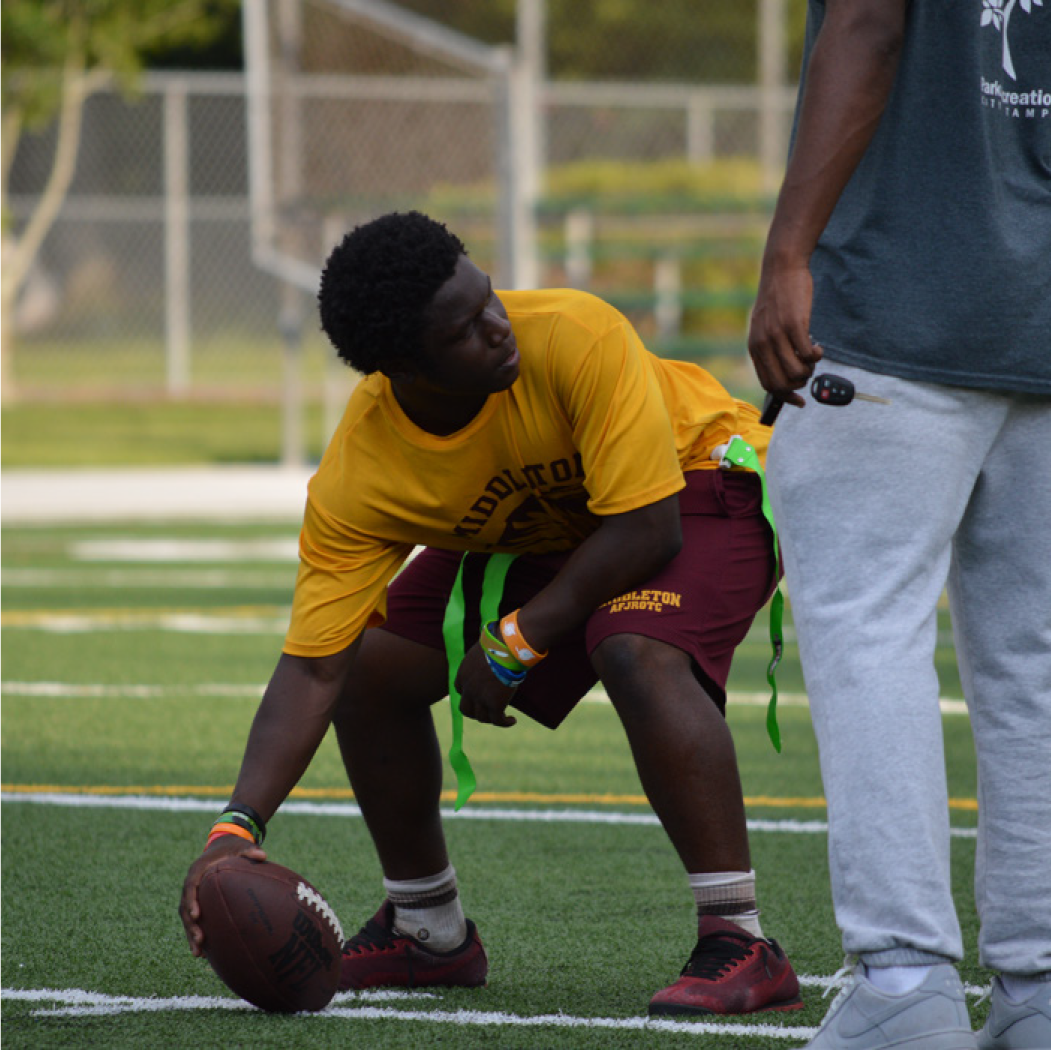
The City of Tampa will expand the Stay and Play program in partnership with schools across the county to create equitable delivery of the program and foster cohesive relationships amongst teens from varying neighborhoods. To increase participation in the program, the City will increase awareness and funding, and better coordinate resources. Specifically, the City will develop a partnership with Hillsborough County Public Schools along with private/charter school systems to increase marketing and awareness of the Stay and Play program in an effort to increase teen participation. The City will also create marketing materials aimed at soliciting volunteers and monetary donations, while highlighting funding and community impact to further donor engagement. Finally, the City will establish a central repository to track and manage programming opportunities provided by external partners, which will help management better identify gaps in programming needs.
SHOCKS AND STRESSES THIS ACTION WILL ADDRESS
 Economic inequality
TIMEFRAME
ShortIMPLEMENTATION PARTNERS
 City of Tampa Department of Parks and Recreation and One Tampa
Support Two-Year Community College Completion
Increase the number of students completing a post-secondary credential through advisory services, tutoring, and financial training.
Action Description: In partnership with colleges and organizations supporting student success, the City will decrease barriers to community college completion to uplift underserved Tampanians and close the city’s gaps in access to and completion of post-secondary education.
Community colleges serve as a gateway to post-secondary education for approximately 40% of all undergraduates each year nationwide.34 One-third of community college students are first-generation students from historically underserved populations and communities.35 However, while the open access policy of community colleges provides educational opportunity, a majority of these first-generation students struggle to complete their credential. In fact, only 34% of Hillsborough County Community College students earned their degree in 3 years, 1 year longer than the estimated period of enrollment for full-time students.36 The primary barriers to completion include 1) insufficient academic preparation, 2) student debt, 3) key family responsibilities, and 4) demanding work schedules.
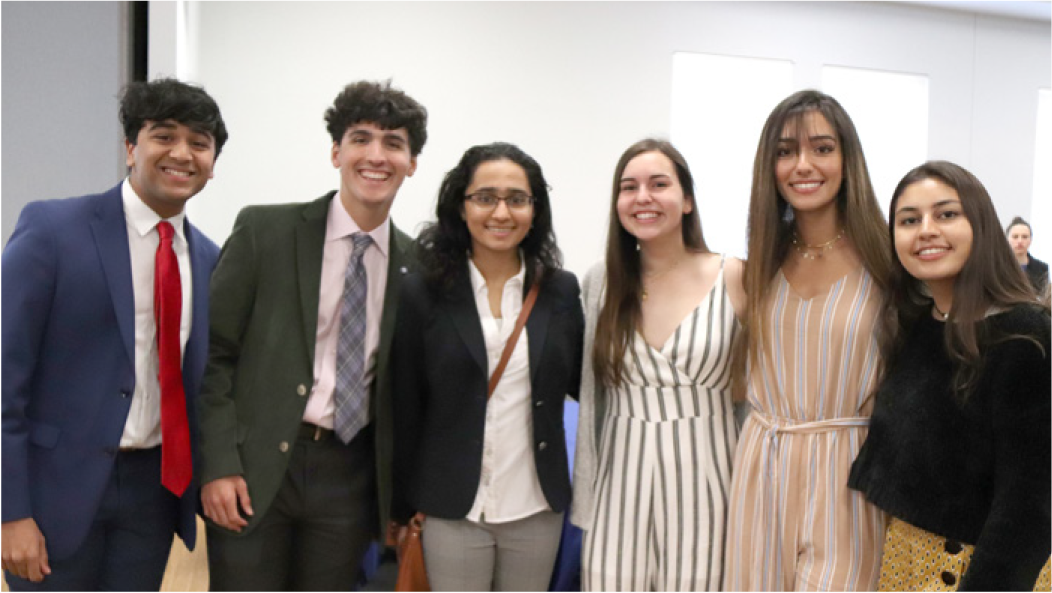
Working in partnership with colleges, and with community-based organizations who currently provide student support, the City of Tampa will also target these barriers using the following actions: 1) advisory services, 2) tutoring, and 3) financial training. These are evidence-based practices that clear the way for individuals to earn a post-secondary credential and enter progressive employment opportunities, both of which are essential to building economic resilience across generations of families.

1.2 REDUCE POVERTY BY CONNECTING TAMPANIANS TO QUALITY JOBS AND ASSET-BUILDING OPPORTUNITIES
Cultivate Partnerships for Economic Mobility Through One Tampa ACTION 1.2.1
Advance innovative economic mobility solutions in partnership with philanthropy and the private sector.
Action Description: The City of Tampa will convene key stakeholders across sectors to support strategic initiatives that support economic opportunity. One Tampa, recently formed by Mayor Castor, is a nonprofit, 501(c)(3) organization dedicated to improving the lives of Tampanians by cultivating partnerships that merge the power of government, the innovation of business, and the determination of the nonprofit sector. One Tampa will serve as a key organization, charged with creating an economically stronger and more just city through supporting economic mobility, workforce development, and housing affordability solutions that lift up every neighborhood in Tampa. One Tampa will also serve as a critical resource in securing funding to make strategic investments in key priorities that advance opportunity for all Tampanians.
One Tampa has integrated its work with the Workforce Council and will now focus on partnering with the largest employers while supporting innovative workforce programming and wrap-around services including childcare, transportation, and language translation. The Workforce Council will be a critical element in ensuring that all workforce activities are aligned with the needs of the business community and train Tampanians for long-term career pathways.

Promote Job Training in High-Growth Industries
Match job training to demand, expanding career pathways.
Action Description: The City of Tampa will promote organizations providing effective programs that train Tampanians for sustained career pathways. The City believes that transformational workforce development is a team effort and collaboration is key. To achieve our shared goals, the City will work in concert with stakeholders from private, nonprofit, and public sectors to align the workforce ecosystem for users. A critical component of this alignment is elevating innovative programs that take into account the City’s unprecedented growth and connect Tampanians to meaningful career pathways. This could be done through linking existing websites, establishing a clearinghouse approach for the most critical information, and using the Mayor’s Workforce Council to better share and engage best practices and programs.
Finally, the City will also explore mechanisms to ensure that the programs resulting in the most successful placements are amplified.
| Category | Shocks and Stresses | Timeframe | Implementation | Partners |
|---|---|---|---|---|
| Promote Job Training |  Economic inequality Economic inequality Shifting macroeconomic trends Shifting macroeconomic trends |
 Medium Medium |
IMPLEMENTATION | The Mayor’s Workforce Council |
Promote Home Ownership and Explore Innovative Wealth Building Opportunities
Promote effective wealth-building opportunities, such as affordable home ownership for all Tampanians.
Action Description: The City will continue to expand homeownership throughout Tampa through down payment and homeownership financial assistance programs. The City of Tampa will also support wealth-building by researching best practices around community shared ownership models and developing a Community Land Trust.
Tampa’s economic growth through 2019 has not created gains for all Tampanians. Unfortunately, Tampanians of color, who are nearly three times as likely as their white neighbors to live below the poverty line, are the same residents who have faced disproportionate economic losses as a result of the rising unemployment accompanying the COVID-19 pandemic.37 To address this disparity, the City will work to ensure that Tampanians are aware of available home ownership resources, such as the Dare to Own the Dream program by increasing outreach in vulnerable communities.
In addition to homeownership, other asset-building resources will be amplified in vulnerable neighborhoods. This will include looking into the feasibility of community shared ownership models, such as community investment trusts, which could provide accessible investment opportunities in real estate for low-income Tampanians and would allow the City to minimize the uneven economic recovery post-COVID-19. The City will also explore how shared ownership housing models, which would allow community members to purchase a home in an area where they would otherwise be priced out on the open market, could be integrated into the proposed Community Land Trust in Tampa. Finally, the City will also prioritize the promotion of asset-building tools such as emergency savings funds.
DARE TO OWN THE DREAM PROGRAM
The City of Tampa’s Division of Housing and Community Development launched the Dare to Own the Dream (DARE) program to support homeownership for eligible Tampanians. DARE offers up to $30,000 for income eligible first-time homebuyers. The program not only helps Tampanians achieve the dream of homeownership, but it can also decrease the wealth gap by connecting families to asset-building opportunities.
SHOCKS AND STRESSES THIS ACTION WILL ADDRESS
 Economic inequality
 Lack of affordable housing


IMPLEMENTATION
PARTNERS
City of Tampa Development and Growth Management Department and Tampa Community Land Trust
Expand Support for Small Businesses, Prioritizing Underrepresented Entrepreneurs and Neighborhoods
Advance equitable procurement and capacity-building for Tampa’s small businesses and entrepreneurs.
Action Description: The City will enable procurement processes that expand opportunity while ensuring that entrepreneurs and workers benefit from integrated economic and workforce development efforts. More than ever, bolstering Tampa’s small business and entrepreneurial ecosystem is critical to counteract unemployment and a growing unskilled labor pool exacerbated by the COVID-19 crisis.
In Tampa, as of March 2021, the number of open small businesses decreased by 41.3% compared to January 2020.38 Entrepreneurship is not only the largest source of job creation in the country, it also is a key pathway for economic mobility for Tampan-ians. Given the inequities in our community in wages, employment rates, and business ownership, the City has an opportunity to create a stronger support structure to help underserved Tampanians access the resources needed to establish and grow their own businesses.
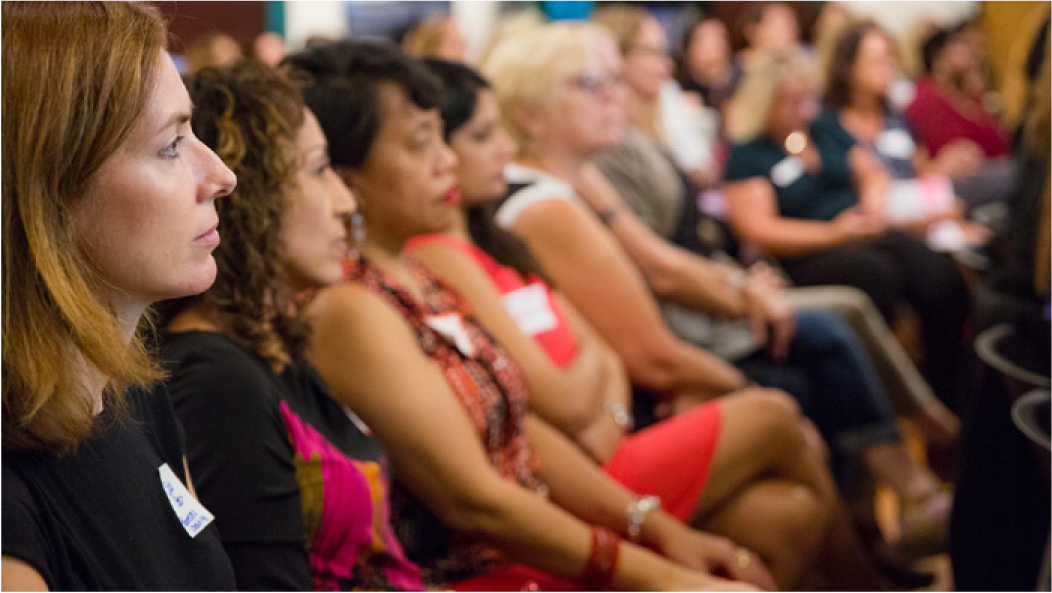
To achieve this goal, the City will expand support for small businesses and entrepreneurs by strengthening Tampa’s engagement of diverse business enterprise groups through its Equal Business Opportunity (EBO) program, targeting small, women, and minority-owned small businesses, as well as Service-Disabled Veteran Owned Business (SDVOSB), Veteran Owned Small Business (VOSB), and LGBT-owned businesses. Furthermore, the City will leverage an equity lens in procurement processes. The City has already deployed these tactics on RFPs for land acquisition by incorporating bonus provisions into those RFPs to create opportunities for BIPOC-owned contractors. Beyond these existing efforts, the City will explore opportunities to expand its support of small businesses and entrepreneurs through its partnerships with economic and workforce development organizations in the region.
Building the capacity of Minority-Owned or Women-Owned Business Enterprise (MWBEs) and Small Local Business Enterprises (SLBEs) to compete and thrive as pillars of the local economy has the potential to drive economic mobility for our community and strengthen the city’s economy overall.

| Timeframe | Shocks and Stresses This Action Will Address | Implementation Partner |
|---|---|---|
| Short, Long | Economic inequality Shifting macroeconomic trends | City of Tampa Economic Opportunity Department |

FOCUS ON SMALL BUSINESS RECOVERY
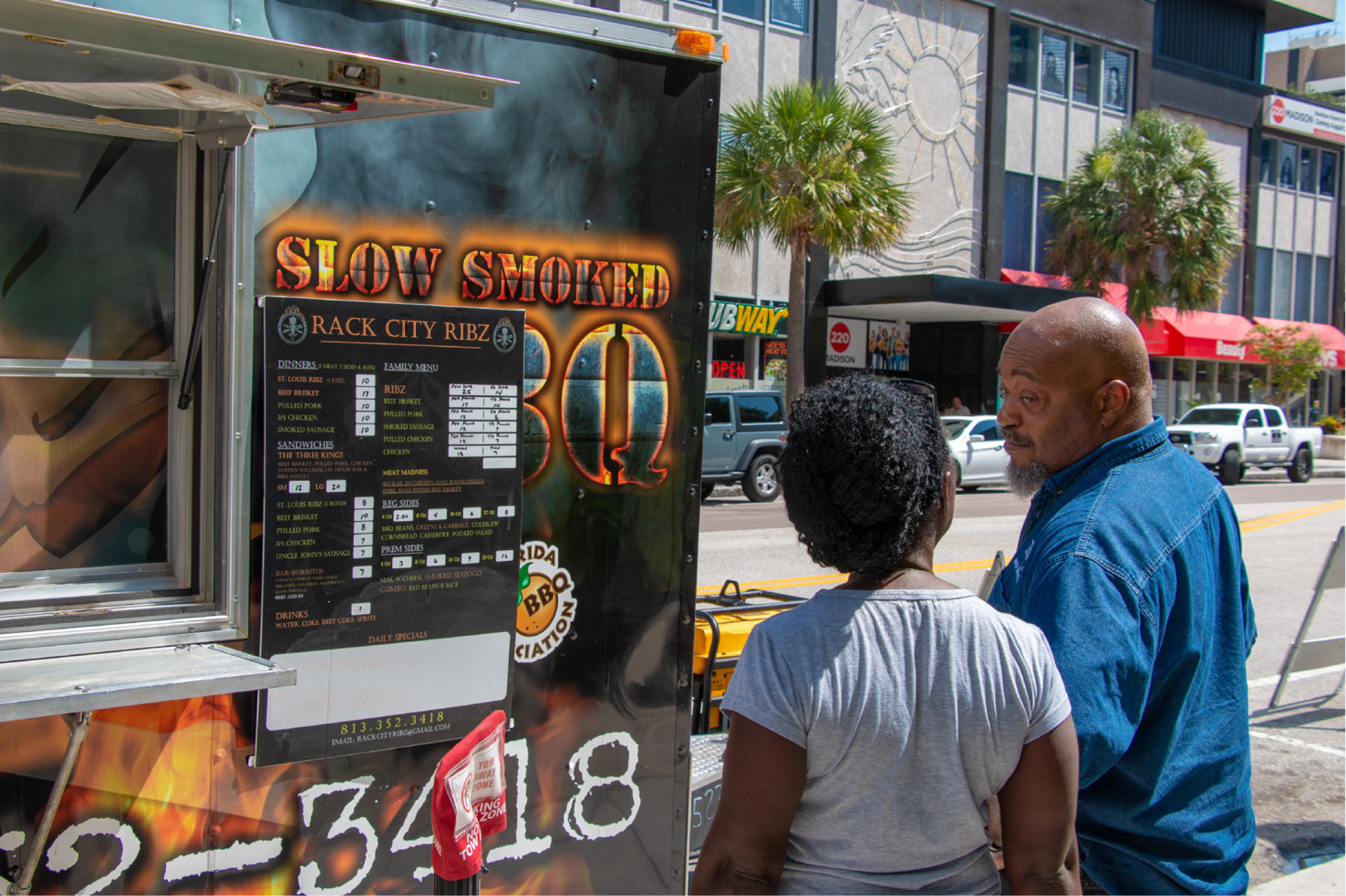
COVID-19 has deeply impacted the nation’s economy with disproportionate impacts felt by our small businesses. In the Tampa Bay region, the number of open small businesses open decreased by 20% in December 2020 compared to January 2020,39 revenue has yet to return to pre-COVID-19 levels,40 and many small businesses have been unable to receive federal financial support.41 To respond to these impacts, the City of Tampa deployed the Lift Up Local program to enable Tampa restaurants and bars to safely increase seating capacity and support businesses in establishing outdoor capacity. The program temporarily suspended certain code and permit requirements for bars, restaurants and retail businesses to enable greater use of outdoor space, using adjacent privately owned and public areas and bypassing the full application and permitting process or fee.
The resilience of Tampa’s small business community will be a critical component of the City’s continued recovery from the COVID-19 pandemic. The small business-related initiatives outlined throughout this roadmap highlight the need for small business-opening support, training programs, and further ways to drive the longer-term recovery and resilience of this sector.
1.3 MEET THE CRITICAL NEEDS OF VULNERABLE TAMPANIANS, ESPECIALLY SENIORS AND VETERANS
ACTION 1.3.1
Reduce the Unsheltered Homeless Population
Continue to support housing and food programs and the unhoused community’s uncomplicated access to services.
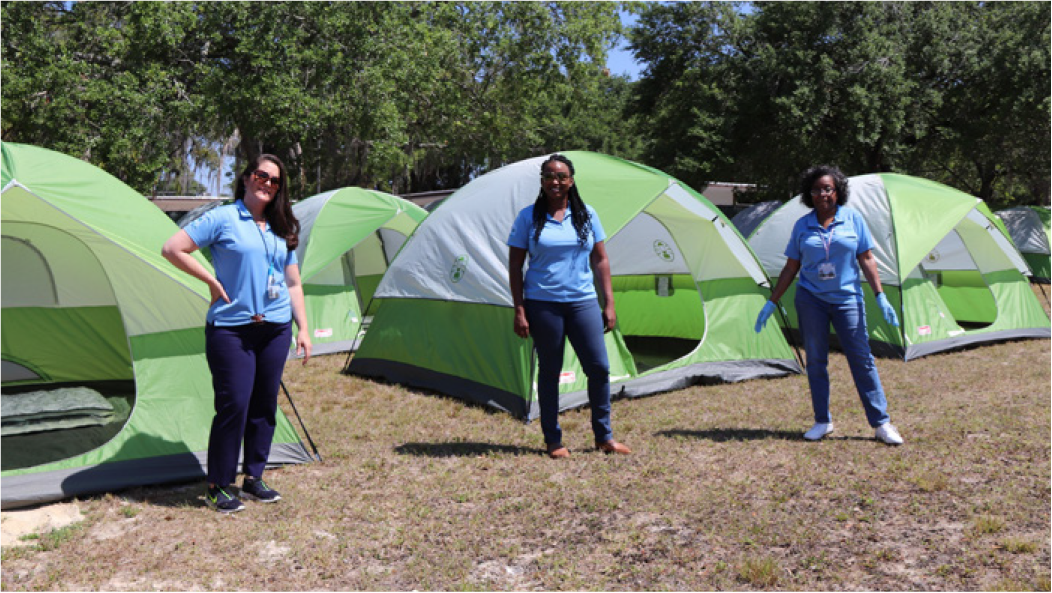
Action Description: More than 1,450 people live in places not meant for human habitation.42 Daily food programs, access to services, shelter, and eventually permanent housing are essential for reducing the number of unsheltered Tampanians. The City of Tampa will continue to foster partnerships for needed services while increasing access to permanent housing and rapid rehousing services.
The City of Tampa will collaborate with the key regional leaders to measurably reduce homelessness. Critical to this work is collaborating and innovating in connecting people experiencing homelessness with permanent housing solutions. Therefore, the City of Tampa will promote and support the development of permanent housing solutions, such as supportive housing. The City will also help individuals navigate this system, by connecting them to more rapid rehousing resources, coordinated entry access points, and Community Housing Solution Centers that enables a more holistic approach to connecting residents to the services and care they need and help them on a pathway to permanent housing. For instance, the City of Tampa is working with Hillsborough County and other municipalities to coordinate outreach and better connect with people experiencing homelessness. The City will also continue to promote successful existing partnerships with Metropolitan Ministries and Catholic Charities, to meet the most basic needs of Tampanians experiencing homelessness.

Provide Ongoing Support for Homelessness Prevention Programs
Support our most vulnerable Tampanians by preventing homelessness through eviction prevention programs.
Action Description: The City will provide direct rent and mortgage assistance to prevent evictions and potential homelessness. The CDC’s temporary halt on evictions has provided security to many Tampa-nians and Hillsborough County residents. However, given the continued economic crisis, the moratorium’s expiration threatens to displace hundreds of Tampanians. During the COVID-19 pandemic and the resulting economic crisis, the City of Tampa saw unemployment rates rise to 13.5%.43 In response, the City and Hillsborough County began providing financial support to landlords and tenants to cover Tampanians’ unpaid rent. City support began in April through the COVID-19 Rent, Mortgage, and Utility Relief Plan. The plan, offered direct rent, mortgage, or utility payments to eligible individuals, families, and small businesses. Hillsborough County began a similar program in July of 2020. Together, programs run by the City and Hillsborough County provided $36 million to over 6,500 individuals who could not pay their rent, mortgage, or utility bills.
In March 2021, the City and County expanded this program to prevent evictions and support Tampa’s most vulnerable communities. Tampa will continue working with the County to launch a new long-term assistance program for landlords to provide them with much-needed financial support. In addition, Tampa is looking to prevent evictions by providing financial assistance toward unpaid utilities, connections to support services, and financial coaching. Finally, the City will ensure it is also connecting Tampanians to rapid rehousing resources when needed to prevent community members from experiencing homelessness.

Short City of Tampa Housing and Community Development Department Economic inequality Lack of affordable housing Responsive / effective governance SHOCKS AND STRESSES THIS ACTION WILL ADDRESS TIMEFRAME IMPLEMENTATION PARTNERS
Promote and Centralize Social Service Resources
Ensure an equitable recovery from the effects of COVID-19 by continuing to streamline and promote needed resources, such as food access.
Action Description: The City will continue to streamline and disseminate resources for those Tampanians affected by COVID-19.
Since the onset of the coronavirus pandemic, the need for social services has become all the more acute. For instance, food insecurity has nearly doubled since the start of the pandemic.44 Tampan-ians’ economic security has suffered with job losses and the need to scale back on work hours. The City of Tampa has provided robust resources to Tampan-ians affected by COVID-19 by streamlining information about food resources, financial assistance, and health and mental health services. Given the lengthy nature of this disaster, the City recognizes that many families will still be in a state of recovery even after the health threats of the disaster are brought under control. Therefore, the City will ensure that Tampa-nians can easily navigate the resources available to them by ensuring that its website and outreach materials are effective and culturally competent.
FEEDING TAMPA BAY
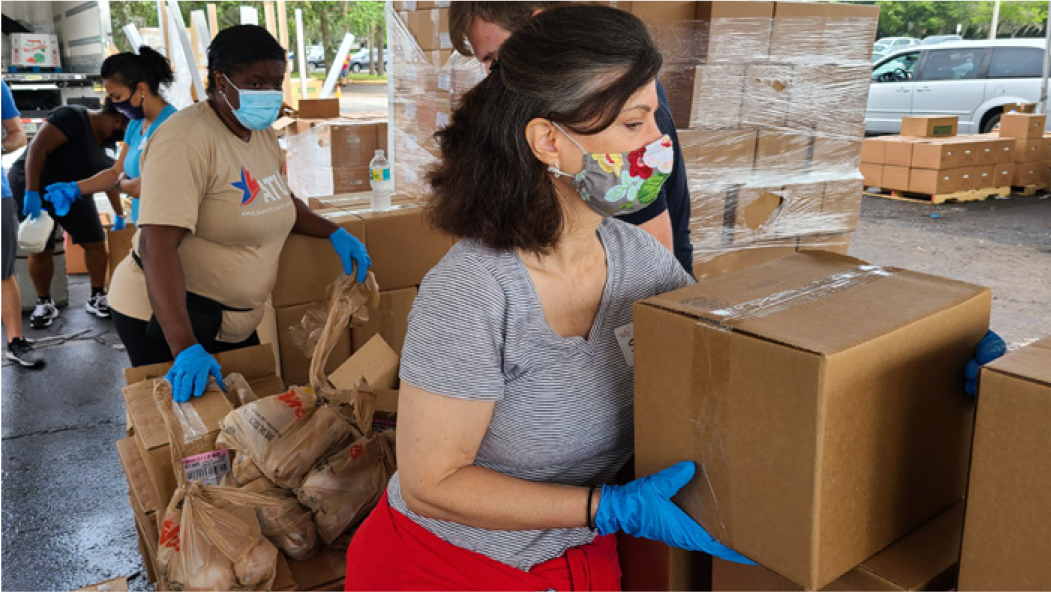
Feeding Tampa Bay has and continues to provide a critical service to meet Tampan-ians’ basic needs in this unprecedented time. COVID-19 led to a surge in the need for food stability in the Tampa Bay region by 400%.45 In response, Feeding Tampa Bay has evolved their services by almost tripling their reach to serve the nearly 1.7 million facing increased need.46 As they continue to serve the Tampanians most impacted by the pandemic, they expect to provide over 100 million meals this year.47
SHOCKS AND STRESSES THIS ACTION WILL ADDRESS
 Responsive / effective governance
 Economic inequality
TIMEFRAME
Short
IMPLEMENTATION PARTNERS
 Feeding Tampa Bay and City of Tampa Department of Neighborhood and Community Affairs

Connect, Mobilize, and Empower Tampa’s Veteran Community Through Mentorship and Connections to Benefits
Improve the quality of life for Tampa’s veterans.
Action Description: The City of Tampa’s Military Affairs Liaison will continue to support Tampa´s veteran community through connections to existing support services. As the home of MacDill Air Force Base, we need to ensure a strong quality of life for our military families and veterans. The City will work to expand outreach to this population through new communications tools and collaboration with existing resource centers, such as libraries. It will also ensure that veterans experiencing homelessness are connected to the housing and support services they need. Finally, the City will explore the creation of linkages to specific mentorship and job placement programs that focus on the needs of our veteran community.
| Shocks and Stresses | Details | Timeframe | Implementation | Partners |
|---|---|---|---|---|
| Responsive / effective governance | Economic inequality Shifting macroeconomic trends |
Short | City of Tampa’s Military Affairs Liaison and Tampa Crossroads |




Expand a Network of Age-Friendly Communities
Ensure livable communities for older adults.
Action Description: 8 out of 10 COVID-19 deaths reported in the United States have been of adults 65 years or older.48 As Tampa recovers from the virus, the City will prioritize the needs of our senior community to ensure that their basic needs are met and ensure they have the opportunity to thrive.
The City will work with AARP to designate Tampa as an Age-Friendly Community, connecting it to a network of 37 other communities across the state. In 2019, the State of Florida was also designated as an Age-Friendly State (AARP Age-Friendly Communities). The initiative focuses on connecting the built and social environment to make communities a better place to live, work, and thrive for people of all ages. This includes a strong focus on social engagement and combating social isolation. The City of Tampa will also ensure that these age-friendly community resources are distributed equitably by prioritizing lower-income communities.
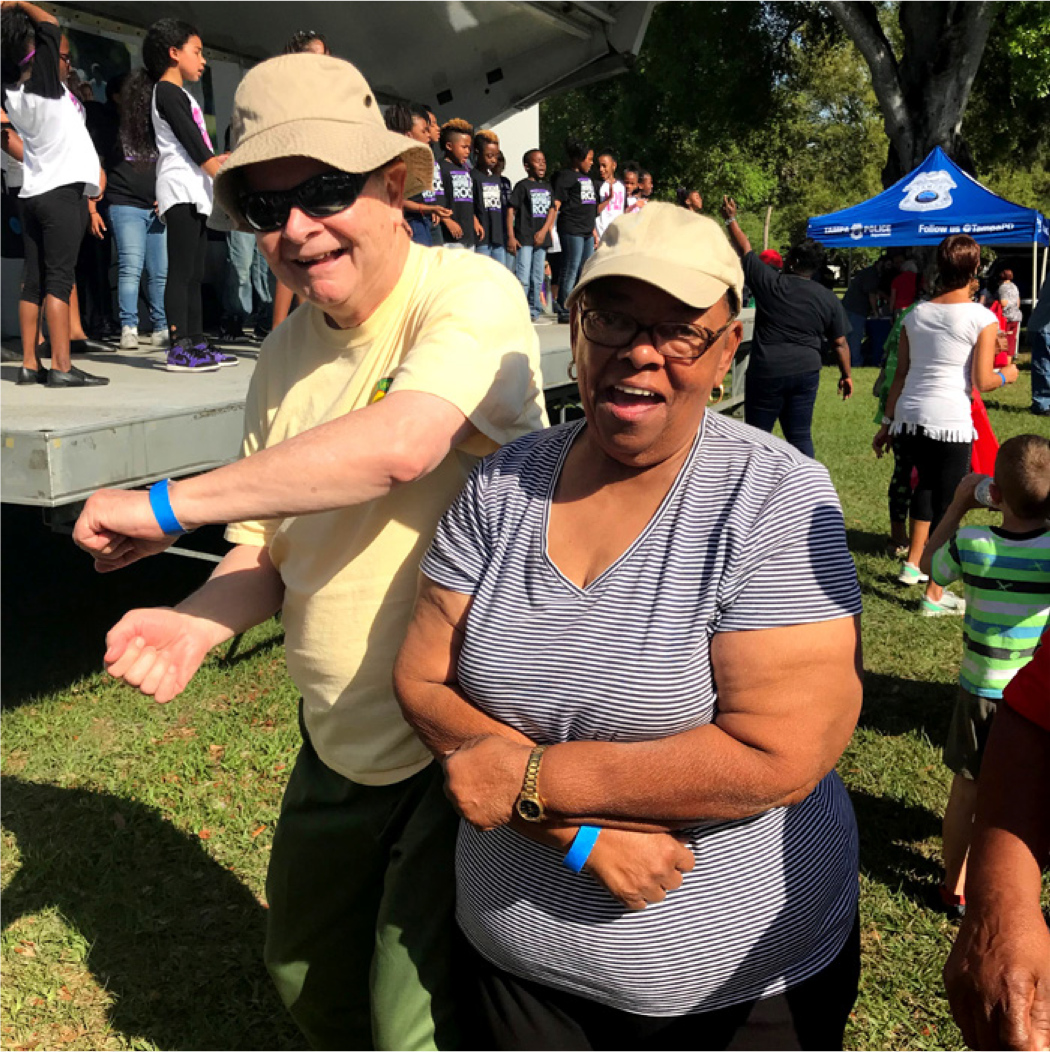
The City of Tampa will also lift up the work of the local organizations, agencies, and residents working collaboratively to promote resiliency through information dissemination, direct services, and opportunities for virtual connectedness. In particular, the Senior Connection Center is serving as a one-stop shop for senior services (Senior Connection Center). Finally, the City will work to pilot a program to reduce social isolation in the senior population through volunteer connections.


CHAPTER 2 THRIVING NEIGHBORHOODS 3838
We envision a Tampa that is built on the diversity and strength of every neighborhood. With the initiatives outlined below, the City will leverage the assets of our vibrant communities to tackle resilience challenges, from affordability to climate to connectivity.
As Tampa grows, we recognize the limitations of a one-size-fits-all approach. We have the opportunity to build resilience by focusing on challenges and strengths specifically at the neighborhood scale. Today, Tampa’s neighborhoods face new challenges that will continue to arise as our city grows. The annual income needed to secure a one-bedroom apartment now exceeds twice the annual income earned at a minimum wage job;49 one in five parents with a household income below $25,000 report feeling unsafe in their neighborhoods;50 and 20% of Tampanians face commutes of over 45 minutes, up from 14% a decade ago.51 Tampanians fear their communities are at risk of gentrification and they will face displacement from their homes. By fostering a bottom-up approach that amplifies and scales community-driven innovations, we can address neighborhood-specific resilience challenges related to affordability, connectivity, climate change, and poverty.
Understanding our city from the point of view of neighborhoods, its foundation, will allow us to promote safe, prepared, and economically accessible spaces for our residents. We will increase our supply of affordable housing in a way that fits the local context of unique neighborhoods so that we are prepared for Tampa’s population growth and can prevent displacement. We will ensure that all communities are connected to jobs and critical goods and services, both within their neighborhoods and elsewhere through appropriate and affordable transit options. We will prepare for and adapt based on local risks in the face of a changing climate. Through partnerships, we will target social and economic support to neighborhoods where it is needed most.



2.1 INCREASE THE SUPPLY OF AFFORDABLE HOUSING
ACTION 2.1.1
Finance Acquisition of Housing and Land Through a Community Land Trust
Expand housing affordability in Tampa by creating a community land trust based on best practices from models across the country.
Action Description: The City will support the establishment of a noncontiguous community land trust (CLT) as part of Mayor Castor’s T3 plan to ensure that Tampanians can remain in their neighborhoods and that affordable housing is extended throughout the city.
The City will promote the implementation of the CLT by exploring best practices from models across the region that ensure effective control and accountability for the trust. For instance, the City will work with partners to ensure that the CLT is structured to be responsive to a wide range of stakeholders’ needs and that the land is managed strategically through a strong governance structure. This process will result in the development of a clear vision, mission, and measurable goals that will increase the Trust’s effectiveness. Simultaneously, the City of Tampa will work toward the adoption of citywide policies that will help decrease the cost of building and begin acquiring land that can be used for CLT housing throughout Tampa.
SHOCKS AND STRESSES THIS ACTION WILL ADDRESS
 Economic inequality
 Lack of affordable housing
 TIMEFRAME Medium
IMPLEMENTATION
PARTNER
One Tampa
DEVELOPING TAMPA’S COMMUNITY LAND TRUST
Community land trusts are nonprofit, community-based organizations that own land for the purpose of maintaining affordable housing. Traditionally, a CLT leases land to residents living on that land. Residents fully own their homes. However, when a home on the CLT is sold, the seller only receives a portion of the home’s appreciated value. The remainder goes back to the CLT to maintain affordability for future generations of homeowners.52
Following Mayor Castor’s Housing Affordability Advisory Team’s final recommendations, the City is looking to support the creation of a community land trust. The nature of a CLT requires that it be led by a nonprofit organization. As with implementing many inititatives in this roadmap, the City will be looking to partner with nonprofit and community-based organizations to assist in the development of the trust.
Accelerate the Development of New Affordable Housing Units
Increase and diversify the supply of affordable housing for residents of all income levels, with a focus on very-low-income, low-income, and workforce housing, reaching 10,000 new units by 2027.
Action Description: Building on the steady progress made to date with 1,110 new units built or under construction as of January 1, 2021, the City will accelerate the expansion of affordable housing development by leveraging Tampa’s suite of existing tools, incentives, and cross-sectoral partnerships to meet Mayor Castor’s goal of 10,000 new units by 2027.
To remove and reduce impediments to affordable housing development faced by the private and nonprofit sectors, the City of Tampa will explore opportunities to formalize priority review processes, expedite waiver requests, and promote administrative approval solutions. In addition, the City will consider a range of low- to no-cost solutions to further expedite the process for developers and nonprofit partners. These solutions could include granting City-owned land for dedicated attainable housing, providing property tax and impact fee abatements in priority areas, and increasing lot subdivision flexibility to increase density and promote home ownership. To expand its reach, the City will also amplify its work with partners in several ways. The City will work with Tampa’s largest employers to develop programs that allow them to invest in specific housing assistance programs as part of individual employee compensation packages. The City will update its disposition policy to provide deeply discounted land to nonprofits who can then work in partnership with the City as it expands affordable units throughout Tampa. Lastly, the City will continue to explore best practices from across the country to expedite the development process.
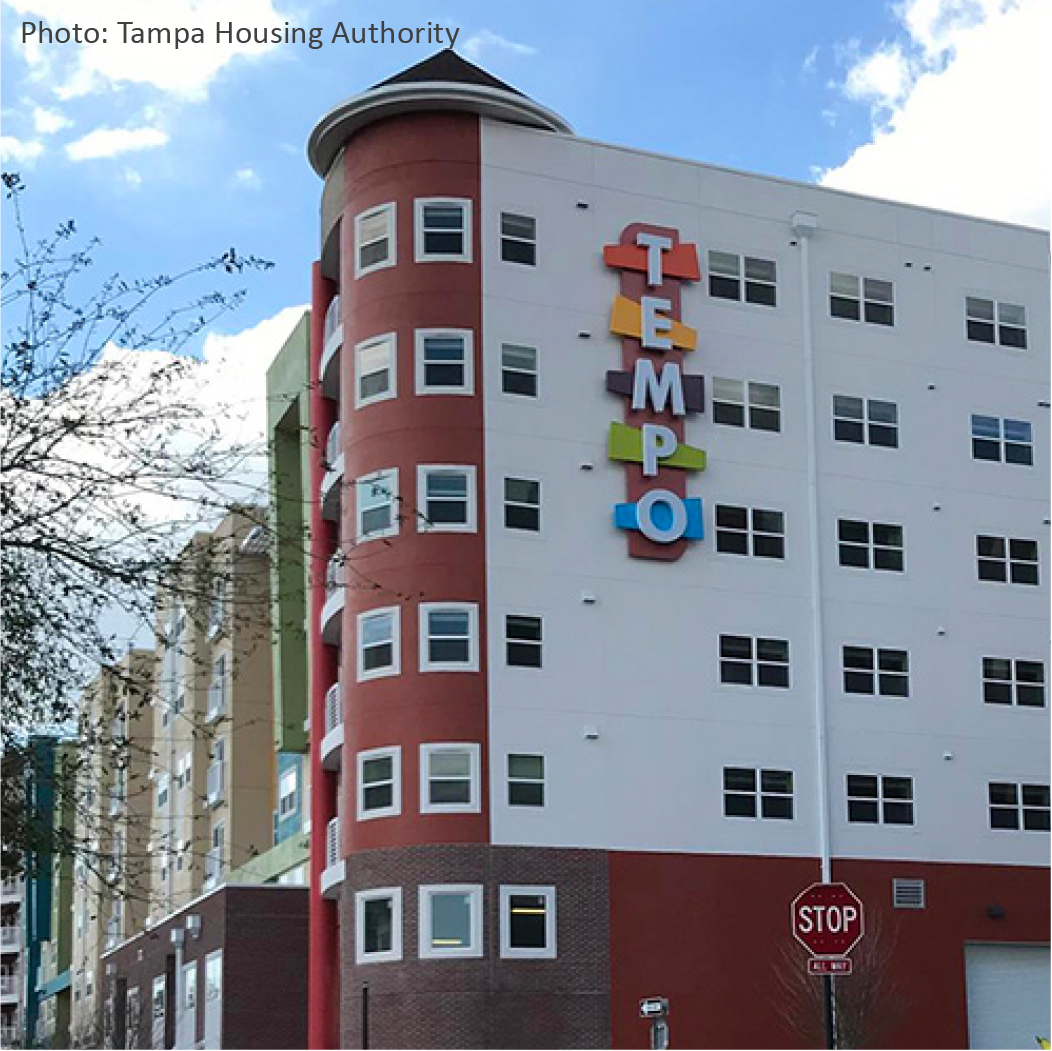
Photo: Tampa Housing Authority
Beyond these intensive efforts to catalyze new affordable housing construction, the City will also explore opportunities to activate existing housing inventory to help meet the City’s goal of 10,000 units by 2027. Focusing on outreach to Class B and Class C property owners, the City will work to activate vacant units or leverage incentives to transition existing inventory to help meet the housing needs of Tampa’s residents. Across all of these programs, the City will identify synergies to maximize investment in affordable housing to ensure it is fostering healthy and attractive neighborhoods across the city.
SHOCKS AND STRESSES THIS ACTION WILL ADDRESS
 Economic inequality
 Lack of affordable housing
 MediumTIMEFRAME
IMPLEMENTATION PARTNER
City of Tampa Development and Growth Management Department and City of Tampa City Planning Department
Pursue Strategies for Expanding Housing That Integrates With Neighborhood Fabric
Explore new approaches for increasing housing density across Tampa’s diverse neighborhoods.
Action Description: Demand for housing is rising as Tampa’s population continues its upward trajectory, and the City’s housing supply is not keeping pace. To help reach the Mayor’s goal, the City of Tampa will assess the opportunity for strategically integrating multiple family housing by using design approaches that help meet housing demand while building upon existing unique neighborhood attributes. Building on its recent landscape analysis of City-owned parcels across Tampa, the City will endeavor to provide a range of alternative housing stock throughout the city that is proximate to transit and community infrastructure such as libraries, parks, and schools; expand on the City’s existing affordable housing developments through thoughtful partnership with the private sector and the Tampa Housing Authority,
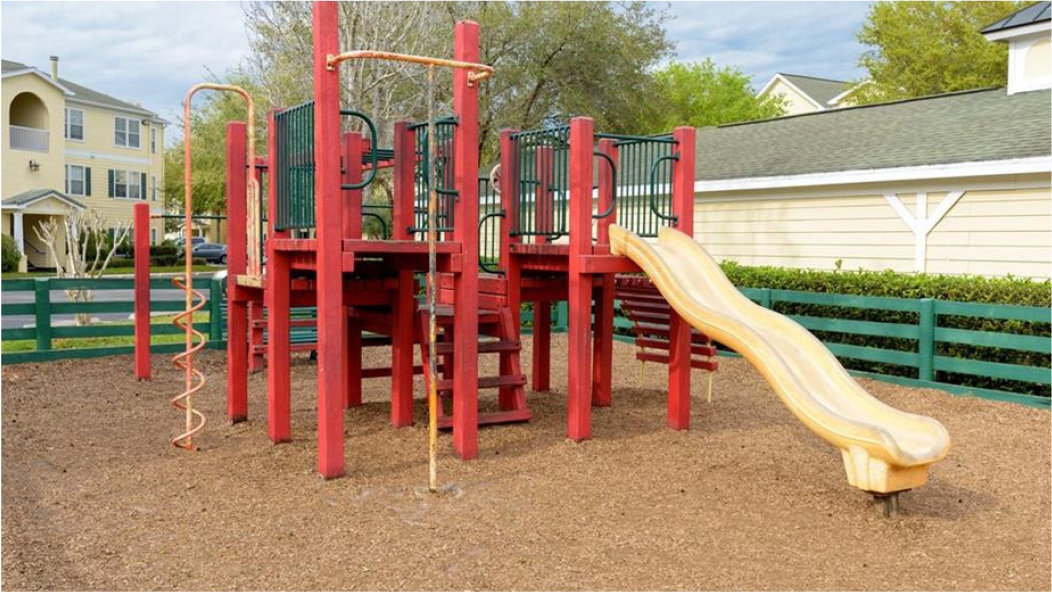
leveraging the Robles Park redevelopment as a pilot; and acquire additional properties in strategic locations throughout the city that build and expand upon existing community assets like the Fair Oaks Community Center.

Medium City of Tampa Development and Growth Management Department TIMEFRAME IMPLEMENTATION PARTNER Economic inequality SHOCKS AND STRESSES THIS ACTION WILL ADDRESS Lack of affordable housing
Preserve and Restore More Affordable Housing Units
Ensure Tampanians have access to the capital they need to stay in their homes and preserve their housing investments through the City’s Owner-Occupied Rehab (OOR) Program.
Action Description: The City will expand its promotion of OOR to ensure those Tampanians who are most in need can take advantage of the program, with a goal of restoring and preserving 100 units annually.
Many low- and moderate-income Tampanians face significant barriers to financing the upgrades and repairs necessary to maintain their homes. Leaking or failed roof systems, lack of working heat systems or air conditioning, and faulty electrical systems not only pose health and safety risks to families, but these and other essential costly repairs can put at risk families’ ability to hold on to their most significant asset – their homes. The City’s Owner-Occupied Rehab Program is designed to help maintain decent, safe and affordable housing for Tampa’s low- and moderate-income families and ensure that Tampan-ians can stay in their homes. The program provides low- to no-cost loans and grants that allow Tampan-ians to bring their homes into compliance with the City’s Florida Building Code and Housing Quality Standards. Beyond leveraging federal and state funding sources to drive this important program, the City is also partnering with Community Redevel-
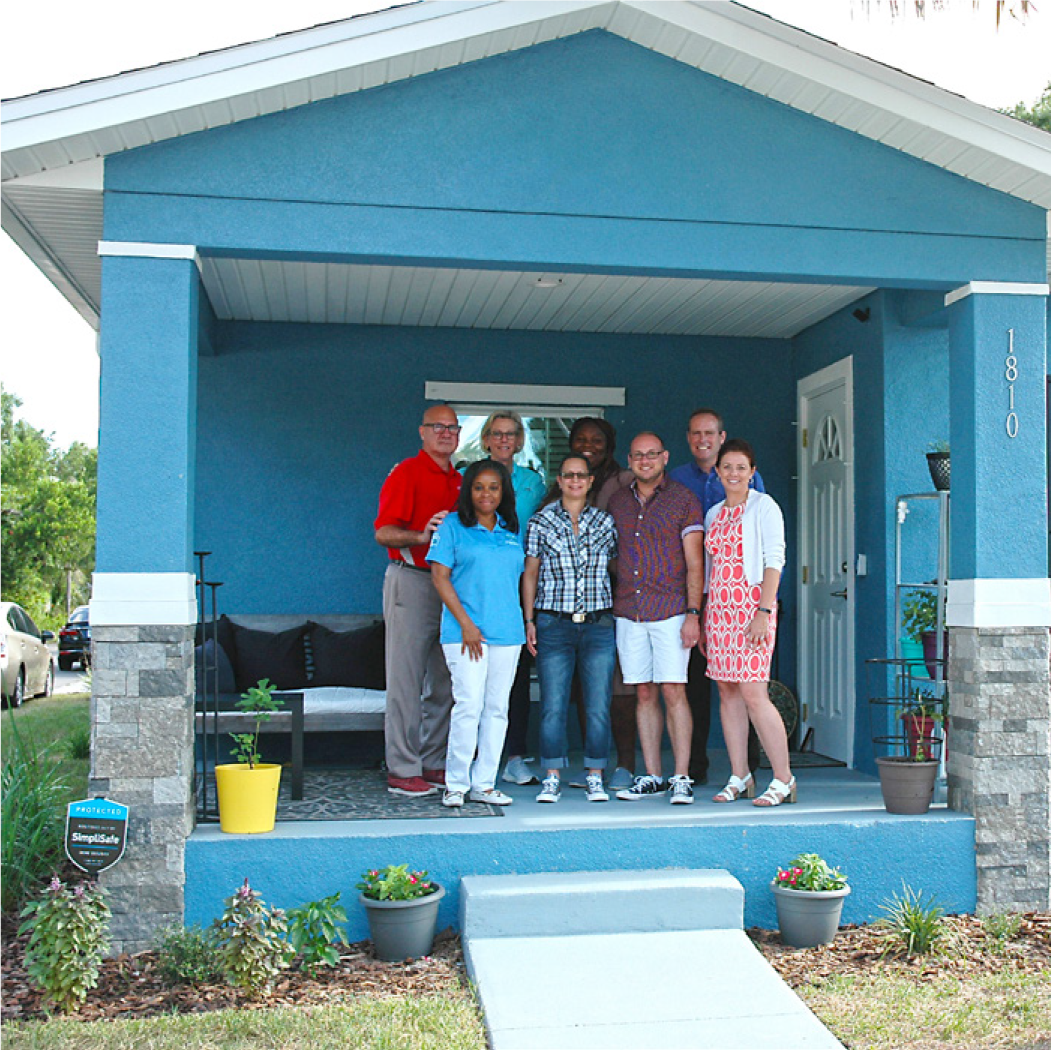
opment Areas (CRAs) in the Drew Park, East Tampa, and West Tampa neighborhoods to bring additional funding to this effort. The OOR Program will serve as a critical pillar of the City’s strategy to expand Tampa’s affordable housing inventory for residents by maintaining and sustaining existing homes.

Economic inequality SHOCKS AND STRESSES THIS ACTION WILL ADDRESS Medium City of Tampa Development and Growth Management Department TIMEFRAME IMPLEMENTATION PARTNER Lack of affordable housing
2.2 ENSURE TAMPA’S NEIGHBORHOODS ARE HEALTHY, SAFE, AND LIVABLE
Action 2.2.1
Transform Tampa’s Public Realm Through Vision Zero and Complete Streets
Build on Tampa’s Vision Zero and Complete Streets policy innovations to create safer, more walkable neighborhoods for all residents across the city.
Action Description: The City of Tampa has laid out a bold vision for the future through its Complete Streets and Vision Zero programs. When Mayor Castor took office, she made a commitment to increasing safe, healthy, and equitable mobility for all Tampanians through Vision Zero. Vision Zero, which aims to eliminate all traffic fatalities and severe injuries, is a multinational strategy that began in Sweden in the 1990s, has proven successful across Europe, and is gaining momentum in major American cities.53 The City of Tampa was officially admitted as a member of the Vision Zero Network in late 2020. Tampa’s Complete Streets program has design principles to create roadways where all modes of transportation can share the road safely: automobiles, pedestrians, bicycles, and transit. Beyond these foundational initiatives, the City of Tampa is also pursuing a suite of innovative programs that foster more walkable communities where residents have access to a greater range of mobility options.
Together, these initiatives have the potential to transform Tampa by reimagining the collection of spaces known as the public realm – the streets, sidewalks, medians, and public plazas – to better serve Tampanians and foster more vibrant neighborhoods.
- Vision Zero Priority Corridors: The City will prioritize capital investments in priority high-injury arterial corridors through a range of policy interventions, data and trend analyses, and robust community engagement, with a focus on driving equity through implementation.
- Increase Community Voice through Tampa M.O.V.E.S.: As part of Tampa’s Citywide Mobility Plan (Tampa M.O.V.E.S. – Mobility, Opportunity, Vision, Equity and Safety), the City will launch two major outreach efforts: 1) a series of Neighborhood Listening Sessions to collect input on Tampa’s mobility assets, challenges, and opportunities as well as provide clarity on the M.O.V.E.S. planning process and 2) neighborhood-based design charrettes that will create the opportunity for co-creation of a unified vision for each corridor.
- Integrate Complete Streets into All Capital Improvements: As the City continues to upgrade and maintain its complex network of roadways, it will leverage each capital investment to implement Complete Streets design standards in all neighborhoods.
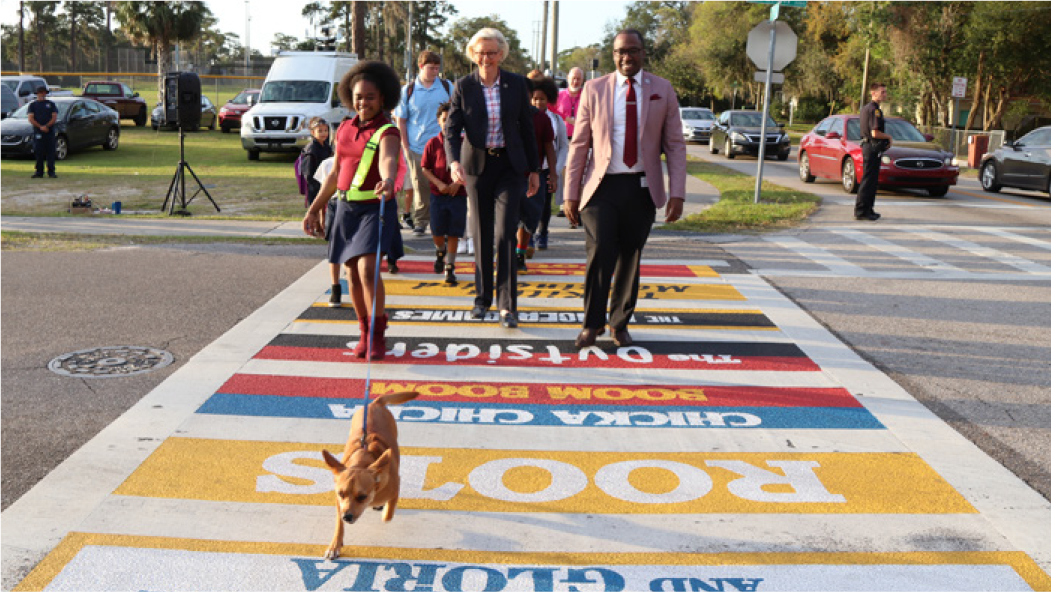
- Expand the City’s Network of Trails, Greenways, and Safe Crosswalks: Beyond roadways, Tampa’s Mobility and Parks and Recreation departments will enhance their collaborative efforts to build up Tampa’s network of trails, greenways, and safe crosswalks with a focus on establishing safe and accessible bicycle connections as has been accomplished with Tampa’s Green Spine: 3.4 miles of urban trails and cycle paths that connect the neighborhoods of North Hyde Park, Downtown, Ybor City, and East Tampa.
- Deploy Tactical Urbanism in Partnership with Community Groups: The City will engage the community through a series of place-making design initiatives that pilot Vision Zero and Complete Streets interventions at key intersections in local neighborhoods.
- Leverage Tampa Union Station to Pilot Public Plazas: The City will partner with local nonprofit Friends of Tampa Union Station to pilot the activation of public spaces through public–private partnerships.
- Reduce Utility Obstructions on Tampa’s Sidewalks: The City will explore new partnerships with utility companies to catalyze the undergrounding of utility infrastructure and make sidewalks more walkable in high pedestrian areas.
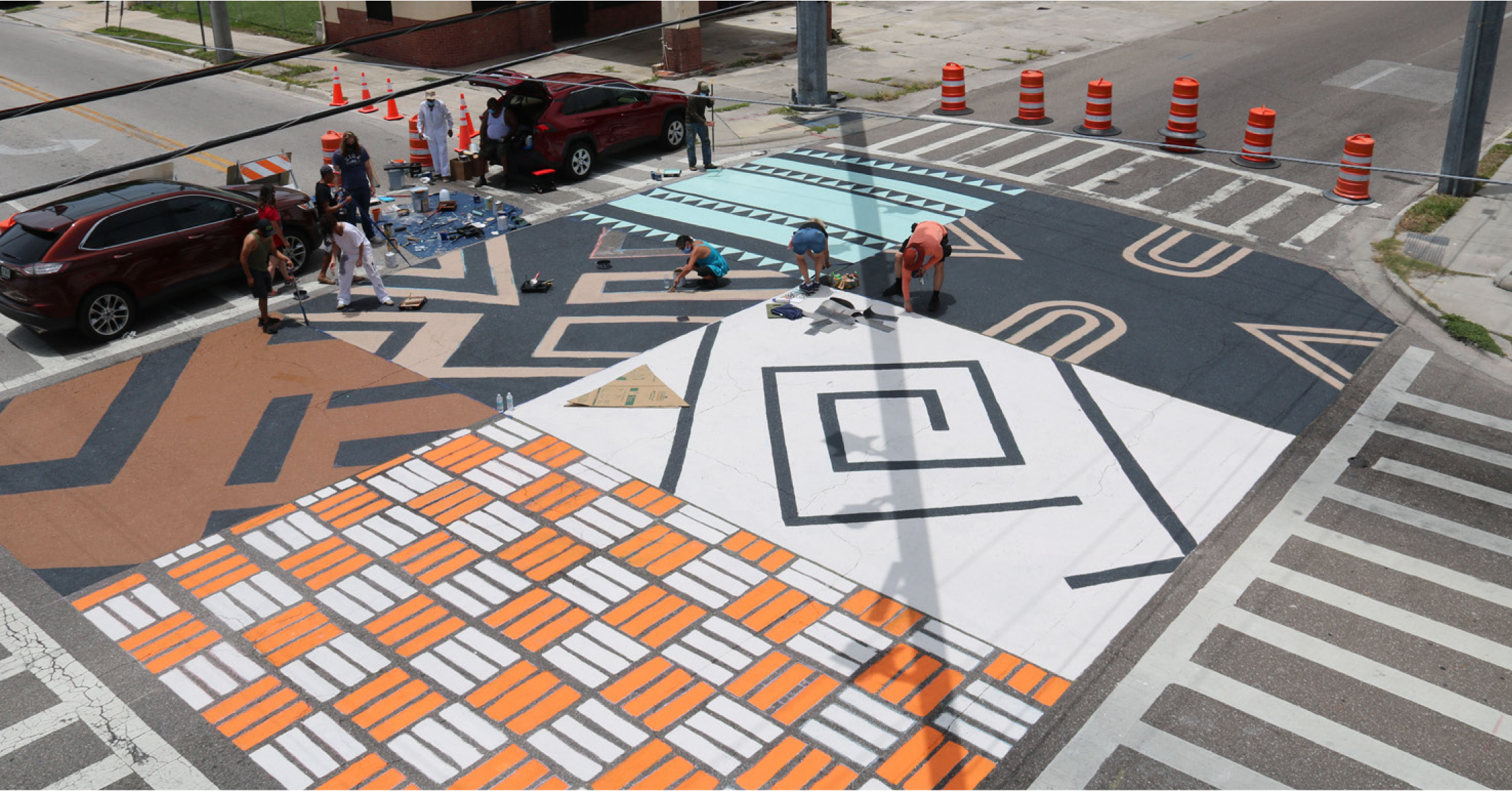

Expand the Neighborhood Commercial District Plan Program
Partner with local communities to create resident-driven action plans that aim to enhance and preserve the unique quality of neighborhood commercial districts across Tampa.
Action Description: Building on the inaugural Neighborhood Commercial District Plans underway in Main Street / West Tampa and Palma Ceia, the City Planning Department will expand its partnerships with local neighborhoods to establish this community-driven guide in more neighborhoods by 2022. Each plan will outline a suite of initiatives that focus on elevating Tampa’s varied and unique commercial districts as hubs of business growth, community involvement, appropriate residential density, safe public streetscapes, healthy food sources, relevant retail options, reliable mobility opportunities, and comfortable pedestrian experiences.
The Neighborhood Commercial District Plan program brings together local residents and business owners with the City of Tampa to lay out a vibrant course of action that aims to integrate and improve public spaces, streetscapes, transportation options, business growth, attainable housing choices, and economic networks that contribute and enhance the overall quality of life of all residents. By focusing on citizen involvement and participation, this inclusive, transparent, and collaborative effort will improve the quality of life for local residents, expand opportunities for nearby employment, and provide attainable housing alternatives.
| Shocks and Stresses | Timeframe | Implementation | Partner |
|---|---|---|---|
|
Short | Implementation | City of Tampa City Planning Department |
Expand Community-Led Initiatives That Encourage Alternatives to Cars
Deepen the City’s partnerships with community-based organizations and civic groups to provide a greater diversity of mobility options for Tampanians of all ages and backgrounds.
Action Description: The City of Tampa will amplify community-led innovations through its programs and promotions to ensure that more Tampanians can navigate the city and access the opportunity and education they need to succeed.
Community partners play a critical role in helping to transform Tampa’s public realm and how Tampanians navigate their neighborhoods and the city as a whole. Tampa is home to several innovative nonprofit organizations dedicated to advocating for and providing a range of connectivity options to those Tampanians who need them most. Walk to School programs encourage students to choose active school transportation alternatives as a means of improving child health, creating safer pathways to school, and strengthening school communities.Sidewalk Stompers and Onbikes are two organizations that offer vulnerable Tampanians greater mobility by providing them with bicycles. Through its Earn-A-Bike program, Wellbuilt Bikes provides a pathway to bicycle ownership for Tampanians who face significant transportation barriers, and the cascading education and employment challenges that often come with them. Their approach, through a co-op model, allows Tampanians to build their own bike while gaining employment and giving back to their community. Onbikes provides free bicycles for children and young adults without permanent families to ensure that all young people can enjoy the health and wellness, mobility, and confidence-building benefits that bicycle ownership can bring.

Medium City of Tampa Mobility Department and City of Tampa City Planning Department
TIMEFRAME IMPLEMENTATION PARTNERS
Economic inequality
SHOCKS AND STRESSES THIS ACTION WILL ADDRESS
Inadequate transportation systems
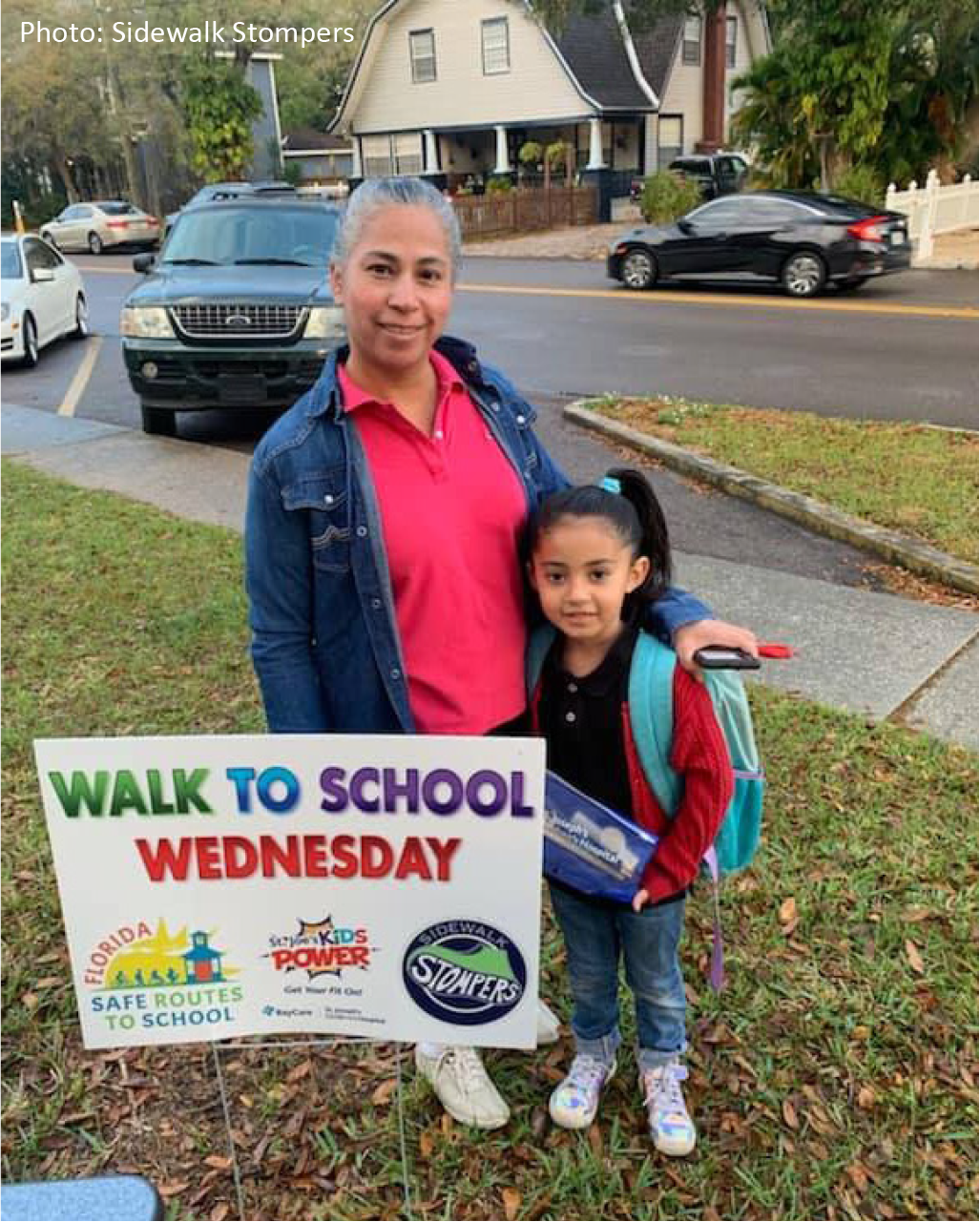
SIDEWALK STOMPERS
Sidewalk Stompers’ Walk to School Wednesday programs encourage and support students walking and biking to school through student incentives, pedestrian education efforts, and identifying key road design safety barriers. Small rewards and competitions drive student participation, while weekly celebratory walking events bring together community business sponsors, neighborhood groups, PTAs, school staff, and student families. Each partner school program includes:
- Weekly to monthly events celebrating student walkers and bikers. Volunteers track participation by student and by classroom.
- Prizes, including recess equipment and individual pedestrian safety items, are distributed as rewards for consistent participation.
- Identifying school-specific safety infrastructure needs that are barriers to student walkers and bikers, including new four-way stops, new safety signage, road murals, pedestrian-friendly signal patterns, and improved site circulation. This advocacy provides a bridge between school communities and Tampa’s Vision Zero goals.
- Coalitions of community supporters to provide funding and volunteers for Walk to School Wednesday events.
- Active transportation alternatives like walking and biking are made available to more students, offer students long-term health improvements, and create opportunities for building community connections. Supporting existing community organizations like Sidewalk Stompers can help Tampa children thrive, not just survive, on their way to their neighborhood school.57
Leverage Health in All Policies (HiAP) Framework to Drive More Equitable Mobility Initiatives
Ensure that the City’s suite of transit and multimodal investments in neighborhoods across the city contributes to building healthier communities.
Action Description: The City of Tampa will work to incorporate the Health in All Policies (HiAP) framework into its mobility initiatives in partnership with the County. HiAP is a collaborative approach to improve the health of all people by incorporating health considerations into decision-making across sectors and policy areas, with a focus on addressing long-standing health inequities. HiAP recognizes that health is created by a multitude of factors beyond healthcare and, in many cases, beyond the scope of traditional public health activities.58 Recognizing the critical links between health and mobility, the City of Tampa will explore partnering with the Hillsborough County Department of Health to integrate this framework into its transit and multimodal initiatives. This will ensure that the significant investments being made in the City’s mobility systems are leveraged not only to expand transit access to Tampanians, but also to improve public health and foster healthier communities in priority neighborhoods.
| Category | Shocks and Stresses | Timeframe | Implementation | Partner |
|---|---|---|---|---|
| HiAP Mobility Initiative |  Economic inequality Economic inequalityInadequate transportation systems Responsive / effective governance |
 Medium Medium |
 |
City of Tampa Mobility Department, HART, and Hillsborough County Department of Health |
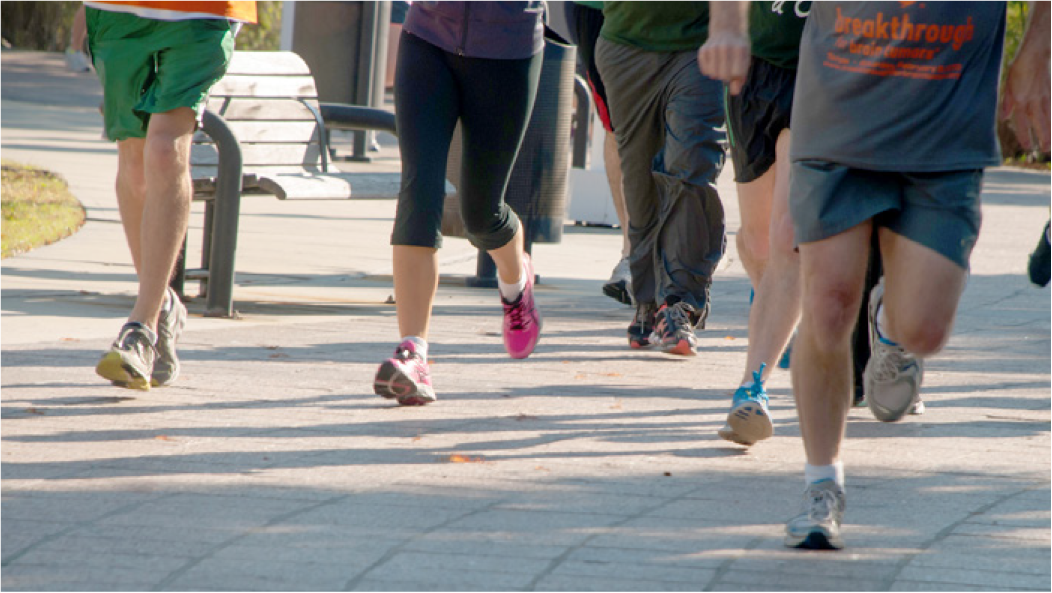
Partner with Community Redevelopment Areas (CRAs) to Foster Vibrant Neighborhoods
Leverage Tampa’s network of CRAs to advance the city’s recovery and resilience.
Action Description: As the City charts a path forward toward a more resilient recovery from the impacts of the COVID-19 pandemic, it will partner with Community Redevelopment Areas (CRAs) to foster greater coordination between City programs and CRA efforts to enhance the quality of life in the communities they serve.
Tampa’s CRAs are powerful catalysts for investment and economic opportunity in many neighborhoods across the city. From Downtown to Drew Park, redevelopment helps make Tampa’s neighborhoods more attractive, safe, convenient, connected, environmentally healthy, and economically strong for residents and business owners. CRAs support local business and property owners by providing funding for facade improvements; they drive private sector investment through strategic resource allocation; and they have well-established community engagement channels with diverse neighborhood stakeholders. The City will work with CRAs to deploy these and other important CRA levers in support of programs and initiatives that bolster Tampa’s recovery and build its resilience to weather future challenges.
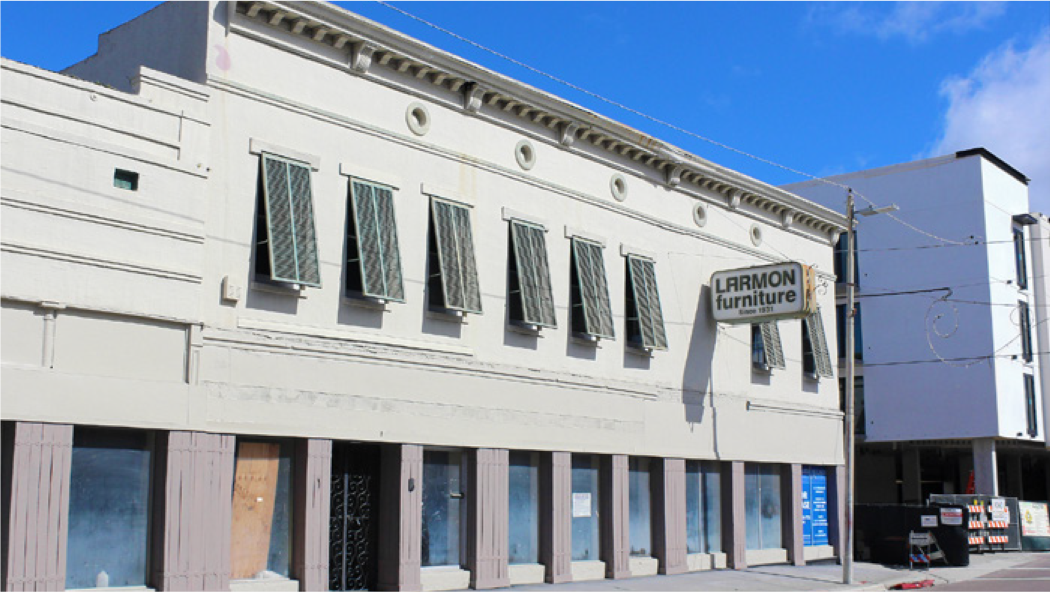

Nurture Community Gardens that Grow and Distribute Healthy Food
Partner with communities to expand community gardens, increasing green space and access to nutritious food.
Action Description: The City of Tampa will work with neighborhoods and community organizations to support and expand community gardens. By working to identify available properties, facilitating efficient permitting, assisting with water access, and promoting the benefits of community gardening, the City can cultivate the expansion of gardens across Tampa. The Tampa Heights Community Garden, the Healthy 22nd Street Demonstration Garden, and Meacham Urban Farm all showcase successful models that can be replicated across the city.
Community gardens and farms can help decrease food insecurity, improve air and water quality, and support local economies. Downtown Tampa, West Tampa, Ybor City, and the University area are all considered food deserts—places with limited access to nutritious food—by the U.S. Department of Agriculture. Bringing community gardens to neighborhoods such as these would increase access to fresh produce, contributing to the long-term health of both people and place. These gardens provide multiple health and environmental benefits, providing an opportunity for Tampanians of all ages and backgrounds to understand and appreciate the connection of healthy food and lifestyles to clean air, soil, and water. Gardens also support biodiversity, filter water, and absorb carbon and other air pollutants.
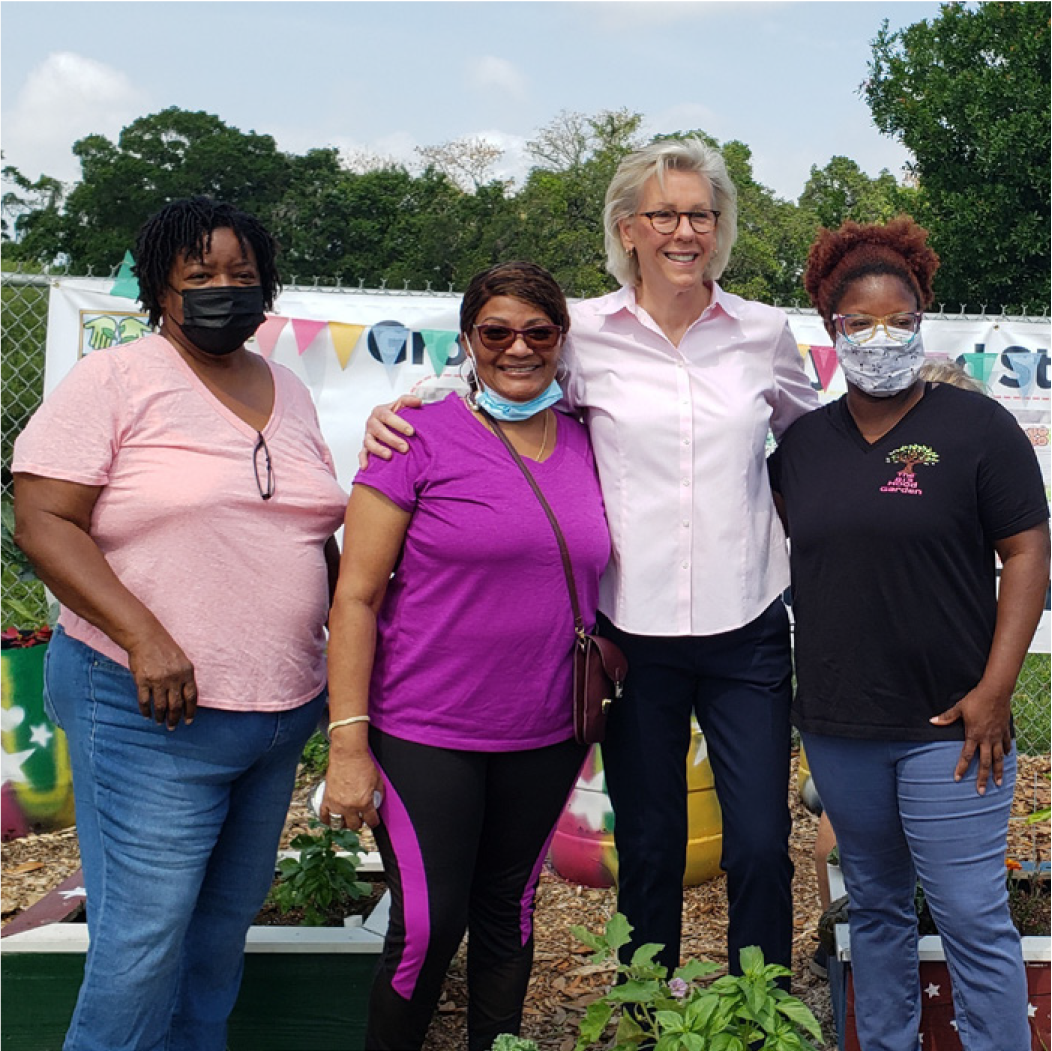

| Timeframe | Implementation Partner | Shocks and Stresses This Action Will Address |
|---|---|---|
| Short | City of Tampa Office of Sustainability and Resilience, Coalition of Community Gardens, Florida Federation of Garden Clubs District VIII | Responsive / effective governance, Economic inequality, More frequent & extreme storms / extreme heat |
2.3 PREPARE TAMPA´S COMMUNITIES FOR CURRENT AND FUTURE CLIMATE RISKS
ACTION 2.3.1
Map Neighborhood-Level Vulnerabilities to Support Decision-Making
Partner to expand the City’s ability to identify neighborhoods facing multiple hazards and vulnerabilities to ensure investments are targeted at the communities that need them most.
Action Description: Social and environmental impacts are asymmetrically distributed across Tampa. For example, while wastewater discharge is generally a concern across the city, across various indicators East Tampa is consistently more vulnerable concerning exposure to toxic air particles, traffic proximity and volume, proximity to hazardous waste management facilities, and ozone levels in air. In addition, Tampan-ians of color disproportionately live in neighborhoods with high exposure to air toxins.59 Recent initiatives of the University of South Florida, such as the Community Vulnerability Study and the Florida Brownfields Redevelopment Atlas, have been providing further insight into these environmental and social impacts using spatial analytical tools that allow for the comparison of data on the neighborhood level and over time. Such tools that take into account spatial and historic data on property values, income, crime statistics, and community health alongside environmental factors are key to informing effective and equitable policies that ensure that all neighborhoods in Tampa are thriving.60 Strategies that align with this intersectional approach will make certain, for example, that policies addressing rising sea levels and storm-water management will not further exacerbate social and economic inequality. Tampa will establish partnerships to bring this analytic capability into its neighborhood-level investment decision-making processes.
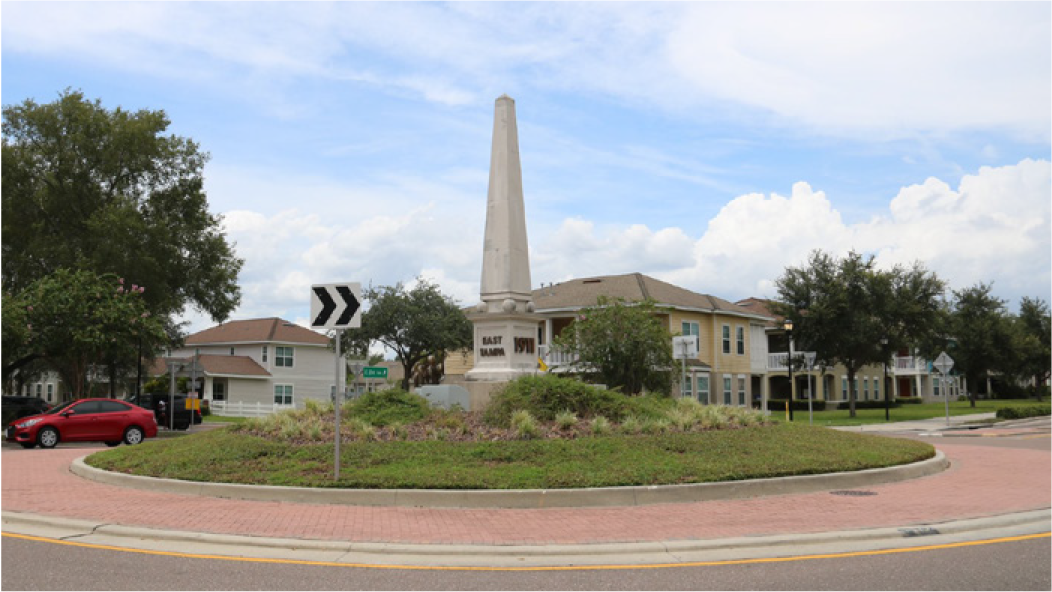

| Timeframe | Implementation Partner | Shocks and Stresses This Action Will Address |
|---|---|---|
| Short | City of Tampa City Planning Department and City of Tampa Office of Sustainability and Resilience | Sea Level Rise / flooding, Responsive / effective governance, Aging / inadequate infrastructure, Economic inequality, More frequent & extreme storms / extreme heat |
Develop and Deploy an Urban Heat Pilot Program That Targets Vulnerable Neighborhoods
Address the well-documented impacts of urban heat through a mix of municipal policy and programmatic innovations.
Action Description: The City of Tampa will undertake a comprehensive review of policy solutions and programmatic approaches that can be deployed to protect city residents from the increasing risks of urban heat. Urban heat islands (UHIs) are a well-studied phenomena in which urban areas are generally warmer than surrounding suburban and rural areas. The most direct impact on health from the UHI effect is due to heat risk, which is exacerbated in urban areas, particularly in heat waves that more readily occur in subtropical climates. Sensitive populations, such as children, older adults, and those with existing health conditions, are particularly at risk during these events. Urban heat contributes to heat-related deaths and heat-related illnesses such as general discomfort, respiratory difficulties, heat cramps, heat exhaustion, and non-fatal heat stroke.61
Tampa is fortunate to have a robust, diverse, and highly productive urban tree canopy which helps mitigate direct sun exposure and reduces cooling costs. However, the city’s tree canopy is not a comprehensive solution to addressing the widespread and increasingly dangerous impacts of urban heat. From 2004 to 2018 the Centers for Disease Control and Prevention recorded 10,527 heat-related deaths in the United States, an average of 702 per year.62 These numbers include deaths where heat was the underlying cause and where heat was a contributing cause. Of particular concern, a 2019 report titled Killer Heat in the United States, published by the Union of Concerned Scientists, shows that even with rapid action to mitigate climate change, the Tampa Bay region should expect more than 60 days per year with a heat index of over 100 degrees and 30 days with a heat index of over 105 degrees.63
The City of Tampa will explore a broad toolkit of policies, projects, and programs – drawing on best-in-class outreach tactics, incentives, green building standards, weatherization approaches, tree and landscape ordinances, cooling materials on roofs and other surfaces, and more – to pilot an urban heat program that will protect Tampa’s most vulnerable communities today and into the future.
SHOCKS AND STRESSES
THIS ACTION WILL ADDRESS
 More frequent & extreme storms / extreme heat
 TIMEFRAME Medium
 IMPLEMENTATION PARTNER
TAMPA’S URBAN TREE CANOPY
The City’s tree ordinance (Ord. No. 2006-74, § 9, 3-23-06) requires that the urban forest be assessed every 5 years. In an effort to reduce concerns over bias, this work has been conducted by a collaborative team from the University of South Florida and the University of Florida following an established USDA Forest Service field protocol. This report provides detailed information about the current size, composition, health, and distribution of Tampa’s urban forest.
Key facts: Tampa’s urban tree canopy
- Reduces 808 tons of air pollutants that cause respiratory problems – eliminating an estimated $4.5 million in health care costs.
- Reduces residential building air conditioning (shading) and heating (wind break) costs by $7 million.
- Reduces 50 million cubic feet of stormwater runoff (valued at $3.4 million).
COMBAT URBAN HEAT AND FOSTER CLOSER RELATIONSHIPS WITH COMMUNITY MEMBERS
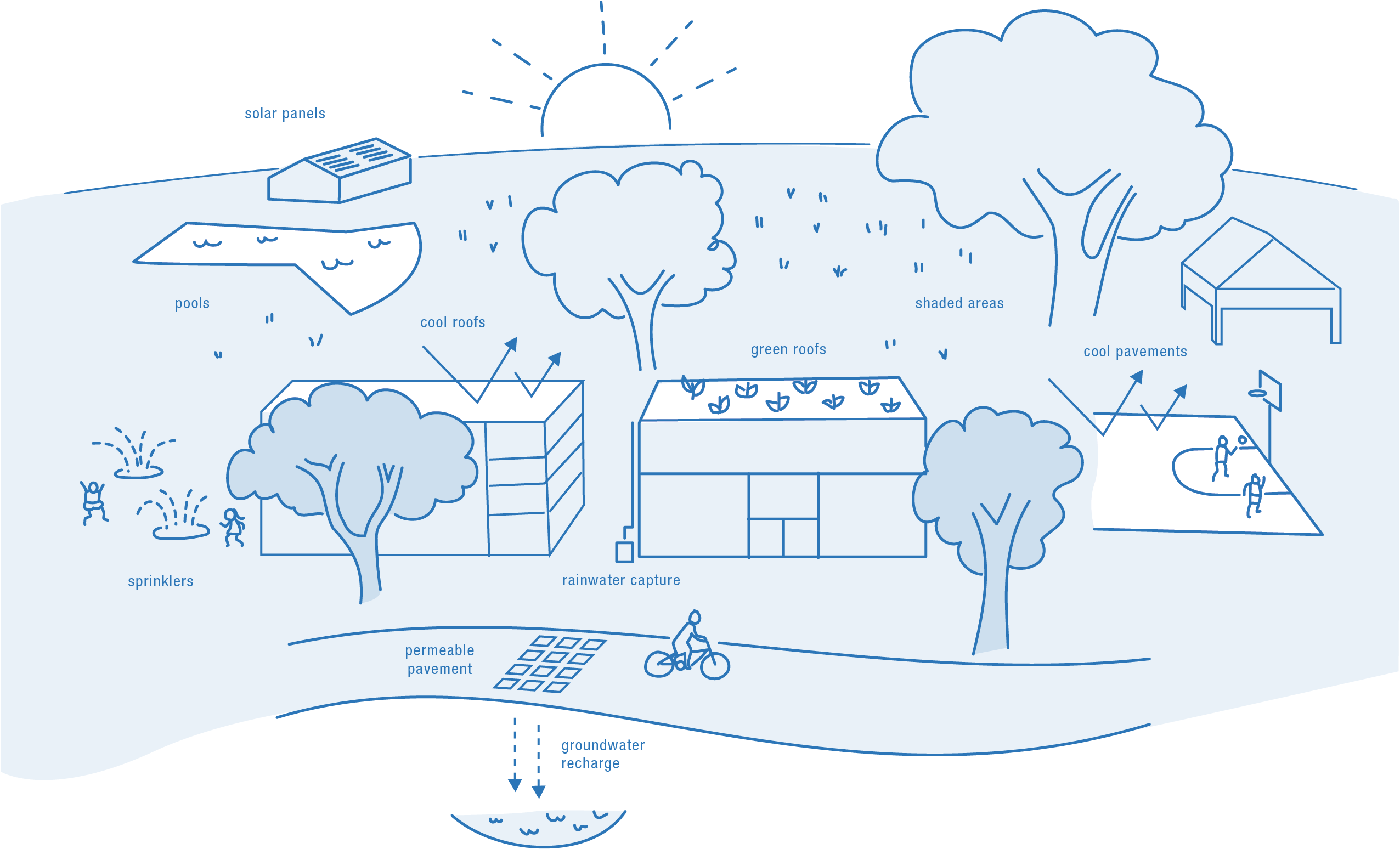
solar panels shaded areas pools sprinklers rainwater capture permeable pavement groundwater recharge cool roofs cool pavements green roofs
Launch a New Climate Risk Education and Communications Campaign
Equip Tampa residents with the information they need to prepare for and navigate potential hazards of coastal and rainfall flooding, extreme heat, and wind storms.
Action Description: The City of Tampa, through its Communications and Emergency Management departments, will explore new ways to present compelling and important messages related to storm surge and other hazards the city faces. Florida is no stranger to the threat of hurricanes, high heat, and coastal flooding. Tropical storms and hurricanes can bring both strong winds and storm surge. A category 2 or 3 storm can cause significant property damage and presents major life safety concerns.65 While storm surge is likely to cause the most widespread damage, high heat events, lightning, and flash flooding from intense rain must be taken seriously as well.
As Tampa’s population continues to grow and diversify, it is important to communicate safety messages about local hazards to city residents. The City will rely on a combination of tested emergency management communication practices and seek new platforms to ensure that all residents are aware of both immediate risks and long-term vulnerabilities associated with living in coastal areas. Continually refreshing communications is important to avoid evacuation fatigue and to ensure that all residents have access to this critical information through a broad variety of media and channels.
| Shocks and Stresses This Action Will Address | Timeframe | Implementation / Partners |
|---|---|---|
| Sea level rise / governance flooding More frequent & extreme storms / extreme heat |
Medium | IMPLEMENTATION City of Tampa Office of Sustainability and Resilience; City of Tampa Office of Emergency Management; City of Tampa Communications Office PARTNERS |
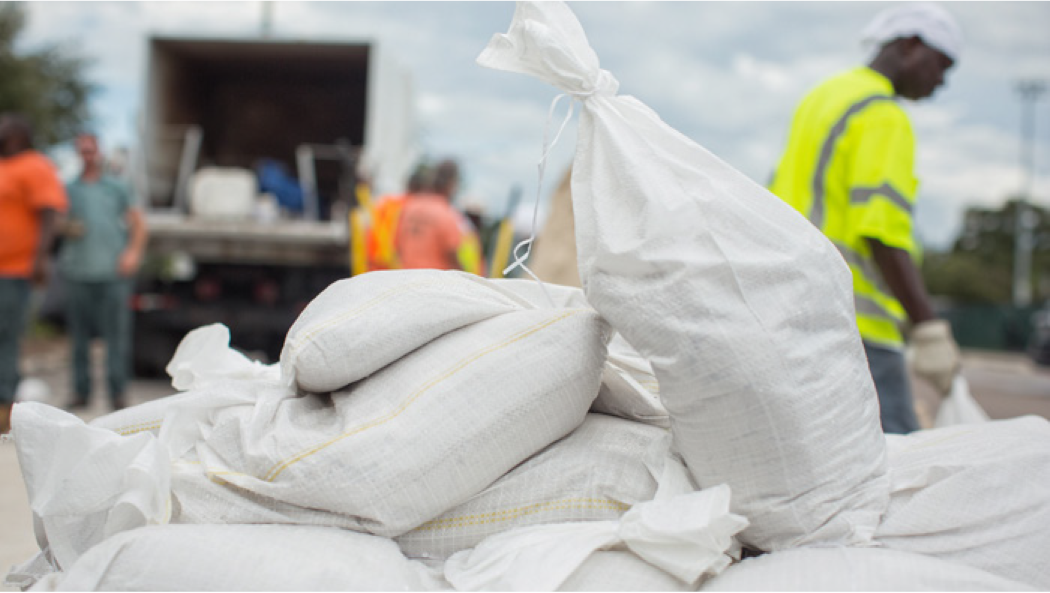
2.4 REDUCE NEIGHBORHOOD DISPARITIES THROUGH INNOVATIVE PARTNERSHIPS AND PROGRAMS
Action 2.4.1
Leverage Opportunity Zones to Bring Employment Opportunities to Communities
Explore mechanisms to better utilize Tampa’s network of Opportunity Zones to drive economic opportunity for Tampanians.
Action Description: Tampa’s federally designated Opportunity Zones are a community investment tool delivered through federal tax policy that have the potential to spur economic development and job creation in the city’s under-resourced communities. The City will work to ensure that its Opportunity Zones are leveraged to bolster its existing investments in priority neighborhoods and accelerate existing community- and CRA-led plans toward their economic and workforce development goals.
To help attract a broader array of investors, the City will create an Opportunity Zone Prospectus and Marketing Plan that elevates these districts and connects them to the City’s broader economic development approach and tools. As part of this effort, the City will explore creating summaries of key infrastructure elements (streets, drainage, parks, schools, and transportation, among others) and projections of any enhancements of those assets in designated Opportunity Zone areas, along with information on proximate educational institutions, available workforce, transit access, and other relevant data. In addition, the City will partner with Hills-borough County and Tampa Bay EDC to explore how existing economic incentives could be aligned with Opportunity Zone benefits to further spur investment in targeted neighborhoods. Finally, the City will explore using the Urban Institute’s Opportunity Zone Community Impact Assessment Tool to ensure that the potential impacts of development projects actually advance community priorities while also working toward citywide goals of creating accessible and quality jobs, building community wealth, and enhancing connectivity.
Shocks and Stresses This Action Will Address
 Economic inequality
 Shifting macroeconomic trends

Timeframe: Medium, Long 
Implementation Partners
City of Tampa Economic Opportunity Department and Tampa Bay EDC
Promote a Community-Based Collective Impact and Service Delivery Model in Priority Neighborhoods
Leverage Tampa’s robust network of public and nonprofit human services agencies and partner with Hillsborough County to catalyze collective impact collaborations that drive household- and neighborhood-level change.
Action Description: Tampa is home to a vibrant ecosystem of innovative community-based organizations and human services providers that – in partnership with Hillsborough County – provide a critical suite of services for Tampa’s most vulnerable residents and neighborhoods, from early childhood education and quality childcare services to job training and placement services to food provision and beyond. While these individual efforts have real impact on the lives of Tampanians across the city, there is an opportunity to build stronger coordination and collaboration across organizations’ individual programs to deliver a more holistic, family-centered set of services in the neighborhoods that need them most. To support this greater coordination effort, the City of Tampa will leverage its convening power to bring together nonprofits and public and private agencies to pilot a collective impact service delivery model in priority neighborhoods.
Collective impact fosters greater collaboration grounded in the idea that for organizations to create lasting solutions to complex problems, they must coordinate their efforts and work together around a clearly defined set of goals established in partnership with community members such as building assets

among low-income families or creating career pathways for young adults.66 This effort will begin with the cohort of neighborhood-focused service providers and community members coalescing around the goals they hope to advance through the effort and then could progress to data-sharing efforts across systems, cross-referral among programs for individual families, and eventual co-design or re-design of services to better meet the needs of residents.
The City of Tampa will pilot this effort in the priority neighborhoods that have been most impacted by the cascading negative health, economic and social effects of the COVID pandemic.
SHOCKS AND STRESSES
THIS ACTION WILL ADDRESS
 Economic inequality
 Responsive / effective governance
 Shifting macroeconomic trends
TIMEFRAME
 Medium
IMPLEMENTATION PARTNER
 One Tampa
Amplify the Innovation District Model Through Partnerships
Shape the trajectory of Uptown Tampa’s redevelopment to create an inclusive and sustainable innovation district, while sharing best practices to expand the model throughout Tampa.
Action Description: The City of Tampa, Hillsborough County, Tampa Innovation Partnership, and the anchor institutions of Uptown Tampa are advancing a Strategic Action Plan for the development of the Uptown area as an inclusive, sustainable innovation district. This collaborative cross-sectoral process is intended to remedy the unplanned growth that has occurred in the area to date and shape the trajectory of major redevelopment underway into a cohesive, complimentary development that will spur innovation and business development, while driving greater inclusivity and sustainability.
The Strategic Action Planning process has identified a number of stressors affecting the area and envisions a range of proposed action steps that may be explored in 2021:
- Development of an innovation superhub within the Uptown Innovation District that becomes the source for an ever-growing and evolving ecosystem that drives homegrown innovation and entrepreneurial development. IMPLEMENTATION PARTNER: TAMPA INNOVATION PARTNERSHIP
- Creation and implementation of a Community Benefits Program, including incentives for affordable housing, that allows developers to help address the needs of neighboring residents. IMPLEMENTATION PARTNERS: TAMPA INNOVATION PARTNERSHIP IN COLLABORATION WITH UACDC, HILLSBOROUGH COUNTY, AND THE CITY OF TAMPA
- Securing funding for a job-training program that will deliver the skills needed to excel in the fields of artificial intelligence, machine learning, and other emerging tech specialties. IMPLEMENTATION PARTNER: THE MAYOR'S WORKFORCE COUNCIL IN PARTNERSHIP WITH TAMPA INNOVATION PARTNERSHIP
- Creation of a commercial overlay district for the Fowler Avenue and Busch Boulevard corridors in order to develop a more pedestrian-friendly area less dependent on single-occupant vehicles. IMPLEMENTATION PARTNER: CITY OF TAMPA (BUSCH BLVD.), HILLSBOROUGH COUNTY / CITY OF TAMPA (FOWLER)
- Delivery of a study on the existing conditions of the water, wastewater, and stormwater infrastructure in the to-be-proposed Uptown Overlay Area. IMPLEMENTATION PARTNER: HILLSBOROUGH COUNTY
- Launch of the proposed Uptown Circulator transit service. PROJECT OWNER: HART
- Construction of a multi-purpose trail connecting the University Mall (Rithm at Uptown) to the James A. Haley Veterans’ Hospital and a link to an expanded trail network. IMPLEMENTATION PARTNER: HILLSBOROUGH METROPOLITAN PLANNING ORGANIZATION
The City of Tampa will take the learnings and insights from this collaboration and explore how to replicate relevant elements in other areas that are home to strong anchor institutions.
Inadequate transportation systems


SHOCKS AND STRESSES THIS ACTION WILL ADDRESS Shifting macroeconomic trends Responsive / effective governance Economic inequality LongTIMEFRAME IMPLEMENTATION PARTNERS
Tampa Innovation Partnership, Hillsborough Metropolitan Planning Organization, HART, the Mayor's Workforce Council, City of Tampa Planning Department, and City of Tampa Economic Opportunity Department
CHAPTER 3
CLIMATE-READY INFRASTRUCTURE
We envision a Tampa that is prepared for a changing climate. The following initiatives will reduce our climate impacts while strengthening our city’s existing and future infrastructure so that regardless of what climate driven shocks and stresses come our way, we will be ready to bounce back.
Our climate is changing. Sea levels in Tampa have risen nearly 8 inches in half a century,67 our heat index is rising to the point that it will be unsafe to work outdoors for extended periods of time,68 and hurricanes pose a rising threat.69 Tampanians are increasingly feeling these impacts in terms of burdens on human health and safety as well as to the homes and infrastructure upon which we rely. Unfortunately, these effects exacerbate our existing inequities, disproportionately impacting Tampa’s most vulnerable populations, including low-income Tampanians who may lack the resources to harden their homes before disasters strike and properly recover afterwards.70
Our City is committed to bold action that will address both the causes and effects of climate change. We will build a more resilient city that will better withstand the next climate events. We will create and advance policies that limit our reliance on non-renewable energy. We will build and strengthen infrastructure so that our systems can adapt to a changing climate and provide additional benefits to our communities, including increased access to green space. We will protect our city and its most vulnerable residents as we move through a century of unprecedented climate change.

30% increase in hurricane likelihood in 2030s

Every $1 million invested in flood infrastructure creates 40 new jobs71
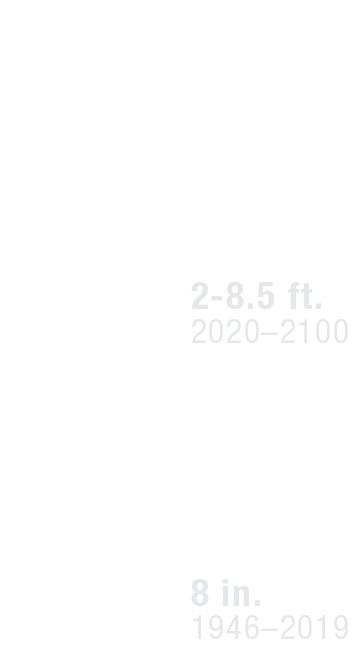
Up to 8.5 ft. of additional sea level rise
3.1 REDUCE GREENHOUSE GAS EMISSIONS
ACTION
Explore funding and financing options to accelerate implementation of clean energy solutions.
Action Description: The City will expand and implement energy-savings programs throughout the city to advance clean energy policies. These programs will be implemented equitably by ensuring that Tampa-nians can access renewable energy for their homes regardless of their financial situation.
Tampa can save taxpayer dollars, protect public health, and create local jobs by reducing energy waste and pollution with building efficiency and solar + storage. 20% of Tampa residents live below the federal poverty level (FPL)72 and according to United Way’s ALICE study, 42% of Hillsborough County households are Asset-Limited, Income Constrained, Employed (income above FPL but below the basic cost of living).73 48% of Tampa households live in homes they own.74 By offering low- and moderate- income (LMI) homeowners equitable financing to make their homes more resilient, the City will dramatically improve the quality of life for those with the greatest energy burden.
The City will implement community-wide energy savings programs to improve housing with an equity lens. Key components of this community energy program will include:
- The City will devise an energy burden map to guide efforts to offer financing and other incentives to reduce energy waste and access solar power for renters and homeowners who have substandard housing.
- The City will partner with SELF, a nonprofit green bank that provides inclusive and low-cost financing for sustainable home improvements, with a focus
SHOCKS AND STRESSES THIS ACTION WILL ADDRESS
 Sea level rise / flooding
 More frequent & extreme storms / extreme heat
 Economic inequality
 TIMEFRAME Medium
 City of Tampa Office IMPLEMENTATION of Sustainability and PARTNERS Resilience; SELF; and SUN
on low- and moderate- income homeowners. As a mission-driven lender, SELF raises low-cost capital from banks, faith-based organizations, impact investors, worldwide crowdfunding, and more, and provides financial inclusion via unsecured personal loans based on the applicant’s ability to pay, not their credit scores. SELF does not charge deal fees to its contractors. SELF’s inclusive financing helps open up underserved markets to take advantage of energy efficiency, bulk-rate solar PV pricing, and climate resilience.75
- The City will partner with Solar United Neighbors (SUN), a nonprofit installer and trusted financing-neutral resource on solar power for communities all over Florida. SUN provides unbiased information on the basics of going solar so that community members make informed decisions, and they provide full project management for every participant from sign-up through full project completion.76
- The City will work with the Weatherization Assistance Project of the Tampa Hillsborough Action Plan (THAP) and also explore leveraging dollars from the Department of Energy and other agencies to ensure that improvements such as high SEER ACs and water/energy saving appliances are sustainable.77
- The City will explore promoting a safe and reliable form of Property Assessed Clean Energy (PACE) financing. PACE financing can apply to both commercial and residential projects.
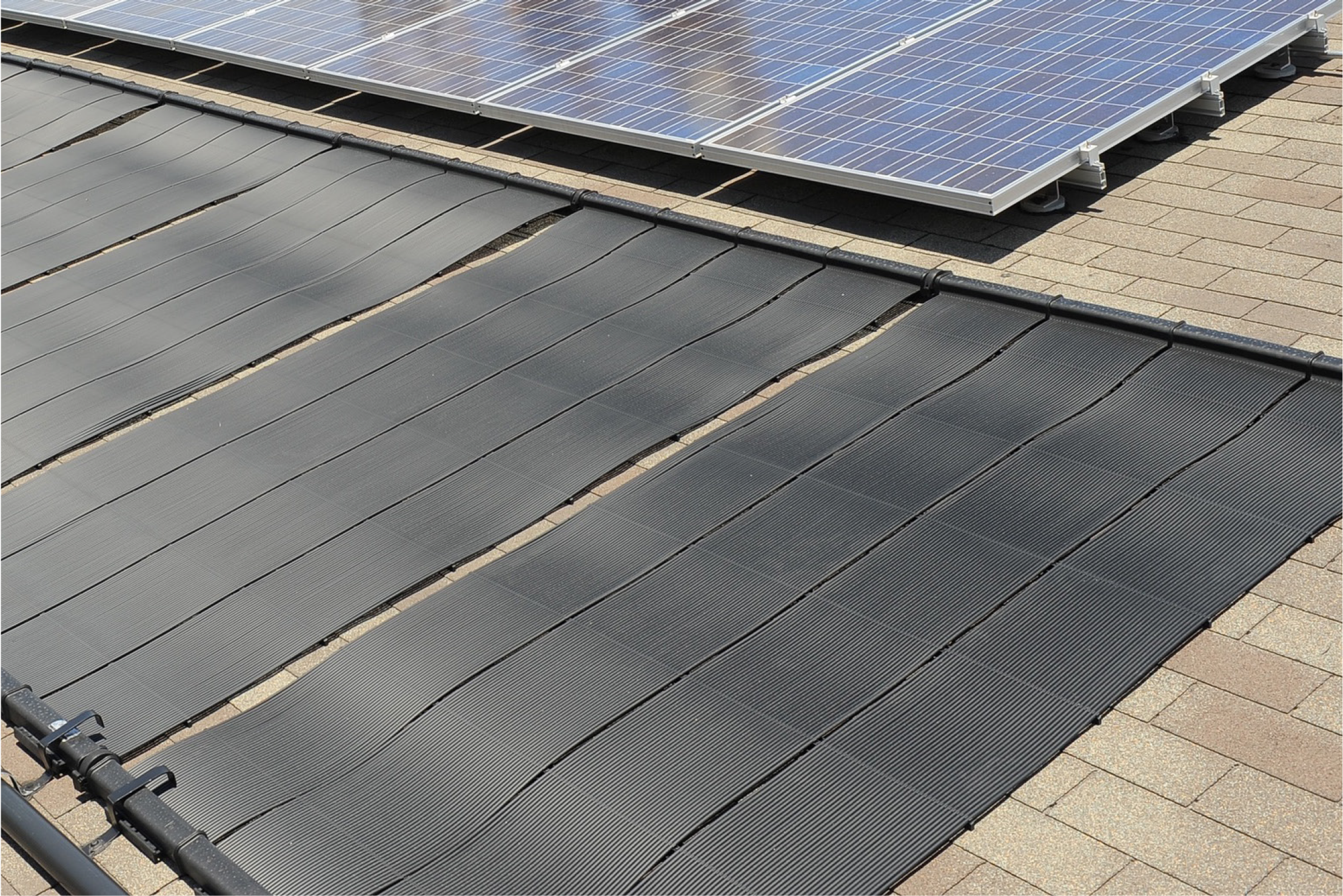
Measure the Value of Clean Energy and Climate Resilience Solutions
Quantify and track the increasing costs of climate change and cost of inaction around climate resilience solutions.
Action Description: The City will quantify and track the benefits of transitioning to clean power by considering the social determinants of health and impacts from climate change. Climate change is harming Tampanians’ health, impacting lung and heart conditions, asthma, waterborne and foodborne illnesses, traumatic injuries, allergies, vector-borne diseases and mental health stress, leaving some Tampanians more impacted than others.78 Dramatic action to reduce greenhouse gas pollution now will avoid the worst implications of climate change. The City will also track how the transition to clean energy will result in significant cost savings over time. When conducting cost–benefit analyses, the City will consider the lifecycle of the investment. The City will also evaluate the cost of inaction versus investing in climate resilience such as stormwater improvements and flood mitigation measures. Finally, The City will track how investments in energy solutions foster local job creation.
| Category | Shocks and Stresses This Action Will Address | Timeframe | Implementation Partner |
|---|---|---|---|
| Action Details | |||
| Impacts | Sea level rise / flooding More frequent & extreme storms / extreme heat Responsive / effective governance |
Short | City of Tampa Office of Sustainability and Resilience |
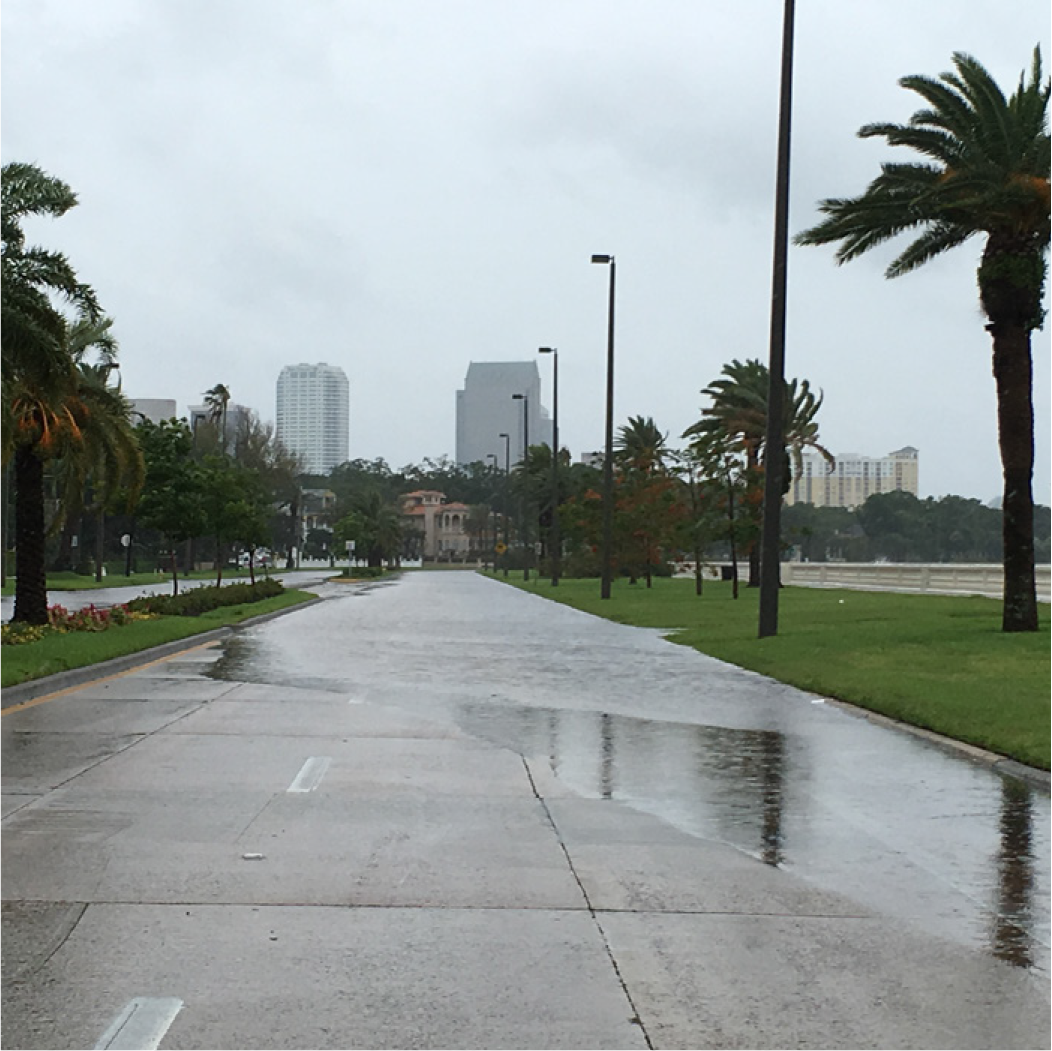



Promote Full Electrification of Municipal Operations Vehicles and Regional Transit Fleets
Work towards the deployment of a fully electric transit fleet resulting in improved air quality, reduced carbon emissions, and long-term savings.
Action Description: The City of Tampa is committed to transitioning its fleet of over 3,300 vehicles to become 100% electric, with a goal of purchasing 10 new electric sedans each year, gradually increasing the number every year. With a current average age of almost 10 years, replacing the current fleet with EVs will reduce pollution in Tampa’s neighborhoods, decrease idling at job sites, and ultimately make the entire community safer by reducing the city’s overall carbon footprint. EVs’ total cost of ownership is less, even with a higher average initial cost. The average City vehicle travels 48 miles each work day,79 which is well within the travel range of EVs, now reaching over 200 miles per charge.
Tampa will also work with the Hillsborough Area Regional Transit Authority (HART) to encourage full EV transition of their fleet of 114 diesel, 114 compressed natural gas, and 41 gas vehicles, which serve approximately 36,000 daily riders.80 This fleet is a major source of municipal carbon emissions, local air pollution, and maintenance costs.
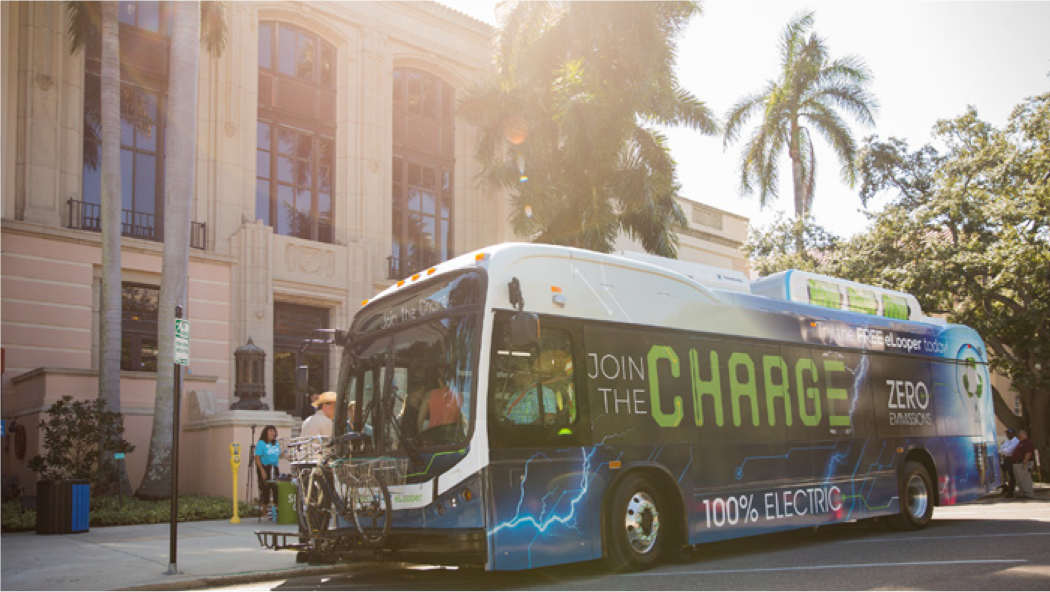
HART has already taken the first steps toward fleet electrification, utilizing a $2.7 million federal grant to purchase its first four electric buses. Electric buses produce zero emissions, run quietly, last longer, and are cheaper to maintain than the current fleet.81
Working toward a fully electric transit fleet will allow Tampanians to reap the long-term benefits of a healthier local atmosphere, a more efficient HART, and a reduction in Tampa’s greenhouse gas emissions. The City will leverage different financing options such as the Climate Mayors EV Purchasing Collaborative and federal tax credits. In addition, the City will work to ensure that Tampanians can leverage incentives, rebates, and financing for the purchase of electric vehicles and the installation of charging stations at home.

Medium City of Tampa Office of Sustainability and Resilience TIMEFRAME IMPLEMENTATION PARTNERInadequate transportation systems SHOCKS AND STRESSES THIS ACTION WILL ADDRESS Sea level rise / flooding More frequent & extreme storms / extreme heat
Ensure All Municipal Operations Are Powered by 100 Percent Renewable Energy
Transition all municipal operations to renewable energy.
Action Description: The City of Tampa is committed to leading by example – 100 percent of municipal operations will be powered by renewable energy. The path to achieve this goal, and to ensure that community operations follow, will be addressed in the forthcoming Climate Action & Equity Plan.
The City will embrace many initiatives in the spirit of this commitment, such as green retrofitting existing municipal buildings, investing in renewable energy infrastructure, and adopting policies that encourage citywide use of renewables to lessen the City’s climate impact, leading to a greener, fairer, and safer Tampa. The City will also develop climate policies based on data collected through the USF greenhouse gas inventory and on the policies of the Climate Action and Equity Plan. As the City consolidates municipal operations and considers a new building, solar power will be evaluated and LEED will be required.
The City has completed hydroelectric generation and energy recovery proof-of-concept studies and is evaluating payback calculations to ensure future implementation of the following projects:
- Hillsborough River Dam Small Hydroelectric Project: Reducing the city’s electric demand on TECO through the implementation of hydroelectric units.
- Interbay Pump Station Energy Recovery Project: Implementing an in-line energy recovery unit at Gandy with an estimated recovery production of 438,000 kilowatt hours.
| SHOCKS AND STRESSES THIS ACTION WILL ADDRESS | Sea level rise / flooding More frequent & extreme storms / extreme heat Responsive / effective governance |
TIMEFRAME | IMPLEMENTATION PARTNER |
|---|---|---|---|
| Long | City of Tampa Office of Sustainability and Resilience |
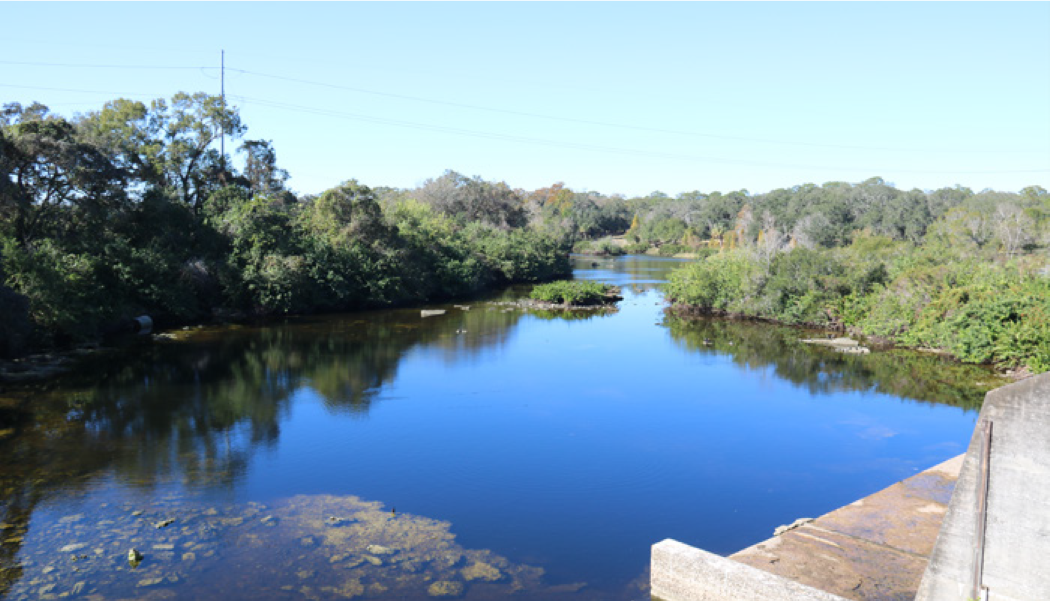

3.2 ADAPT TAMPA’S INFRASTRUCTURE TO THE IMPACTS OF CLIMATE CHANGE
ACTION 3.2.1
Assess and Fortify Our Critical Infrastructure
Periodically review Tampa’s critical infrastructure to assess vulnerabilities to natural hazards and climate change and develop solutions.
Action Description: The city’s geography provides inherent risks from sea level rise, hurricanes, flooding, and other natural disasters that could pose a significant threat to our most critical infrastructure with potential cascading impacts for residents throughout Tampa. The City’s periodic review of the risk facing each of its critical assets is fundamental for its long range planning. Tampa’s various critical infrastructure assets support essential functions for Tampa’s residents, businesses, and visitors. The City will continue to ensure that each asset is evaluated based on the latest natural hazard and climate change risk models. These evaluations will then help drive decision-making in future capital budget planning to mitigate risks of damage to Tampa’s critical infrastructure or downtime.
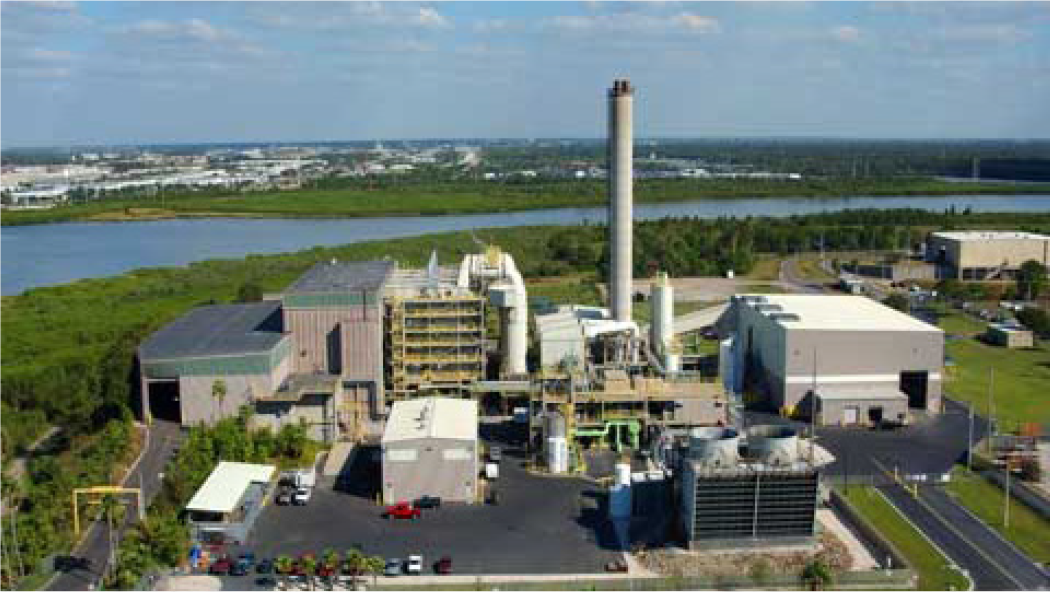

PARCELS IN FUTURE FLOODZONES

Areas that present a 1% annual chance of flooding and a 26% chance over the life of a 30-year mortgage, according to FEMA

Coastal areas with a 1% or greater chance of flooding and an additional hazard associated with storm waves


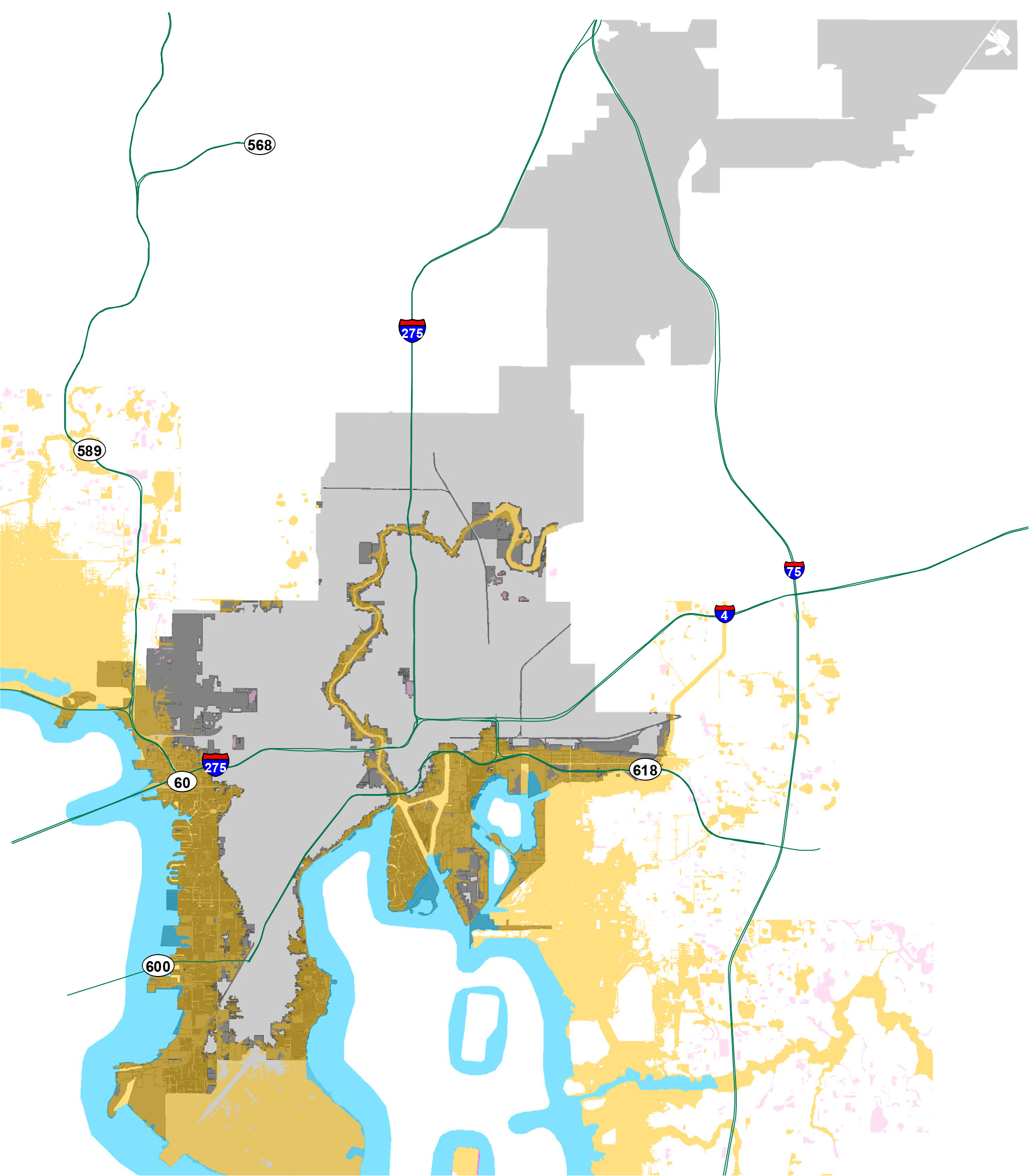
Incorporate Resilience Guidelines Into the Capital Planning Process
Incorporate resilience summary statement and prioritization into individual department CIP submittals.
Action Description: The City will develop and incorporate resilience guidelines into the capital planning process. Each department will consider the principles of resilience during the annual development of the City’s Capital Improvement Program (CIP). A resilience statement, summarizing the benefits and anticipated outcomes of the proposed projects in achieving the City’s resilience goals should be included in the budget narrative as part of each department’s CIP. The anticipated impact on resilience and sustainability should also be reflected in the budget prioritization of projects by each department.

Stormwater Systems for a Changing Climate
Incorporate integrated stormwater infrastructure solutions into planning and design projects that consider future adverse climate conditions.
Action Description: The City’s stormwater infrastructure will be subject to increases in extreme precipitation attributed to changes in climate conditions. Additionally, much of the City’s stormwater infrastructure is connected to the coast, which makes it susceptible to cumulative impacts from sea level rise. As the performance and functions of these systems have degraded, the city will increasingly see direct impacts on critical infrastructure, essential services, and even day-to-day activities that will affect the City’s ability to meet overall resiliency and sustainability goals. Additionally, the City has an obligation to protect the health of the Tampa Bay Watershed and associated waterbodies, which are expected to see ecosystem and habitat changes that may result in water quality impacts. Managing stormwater plays a significant role in meeting water quality goals.
To mitigate or address these climate challenges, the City will look to implementing the following storm-water opportunities:
- Incorporate climate change and sea level rise in stormwater and watershed planning documents. Climate-informed assessments of long-term storm-water infrastructure needs and vulnerabilities that also consider social vulnerability will guide the City in making decisions about adaptation measures that will benefit stakeholders, including those most at risk of future flood impacts. Policies, manuals, and guidance documents will be created to help promote climate-resilient stormwater solutions.
- Incorporate Green Infrastructure (GI) and Low Impact Development (LID) into City Capital Projects, and promote the use of GI and LID elements in citywide development and redevelopment projects. GI and LID provide benefits to both built and natural environments as well as reducing impacts from future disasters by intersecting such systems to meet community goals and provide positive returns on investment.
| SHOCKS AND STRESSES THIS ACTION WILL ADDRESS | Aging / inadequate infrastructure | Responsive / effective governance | TIMEFRAME | IMPLEMENTATION PARTNER |
|---|---|---|---|---|
 Sea level rise / flooding Sea level rise / flooding |
 More frequent & extreme storms / extreme heat More frequent & extreme storms / extreme heat |
Medium | City of Tampa Stormwater Department |
Pilot Nature-Based Solutions Such as Living Shorelines
Harness the productivity of natural systems to improve water quality, provide protection from storms, and add aesthetic value by strategically locating living shorelines.
Action Description: Living shorelines use plants or other natural elements – sometimes in combination with harder shoreline structures – to stabilize estuarine coasts, bays, and tributaries. Living shorelines can provide numerous benefits.
- Protecting shorelines from erosion
- Providing a habitat for fish and other marine life
- Improving water quality and store nutrients
- Increasing stability over time
- Outperforming hardened shorelines during a storm
- Attracting natural wildlife82
The City of Tampa, in coordination with the Tampa Bay Estuary Program, has successfully restored a living shoreline at Ignacio Haya Park on the Hillsborough River. Several other locations for living shorelines projects are under consideration. Although the benefits of living shorelines have been well established, the City does not currently have a master plan for locating future living shorelines projects. The City will focus on grants and funding opportunities
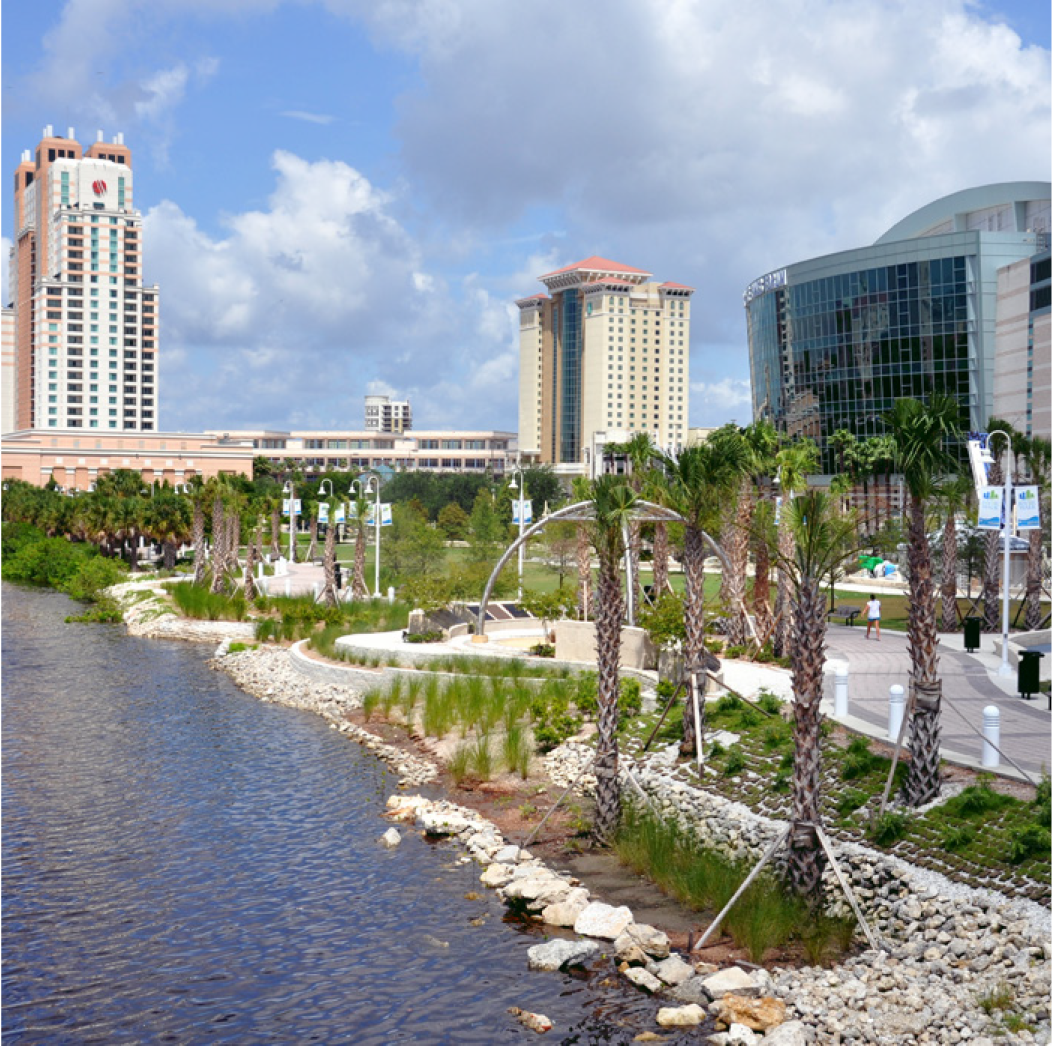
to develop a masterplan and feasibility study for the best locations for living shorelines.
Many seawalls currently maintained by the City of Tampa could be considered for conversion to or buttressing by living shorelines.
| Category | Shocks and Stresses This Action Will Address | More frequent & extreme storms / extreme heat | Implementation | Partner |
|---|---|---|---|---|
| Sea level rise / flooding |  |
 |
 Short |
 City of Tampa Office of Sustainability and Resilience |
Promote the One Water Plan
Ensure a sustainable water supply for future generations.
Action Description: The City will work to promote and implement the One Water plan which will ensure that Tampa approaches water management in a holistic way.
One of the greatest challenges facing major population centers around the world is water security. From Cape Town to Florida, sea level rise and climate change pose an existential threat to drinking water supplies and the long-term survival of these regions.83 One Water is a holistic and integrated approach to planning for potable water, wastewater, stormwater, and the natural environment that recognizes all water as a single resource with a lifecycle that can be optimized and managed.
The City will support the implementation of One Water through the following steps:
- Include water concurrency in the City’s comprehensive plan.
- Protect and preserve existing water resources, including surface water and natural system.
- Develop stronger conservation measures that are easily enforced.
- Store purified water for use during periods of drought.
- Collaborate at the regional level to ensure an adequate supply of potable water for decades to come.
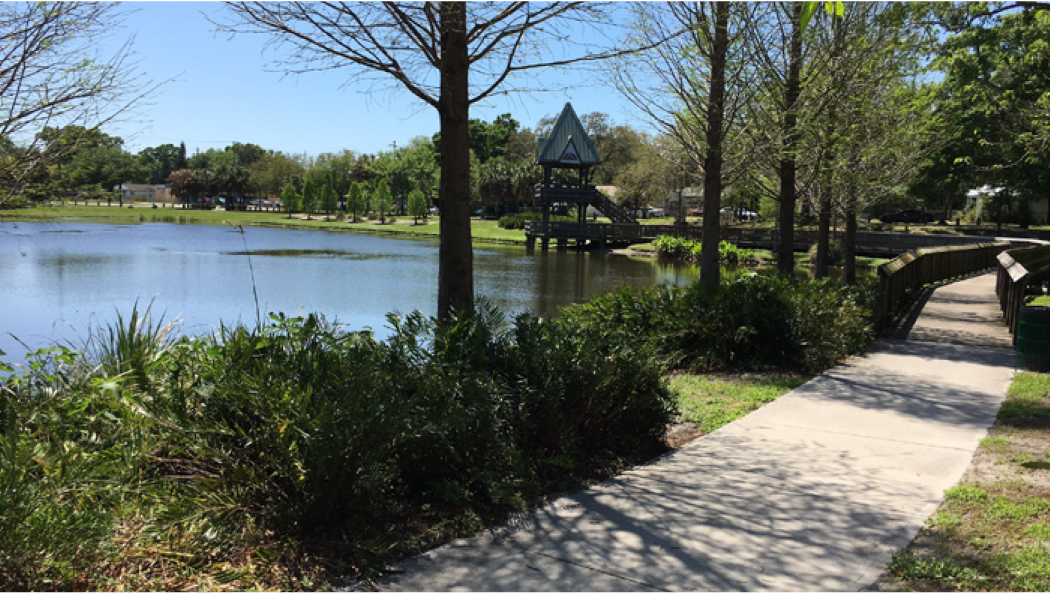
| Shocks and Stresses | Sea level rise / flooding | Timeframe | Implementation Partners |
|---|---|---|---|
| SHOCKS AND STRESSES THIS ACTION WILL ADDRESS | |||
 More frequent & extreme storms / extreme heat More frequent & extreme storms / extreme heatResponsive / effective governance |
 |
Long | City of Tampa Water Department, City of Tampa Stormwater Department, and City of Tampa Wastewater Department |


3.3 INVEST IN WORLD-CLASS GREEN AND OPEN SPACES THAT MITIGATE EXTREME HEAT AND FLOODING
ACTION 3.3.1
Leverage Storm Retention Ponds for Social and Environmental Benefits
Foster interconnected waterscapes for communities suceptible to flooding or exposed to climate-induced flood risks.
Action Description: The City will reimagine its storm retention ponds to mitigate the impacts of climate change during severe weather events and act as a public asset for Tampanians residing in the surrounding areas.
Aging, underperforming infrastructure, projected increased rainfall intensity, limited access to green spaces and waterscapes, and community interest in multifunctional infrastructure require that the City reimagines how it manages stormwater. The City of Tampa owns 242 stormwater ponds. The City’s Transportation and Stormwater Department maintains 137 (77 dry and 60 wet). While the ponds are distributed around the city, the largest concentration is in the northwest. There are 66 ponds southeast of the city, with 31 within the 7.5 square mile East Tampa Community Redevelopment Area (CRA). Not only do the ponds across the city vary in condition, benefit, management, and use by the community, but so do the socioeconomic and cultural structures of the communities living close to the ponds. This action plan brings a multi-sector stakeholder approach to reimagine and innovate our city’s storm-water through an equity lens. To do this properly the City must foster a culture of justice, equity, diversity, and inclusion (JEDI) that allows community members, City staff, and others to make informed decisions and develop community-led stormwater solutions together, from gray to green infrastructure. Storm-water ponds, considered gray infrastructure, and green infrastructure (e.g. rain gardens) are convergence spaces where community benefits include social and environmental services that function more efficiently when neighborhood residents are continuously engaged in the design and maintenance of stormwater ponds and parks. The City will work closely with community members to ensure investments in stormwater retention ponds provide multiple benefits.


TIMEFRAME
Medium

IMPLEMENTATION City of Tampa Office of Sustainability and Resilience, PARTNERS City of Tampa Parks and Recreation Department, and City of Tampa Stormwater Department
FOCUS ON HEALTHY GREEN SPACE
Parks and green spaces provide significant social, economic, and environmental benefits to a city and its residents. According to a July 2020 CDC report, exposure to nature or green space is attributed to lower rates of heart disease, stroke, obesity, stress, and depression.84 These benefits became all the more pronounced as COVID-19 created the need for safe places to congregate outside at a safe distance. Unfortunately, more than half of Hill-sborough County residents, many of whom live in Tampa’s poorest neighborhoods, live farther than a 10-minute walk from a park.85 The City of Tampa’s stormwater retention ponds and other green spaces provide a unique opportunity to reimagine some of these sites in order to provide needed green infrastructure benefits while promoting social and health benefits for all Tampanians.
Increase Green Infrastructure by Leveraging Downtown Parking
Contribute to a healthier environment in downtown Tampa by supporting green infrastructure that provides beauty and ecological benefits to our community.
Action Description: As Tampa continues to feel the impacts of climate change and storm surge, the City will review and upgrade downtown parking and design requirements. Reviewing these requirements will allow the City to increase future planted areas that will contribute to stormwater mitigation downtown.
Over the past decade, the City of Tampa has worked to transform downtown Tampa from a place where people work, to a place where people live, work, learn, and play. Due to the lack of meaningful mass transit in the city and region, and the historically sprawling development pattern of the Tampa Bay region, a significant percentage of land is devoted to parking lots within our downtown core – affecting the beauty and attraction of street life – and contributing to significant stormwater pollution from these predominantly impermeable hardscape surfaces that inevitably is sent to the Hillsborough River and Hillsborough Bay. Adding to this problem are parking code requirements that require developers and building owners to maintain a large amount of parking spaces.
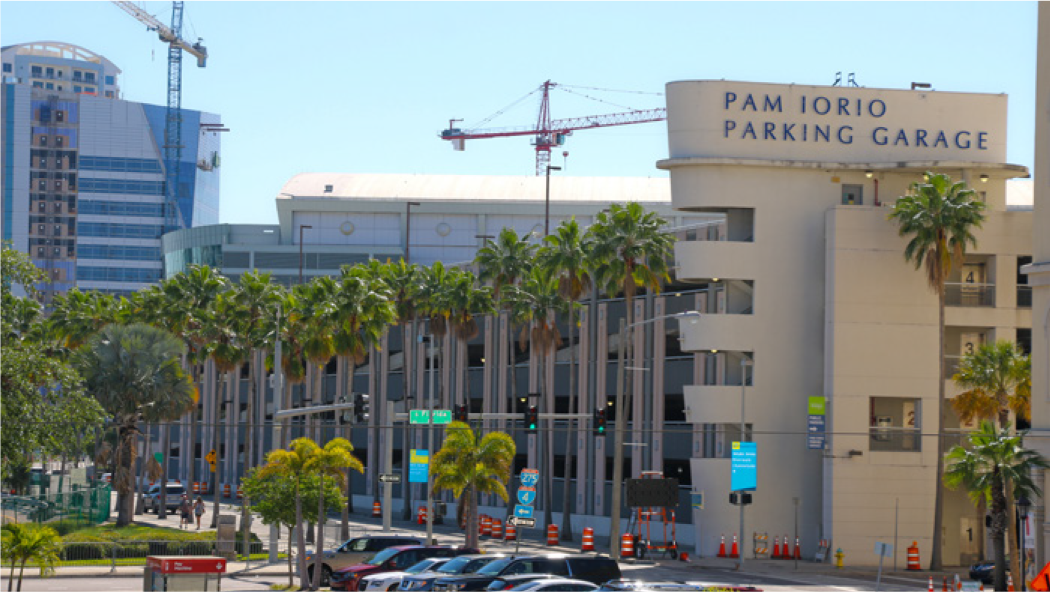
By holistically looking at parking requirements, design requirements, and downtown’s design standards, the City of Tampa will be able to develop upgraded standards that will improve the capacity of existing and future planted areas to contribute to stormwater mitigation. Simultaneously, incentives will be developed to allow developers to reduce parking requirements if they integrate innovative green infrastructure (such as rain gardens, bioswales, stormwater parks, pocket parks, and linear parks along sidewalks) into their parking lot design and/ or upgrade them over time. These innovative design features can contribute to a healthier ecosystem in downtown Tampa that provides public benefits, mitigates the impact of stormwater runoff, and reduces the heat island effect.
| Category | SHOCKS AND STRESSES THIS ACTION WILL ADDRESS | Responsive / effective governance | Inadequate transportation systems | TIMEFRAME |
|---|---|---|---|---|
| Sea level rise / flooding |  |
 |
Short | |
| More frequent & extreme storms / extreme heat |  |
 |
 |
City of Tampa Mobility Department |
Preserve and Increase Tampa’s Tree Canopy
Ensure a sustainable tree canopy and urban forest that maximizes air quality, energy savings, carbon sequestration, and other ecosystem services.
Action Description: Tampa has over 32% urban tree canopy cover that provides an estimated $134.9 million in ecosystem services including air pollution mitigation, shading that reduces residential air conditioning costs, stormwater runoff reduction, carbon storage, and increased property values.86 The City’s tree canopy also faces tremendous development pressure, and past planting decisions have resulted in many examples of undesirable or unsafe trees or trees planted in the wrong place. The 2013 City of Tampa Urban Forest Management Plan and the 5-year comprehensive monitoring schedule provides a guide for the City to promote an urban forest with location-appropriate, wind-resistant, healthy, and desirable tree species that maximize benefits and minimize problems. The City will continue to advance tree protection policies aimed at ensuring no net loss in the tree canopy within any of its Planning Districts will result in tree mitigation and planting that ensures that the benefits provided by trees are available to all residents, including low-income communities.

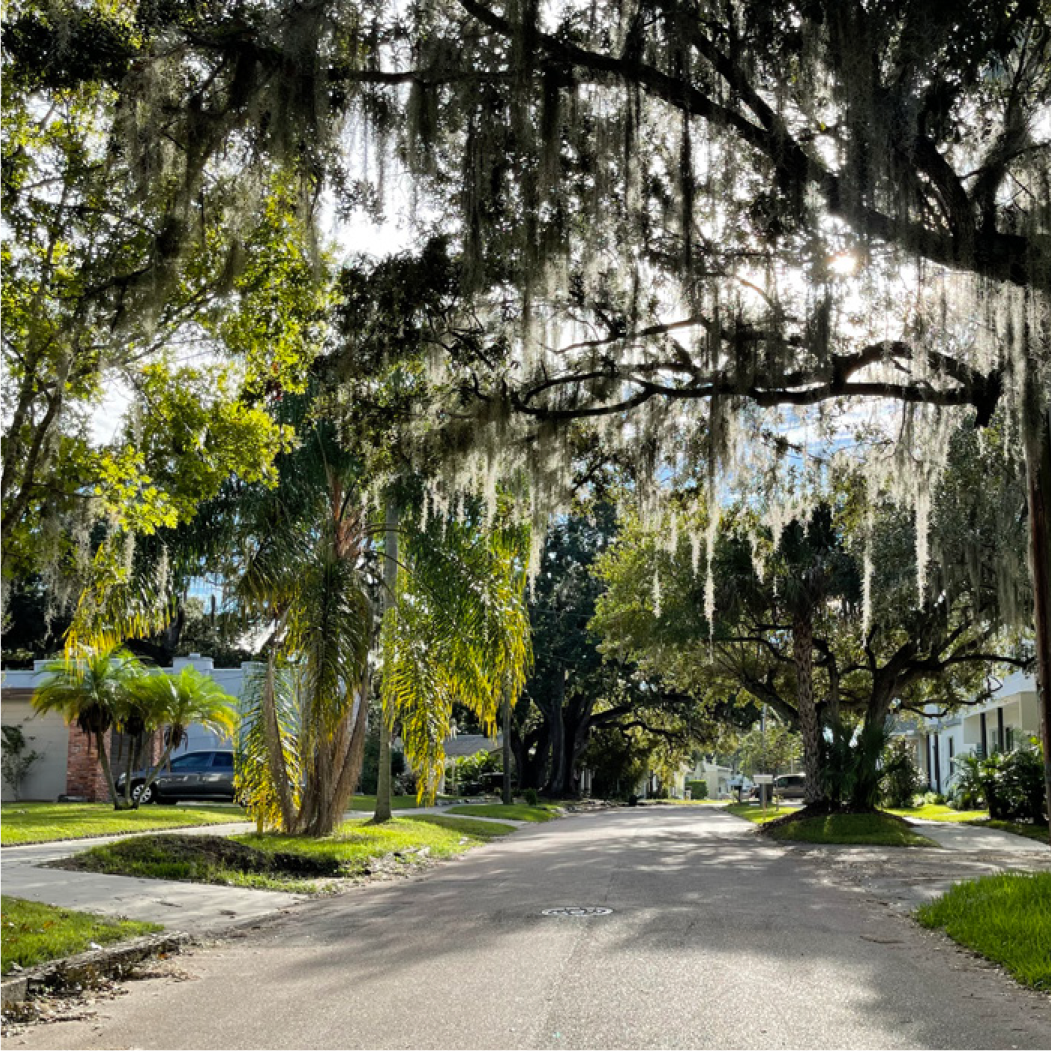
Explore Partnerships to Increase Access to Open Space With Multiple Benefits
Ensure that every Tampanian lives and works within 15 minutes of a robust, climate-ready public space.
Action Description: The City of Tampa will pilot the incorporation of accessible open space and resiliency into all projects impacting the public realm with the goal of providing every citizen access to the public realm and open spaces within a 15 minute walk (i.e. “a 15-minute city”). To achieve this goal, the City will pilot a new interdepartmental task force focused on integrating innovative design elements in specific areas, such as Bayshore, Forest Hills, West Tampa, and East Tampa, that will maximize social and environmental benefits in project design. The task force will leverage the Planning and Urban Design Division to ensure that the pilot advances the goals of creating a public realm that creates multiple benefits while advancing the goals of creating a 15-minute city.
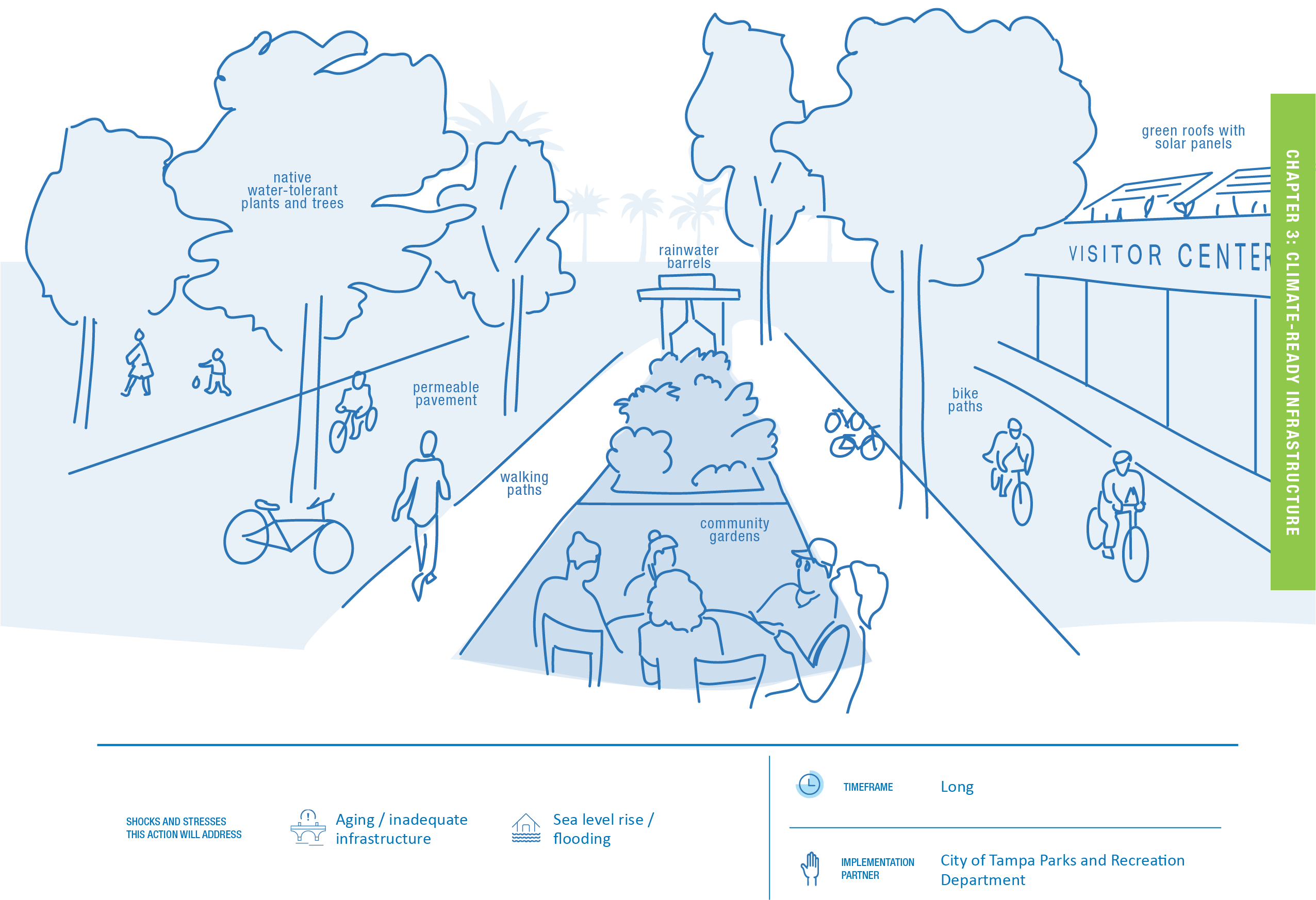
CHAPTER 4 RESILIENT TAMPA
GROWING AND CONNECTED CITY
We envision a Tampa that becomes more resilient as it grows. We envision a city that grows in inclusivity and effectiveness, and that works for all Tampanians regardless of their race, age, ethnicity, or background. The initiatives in this chapter will harness growth to ensure that our government can work fairly and efficiently by embedding resilient systems and addressing historic racial disparities.
Embedding resilience in our city over the long term will require more than implementing the initiatives laid out in Resilient Tampa’s previous chapters. Building upon this important work, we need to change the way our city’s governing systems work to make resilience a permanent fixture. The issues facing everyday Tampanians are interconnected, requiring an integrated response across multiple City departments as well as multi-sector partners. In addition, to adequately confront historic entrenched racial disparities, we must embed policies and practices that promote racial equity.
To make resilience-building a permanent capacity within our governing systems, we will take an innovative and systematic approach. We will harness continued economic growth to promote equity, fostering an economy that generates prosperity for hard-working Tampanians of all backgrounds. We will continue to improve our transportation system in a holistic way so that Tampanians can access increased opportunities as Tampa grows. We will integrate principles of racial equity and resilience into our governing practices to work towards eliminating disparities and strengthening our capacity over the long term to address shocks and stresses.

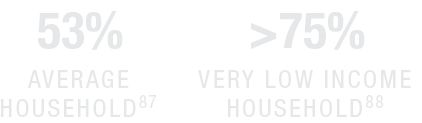
53% >75% AVERAGE HOUSEHOLD87 VERY LOW INCOME HOUSEHOLD88
Percentage of income spent on housing and transportation for the average household. Very low income*: >75%
*WITHIN TAMPA’S POOREST CENSUS TRACTS

Poverty by race/ ethnicity89
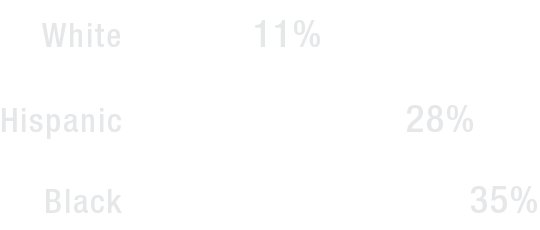
11%White 28%Hispanic 35%Black
4.1 GROW AND DIVERSIFY TAMPA’S ECONOMY WHILE ENSURING OPPORTUNITY FOR ALL
ACTION 4.1.1
Diversify Tampa’s Strong Economic Base
Build on Tampa’s growth sectors and attract more high-wage jobs to the area through closer collaboration with regional partners.
Action Description: The City will strengthen its partnerships with Hillsborough County and the Tampa Bay Economic Development Corporation (EDC) to jointly seek out local, regional, interstate, and international partners that can help the City recruit new businesses and industries to the Tampa market. Leveraging existing market analyses centered on the region’s growth industries, the City will target companies within emerging clusters around those growth industries such as life sciences and healthcare, financial and professional services, and logistics and distribution. This regional collaboration will benefit not only large corporations, but also target small- and medium-sized businesses looking to establish or expand existing operations in Tampa’s diverse neighborhoods through closer coordination with the city’s Community Redevelopment Areas (CRAs). In conjunction with these efforts, the City will ensure its full suite of existing economic development and entrepreneurship programs is brought to bear in business attraction initiatives and that its coordinated workforce development efforts are activated to bolster the pipeline of local talent needed to fill jobs in the most rapidly growing sectors.

Support the Long-Term Recovery of Industries Most Impacted by COVID-19
Leverage lessons learned from the City’s COVID-19 economic response and recovery efforts to help Tampa businesses hardest hit by the pandemic.
Action Description: The City will explore pathways for extending the principles and policies from Tampa’s Lift Up Local Economic Recovery Plan, which offer guidance for expanded restaurant, bar, and retail space, as well as other innovations, to support Tampa’s economic recovery. Many of Tampa’s anchor industries – hospitality and tourism, retail, manufacturing, among others – will feel the impacts of the pandemic for years to come. Formalizing some of the policy innovations piloted through Lift Up Local and expanding partnerships with the City’s economic development partners to bring in other incentives and programs will bolster the City’s suite of business support solutions. As an example, permanent capacity for businesses to expand into open spaces has the potential to increase sales and economic activity (as well as local hiring) and drive a more rapid recovery while permanently fostering the creative use of open space across neighborhoods. Beyond the retail and hospitality sectors, the City could also capitalize upon the region’s strong life sciences and manufacturing sectors to incentivize and promote local manufacturing of personal protective equipment and other goods that will likely be in demand over the long term.
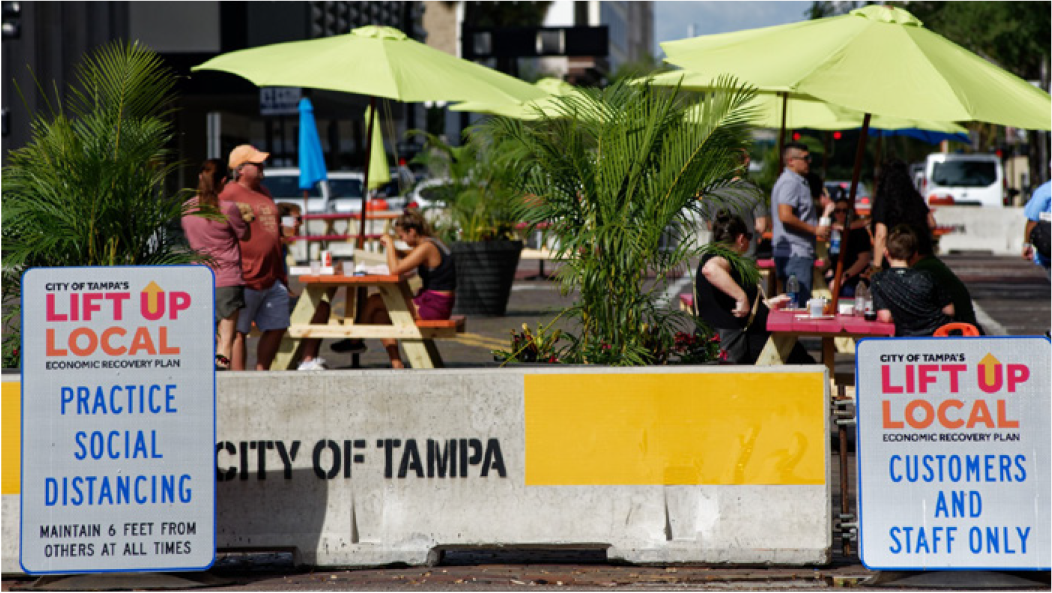

4.1.3 Align Skills with Growing Sector Needs
Foster resilient workforce pathways at multiple skill levels.
Action Description: Tampa’s labor market growth outpaced that of most U.S. metropolitan areas following the Great Recession through 2016.92 While that growth trajectory is expected to continue as Tampa’s population increases in the long term, the COVID-19 pandemic has tempered the city’s employment outlook in the near term. The pandemic has also compounded the long-standing local labor market challenge of Tampa’s persistent skills gap between job requirements for high-growth industries and the skills and experience possessed by residents seeking employment, especially among disconnected youth and underemployed workers in low-income communities.
As the City charts a more equitable and resilient path forward, it will employ a sector-based approach to connect more Tampanians to opportunity. Sector-based strategies bring together the diverse actors across local workforce systems to focus on the talent and skill needs of particular growth industries in order to connect low- and middle-income residents with the training experience they need to secure employment and advance within that industry.
A key tenet of sector-based approaches is skill set transferability, which supports career growth and sustained jobs. To that end, the City will focus its efforts on developing and elevating transferable skills demanded in a variety of industries – with a focus on Tampanians who have been impacted by the contraction in COVID-19-impacted sectors like tourism and hospitality. Another critical element of Tampa’s sector-based approach will center on leveraging the latest data on projected job growth for our region. The City will ensure that it is considering key data points on job growth alongside the need to retrain and realign skill sets. The City will do this by leveraging the Workforce Council to forge strong partnerships with the private and academic sectors to gain a deeper understanding of the skills needed for access to these growing industries. The City will also employ benchmarking and a focus on success measurement to ensure that its suite of programs and approaches is meeting the needs of Tampa’s workforce. In parallel, the City will develop a comprehensive workforce resource guide to help connect Tampanians to the skills training needed (Action 1.2.2). In the context of the current pandemic USF is leading an initiative to train workers with customer service experience to take on new opportunities in growth sectors like banking or professional services.
As part of its sector-based approach, the City will focus its efforts on reaching all of Tampa’s workforce, including young people ages 16 to 24, a group that has experienced historically high unemployment rates even before the impacts of COVID-19. By exploring new partnerships and funding opportunities, the City will foster innovative training experiences that help to overcome the skills gap and better engage this workforce cohort that is so critical to Tampa’s long-term growth and prosperity.

Launch the Collaborative on Economic Mobility
Lift up all Tampanians through a renewed focus on cross-sectoral collaboration on anti-poverty programs.
Action Description: The City of Tampa will launch the Collaborative on Economic Mobility, charged with advancing the upward mobility of all Tampanians. The Collaborative on Economic Mobility will work across agencies and government entities at all levels to help coordinate and improve delivery of anti-poverty programs, especially for those most affected by COVID-19 and its cascading negative impacts. It will also prioritize data and analysis so that the most effective programs can be tested and scaled up.
This effort will build on Tampa’s leadership in identifying and working collectively on ways to remove structural barriers to economic mobility and generational wealth for Tampanians of color. The Collaborative on Economic Mobility will explore the most effective ways to rethink and improve city services, as well as building on initiatives already underway and integrating them with new initiatives to give an increasing number of Tampanians’ access to economic opportunity. In practice, the Collaborative on Economic Mobility will work across City departments and agencies both to eliminate long-standing barriers to wealth-building for Tampa’s communities of color and to make intergenerational wealth-building opportunities accessible to every Tampa-nian. By organizing pilots around key moments in peoples’ lives such as early childhood and childcare, the transition to college and career, and renting or owning a home, as well as preparing for unexpected expenses, the Collaborative on Economic Mobility will help Tampa launch and scale innovative efforts to make economic opportunity a reality for all Tampa-nians no matter what shocks or stresses they may experience.

FOCUS ON ECONOMIC RECOVERY: WOMEN LEAVING THE WORKFORCE RESILIENT TAMPA
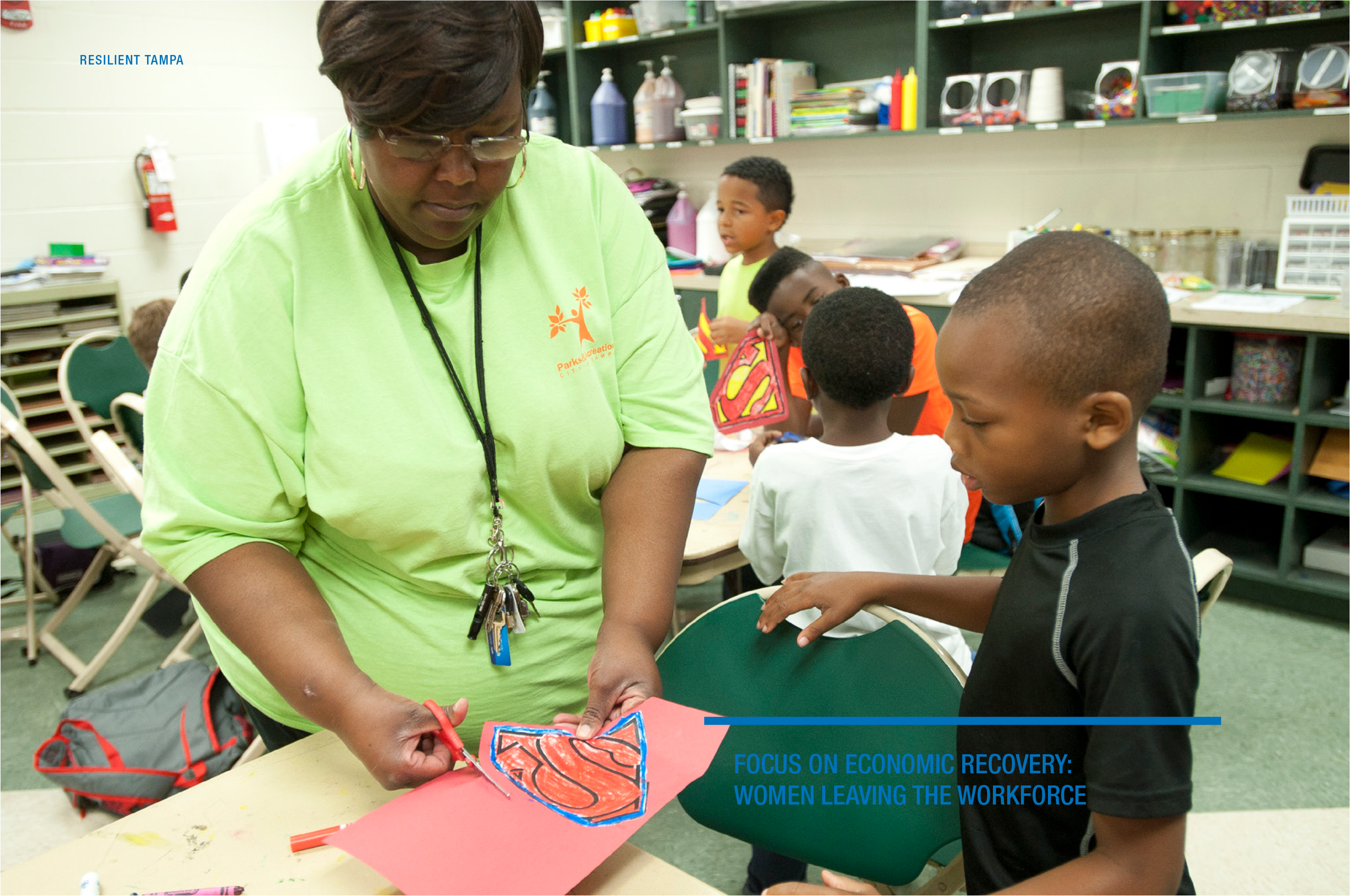
Over the past decade Tampa has made significant progress in increasing the labor force participation rate among women, exceeding the national average before the pandemic.93 COVID-19 threatens to undo much of this progress. Today, there are nearly 2.1 million fewer women in the national workforce than at the same time last year.94 This “she-cession” has been caused by numerous factors; however, unfulfilled child care needs have been a driving force behind this significant loss. Women are three times as likely to be responsible for childcare in heterosexual relationships than their male counterparts.95 In September alone, 865,000 women across the country left the labor force just as children began virtual learning.96 As Tampa looks to recover from COVID-19, finding ways to support women reentering the workforce, through initiatives like 4.1.4, will be a top priority.
Explore Mechanisms to Make Access to Broadband More Equitable
Close economic and educational opportunity gaps through expanded internet access for all Tampanians.
Action Description: The City will explore mechanisms to minimize Tampa’s digital divide by finding ways to invest in our low-income communities and leverage existing partnerships with the private sector to expand the city’s access to broadband and 5G.
Over the past decades, broadband access has become an essential service, allowing Tampanians to communicate, generate income, and access goods and services. However, access to broadband in Tampa is not distributed equitably. Black and Hispanic Tampanians are less likely to have a computer and access to broadband internet. Today, the digital divide between Black and white Tampanians stands at 10 percentage points.97 This divide exacerbates Tampa’s economic inequities now more than ever before as we continue to rely on broadband access for educational and economic opportunities during the COVID-19 pandemic. At the height of the pandemic, the Parks and Recreation Department worked in conjunction with the Technology and Innovation Department to implement Wi-Fi services at 45 recreation centers. This improvement allowed the City to expand services, including an e-learning program and virtual recreational programs, to a greater number of Tampanians. The City will build upon this expansion and work toward expanding broadband access for all Tampanians.
The City will explore pilot programs that provide internet options at no or low cost to residents of subsidized and affordable housing developments, explore ways that the City can invest in new technologies to support commercial corridors in our most underserved neighborhoods, and conduct research on broadband developments to inform future programs dedicated to increased connectivity. The incentives available through Tampa’s network of Opportunity Zones could also be leveraged to bring critical 5G infrastructure to the communities that need it most.
Tampa also has a unique opportunity to accelerate the expansion of 5G access as the host of the Super Bowl LV. In preparation for the event, $80 million was invested to bring 5G technology to Raymond James Stadium, among other renovations.98 The City will explore ways to build on this catalytic investment and recent recommendations from the City’s Economic Advisory Committee report to partner with telecommunications providers to ensure appropriate digital availability in all neighborhoods. Not only will the expansion of 5G help address Tampa’s digital divide, but it will also catalyze new employment opportunities for residents. A recent study projected that the Tampa Bay-St. Petersburg-Clearwater metropolitan area would gain nearly 30,000 jobs over the next decade as a result of 5G expansion in the area.99
SHOCKS AND STRESSES
THIS ACTION WILL ADDRESS


IMPLEMENTATION PARTNERS
City of Tampa Infrastructure and Mobility Administration and City of Tampa Parks and Recreation Department
4.2 INCREASE ACCESS TO AND USAGE OF TAMPA’S REGIONAL TRANSPORTATION NETWORK
ACTION 4.2.1
Implement New Micro-Mobility Solutions That Expand Transit and Multimodal Options for Tampanians
Create more convenient and resilient transportation options citywide.
Action Description: The City of Tampa is launching a citywide micro-mobility program to increase transportation options for all users within city limits. Vehicles to be included in this program include all electric single- and multi-rider scooters and electric assist bicycles. It is anticipated that these options will fill a need for short- to medium-range trips that are now often taken in private vehicles, resulting in the displacement of high emission trips with low impact trips. Additionally, micro-mobility vehicles can play a key role in first/last mile opportunities to connect transit riders to bus and streetcar routes. Increasing the mode split of these types of vehicles reduces the need for roadway capacity, which has the potential to reduce the long-term needs of infrastructure-heavy mobility solutions. Micro-mobility vehicles will be distributed in all areas of the city to provide equitable access for all users, and adaptive vehicle types will address the identified needs of users with disabilities.

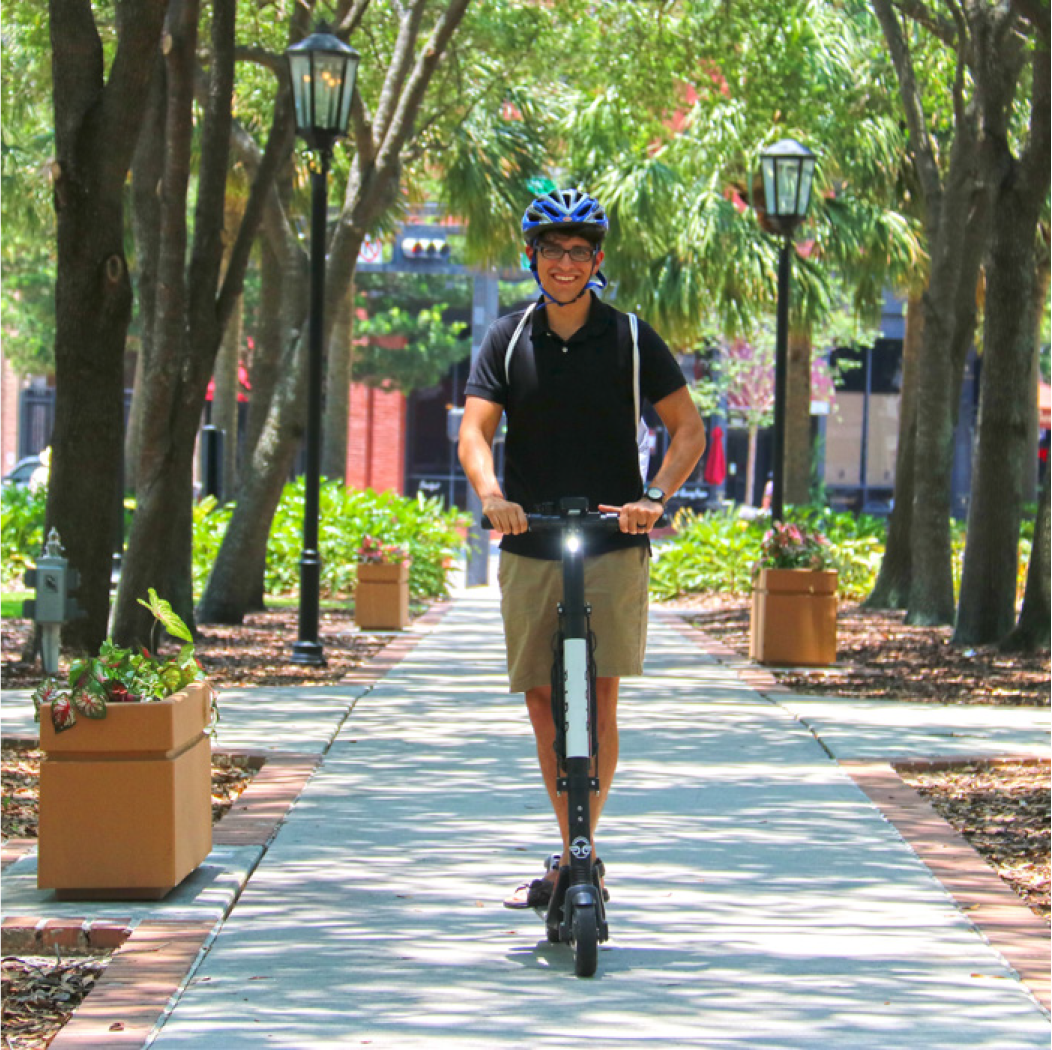
Modernize and Expand the City’s Streetcar System
Leverage the recently awarded $67.3 million in Florida Department of Transportation funding to transform the City’s streetcar system.
Action Description: In December 2020, the City of Tampa received the largest transit funding award the State has ever given to the Tampa Bay region. This strong ($67.3 million) commitment from the State will solidify the City’s position in its pursuit of federal funding to transform its streetcar system into a viable transportation option for city residents. Currently, the Tampa Historic Streetcar System is a 2.7-mile long streetcar transportation network that provides a unique connection from downtown Tampa and the Channel District to the Ybor City historic district. To date, the system has been used mainly by tourists, but with this catalytic investment, the City of Tampa is exploring a future for the streetcar as a true transportation option that better serves the mobility needs of residents, workers, visitors, and students in downtown Tampa, Ybor City, and Channel District, and establishes greater connectivity with surrounding urban neighborhoods.
In partnership with the Florida Department of Transportation (FDOT) and the Hillsborough Area Regional Transit Authority (HART), the City will advance modernization of the existing 2.7-mile TECO Streetcar line and a 1.3-mile fixed guideway extension. The heritage streetcar vehicles currently in use on the system would be replaced with faster modern vehicles, and the proposed system extension is currently envisioned to be built north on Florida Avenue to Palm Avenue with a south route on Tampa Street. Beyond expanding the streetcar system in the near term, this project will position the system for future expansion to enhance connectivity with other Tampa neighborhoods, including links to the University of Southern Florida, East Tampa, Westshore, and the airport.
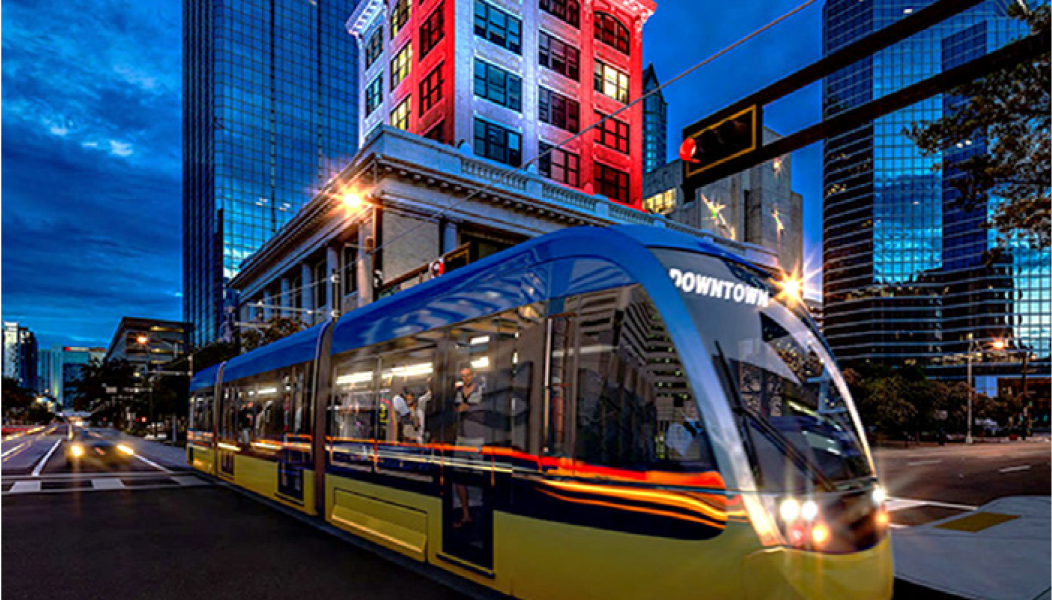

Long City of Tampa Mobility Department and HART TIMEFRAME IMPLEMENTATION PARTNERS SHOCKS AND STRESSES THIS ACTION WILL ADDRESS Economic inequality Aging / inadequate infrastructure Inadequate transportation systems
Ensure Equitable Transit Access and Expansion
Reduce the transportation cost burden by ensuring better connectivity to transit and mobility solutions.
Action Description: The City will work to ensure micro-mobility solutions foster improved connections to transit while exploring ways to promote existing transit discounts, such as student discounts and other subsidized memberships. The City will also work with HART and community members to prioritize transit expansion that connects low-income communities to job centers.
On average Tampanians spend 23% of their income on transportation costs.100 That cost burden exceeds 35% for very-low-income households in the poorest areas of Tampa.101 Transportation costs should not be a barrier to accessing well-paying jobs and it certainly should not be a contributing factor to economic insecurity. Therefore the City of Tampa will look at a comprehensive approach to reducing this cost burden by advancing last mile solutions, such as bike sharing, e-scooters, and car sharing, in order to connect Tampanians to more affordable transit. The City will also promote existing transit and micro-mobility discounts. Finally, the City will work closely with HART to ensure that transit expansions are reaching those with the greatest cost burden to ensure affordable transit options are equitably distributed.
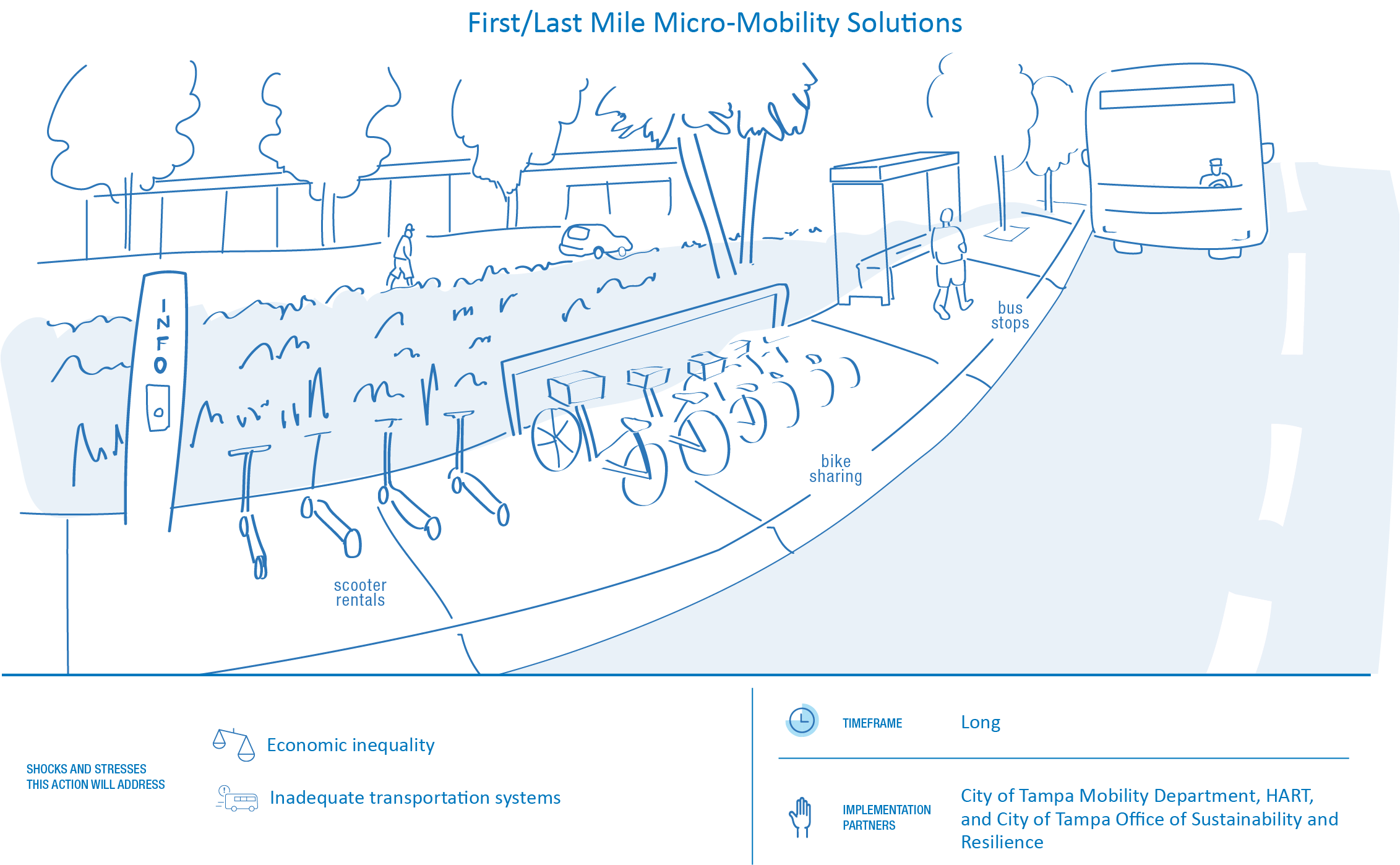
4.3 LEAD THE WAY, AS A CITY, IN INSTITUTIONALIZING RACIAL EQUITY AND RESILIENCE
ACTION 4.3.1
Develop and Implement Tampa’s Climate Action and Equity Plan
Chart the City’s course of action toward a more equitable and climate-ready future.
Action Description: The City will facilitate the creation of Tampa’s first climate plan, focused on addressing climate risks and vulnerabilities and transitioning to renewable energy, while recognizing the particular climate-related hazards faced by frontline communities. Cities play a crucial role in addressing the risks of climate change and embracing the generational opportunities of transitioning to a clean energy future. Central to developing plans and policies that will move towards these goals is ensuring equity and inclusion in the process and outcomes. The City of Tampa, through the support of Mayor Castor, will work to create an action-oriented plan that recognizes and addresses climate-related risks and seizes on sustainability, resilience, and renewable energy opportunities. The plan will be both wide-reaching and specific, addressing transportation, solid waste, energy, water management,
and green space with specific and measured goals that will lead to meaningful change. The process will rely on community input and grassroots outreach to ensure a diversity of voices and points of view inform the development and ultimate implementation of the plan.

Deploy More Equitable and Measurable Community Engagement Across City Agencies
Develop approaches to more intentionally and equitably bring the voices of Tampa residents into the City’s future planning processes.
Action Description: Utilizing learnings from the COVID-19 education and vaccine dissemination campaign, as well as from other community outreach activities and programs, the City will develop a toolkit of approaches that effectively engages all residents – especially Black and Hispanic residents, as well as low-income communities – in the planning of Tampa’s future. Community engagement is critical to Tampa’s future success. Cities thrive because their people thrive, and for Tampa to thrive, everyone’s voice must be heard. It is difficult to ensure that all people are represented when making citywide policy decisions. To do so effectively, the City must be intentional about engaging all residents equally in the decision-making and execution process, especially those communities that have historically been excluded from or underrepresented in planning processes. The toolkit of approaches will be co-created with and for Tampanians by the following.
- Collaborating with grassroots organizations that represent the diverse neighborhoods and people in our community.
- Providing reputable information from experts whom residents trust in order to build and enhance confidence in local government.
- Leveraging social media and other communications channels to reach more people and a greater diversity of residents.
- Bringing residents with diverse perspectives and backgrounds to the table early in the decision-making process.
- Involving key influencers and leaders from various communities who are trusted and represent the diverse views of our residents.
- Prioritizing face-to-face education and engagement that takes place where residents live and work.
- Using clear and accessible language that resonates with diverse groups of Tampanians.
- Bringing transparency and intentionality to the involvement of disparate groups and divergent perspectives as values to the process.
Across all approaches, it is critical to focus on relationship-building over time, which demands that communities and residents be engaged over the long-term rather than through single feedback moments.

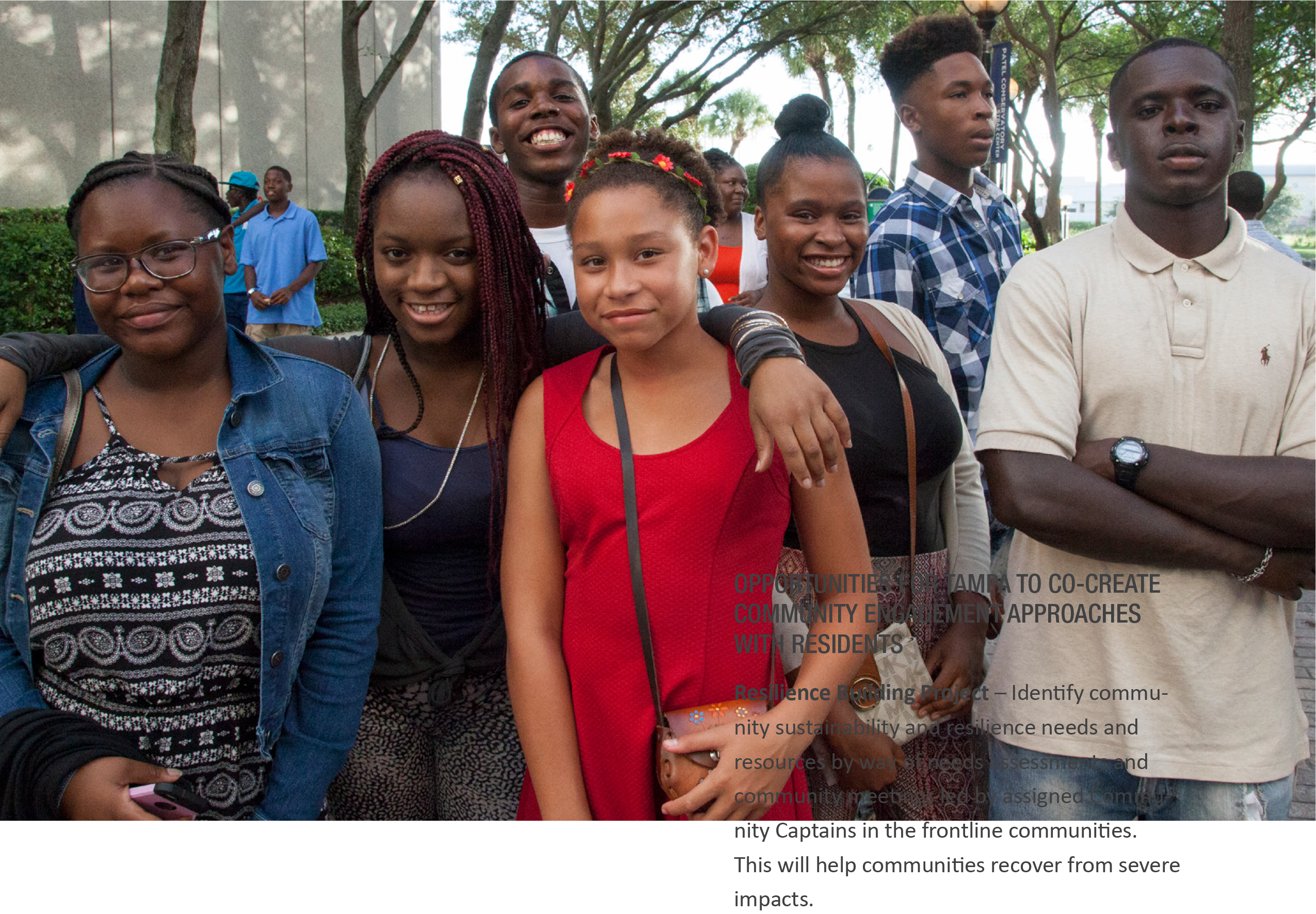
OPPORTUNITIES FOR TAMPA TO CO-CREATE COMMUNITY ENGAGEMENT APPROACHES WITH RESIDENTS
Resilience Building Project – Identify community sustainability and resilience needs and resources by way of needs assessments and community meetings led by assigned Community Captains in the frontline communities. This will help communities recover from severe impacts.
Tampa Environmental Justice/Racism –
Community discussion to identify the environmental impact disparities and history of Tampa’s marginalized communities. This will familiarize people with new and long-standing environmental issues in frontline communities.
Public Education on Solar Energy –
Public education especially in Tampa’s frontline communities to help citizens determine how solar power can work for the community in a disaster scenario and as a sustainability resource.
Incorporate Resilience Guidelines Into City Budget Processes
Secure Tampa’s future through investments made today.
Action Description: To prepare Tampa for the future and make strategic investments in the city today, Tampa will incorporate resilience guidelines into its budget processes. The City of Tampa’s budget is one of the most important indicators of our priorities. And while the FY2021 budget – $1.25 billion – is the largest in Tampa’s history, each dollar spent must help the City achieve multiple priorities and serve more than just its primary purpose. To do this, the City will work to institute a resilience screen into its budget processes: expense budget, capital improvement plans, and special funds budgets.
The current budgets consider needs, standards, the Tampa Comprehensive Plan, and other plans like the Community Vision Plans. As part of the creation of the Mayor’s budget submission to the Council, agencies will be asked to fill out the resilience screen for all capital program requests over $1 million and all expense budget programs in excess of $5 million. This screen will be evaluated by an interagency resilience review committee to encourage collaboration and ensure every dollar spent is aimed at delivering the greatest value towards Tampa’s goals.

MediumTIMEFRAME City of Tampa Budget OfficeIMPLEMENTATION PARTNER Responsive / effective governance SHOCKS AND STRESSES THIS ACTION WILL ADDRESS Aging / inadequate infrastructure
Implement Racial Equity Tools to Ensure Racial Equity is Considered in Policies, Practices, and Partnerships
Deploy a racial equity toolkit to provide City employees with the tools and data necessary to ensure policies and programs advance racial equity.
Action Description: In order to effectively combat racial inequity, it is critical to ensure that local government is doing everything in its power to eliminate institutional barriers. Therefore, the City of Tampa is committed to operationalizing equity within the City government by implementing a racial equity toolkit to promote community-wide structural change. Key components of the toolkit will include integrating a resilience and racial equity lens into the City’s budget (see Action 4.3.2) and procurement processes to ensure that these processes benefit everyone; identifying specific measures in the City’s enterprise performance systems that advance racial equity in City operations and services; evaluating and communicating data on racial equity that are used to track progress and inform strategy shifts if progress is not being made; and advancing workforce diversity through enhanced outreach programs.
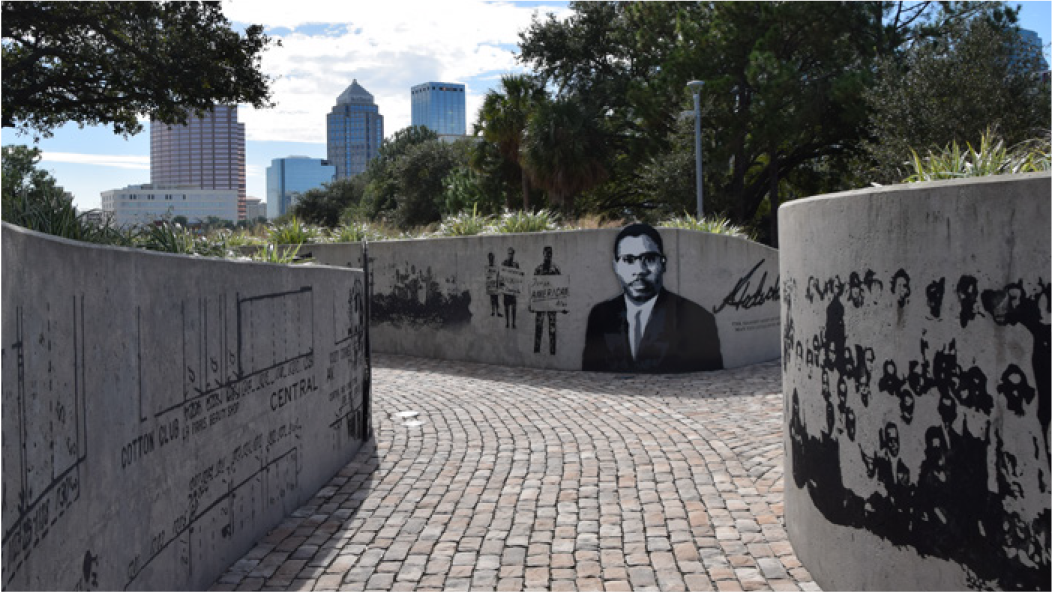

Expand the City’s Toolkit to Advance Resilience Goals in Land Use Decisions
Review the Land Development Code to better align land use, transportation, and mobility policies to advance Tampa’s resilience goals.
Action Description: The City of Tampa will undertake a comprehensive review of its existing Land Development Code to identify opportunities to further the resilience priorities put forth in Resilient Tampa. Tampa’s Land Development Code is one of the City’s most powerful levers to drive its vision of a more equitable, climate-ready, and connected future. Through review of the code, the City will explore a range of policy and regulatory approaches that can foster more walkable neighborhoods with a focus on sidewalks and public plazas, as well as the incorporation of Vision Zero principles and Complete Streets design guidelines. The review will also offer the opportunity to revisit parking minimum requirements for new developments, as well as advance energy efficiency and other climate mitigation measures. Across all of its analysis, the City will focus on building upon the diversity and strength of Tampa’s neighborhoods and promoting vibrant, safe, climate-ready and economically accessible spaces for all Tampanians.
TAMPA’S SIDEWALK NETWORK
| Miles of Sidewalks | Miles of Sidewalk Gaps |
|---|---|
| 1,178 | 1,309 |
Among Tampa’s built infrastructure, the City’s network of sidewalks plays a unique role in fostering safe, connected and equitable communities. Sidewalks provide important connections within and between neighborhoods, schools, transit and other essential destinations. And where sidewalks are lacking, pedestrians – especially our most vulnerable – face real challenges in navigating critical routes to school, work or vital services they need. According to Smart Growth America, pedestrians who are non-white, elderly, and traveling through low-income communities, where sidewalk infrastructure is often lacking, are disproportionately more likely to be killed by drivers, even after controlling for differences in population size and walking rates.102
To help address this challenge and counter the inequities fostered by the lack of adequate coverage, the Mobility Department has redoubled its efforts to expand the City’s sidewalk network. Tampa’s Mobility Department has established a process to prioritize sidewalk projects that will maximize the benefit to the existing network. All existing sidewalk gaps across the city, whether requested by individuals or not, are evaluated over a range of guiding principles focused on connectivity to local and regional routes, proximity to transit, schools and residents’ daily needs, and ADA compliance and safety. To bring more priority sidewalks to more neighborhoods, the City is planning to double its investment in its sidewalk network beginning in FY2022.
Taken together with the City’s adoption of Vision Zero and launch of programs such as Crosswalks to Classrooms, these critical investments in the city’s sidewalks are helping to transform Tampa’s transportation network into a well-connected and safe mobility system for all.
Responsive / effective governance
Medium City of Tampa Development and Growth Management Department
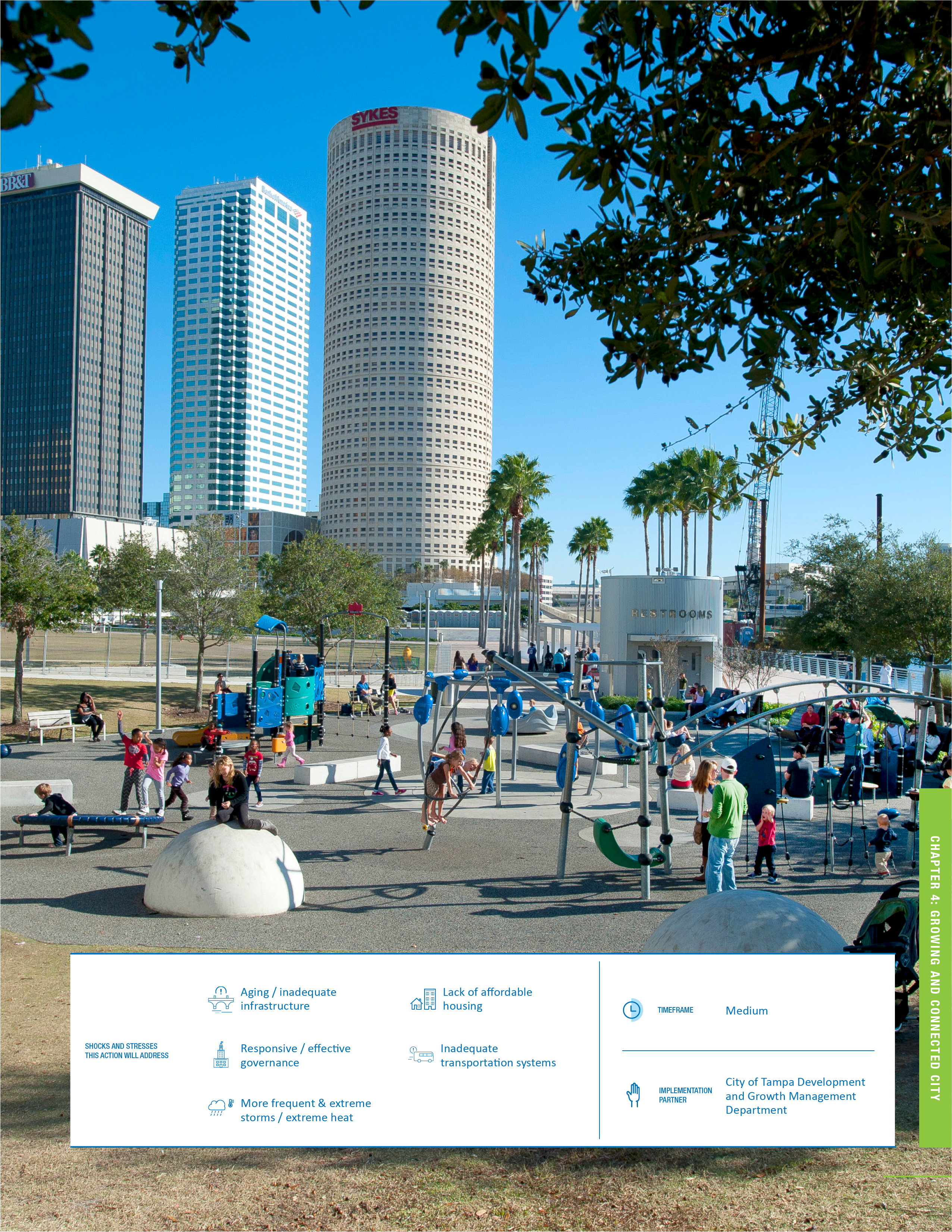
SHOCKS AND STRESSES THIS ACTION WILL ADDRESS
- Aging / inadequate infrastructure
- More frequent & extreme storms / extreme heat
- Inadequate transportation systems
- Lack of affordable housing
CHAPTER 4: GROWING AND CONNECTED CITY
Implement Resilient Tampa Through the Resilience Delivery Team
The City of Tampa will designate key resilience liaisons from across City government to support delivery and measurement of Resilient Tampa.
Action Description: In order to ensure that it can effectively implement the Roadmap across different agencies, the City of Tampa will launch the Resilience Delivery team, who will be tasked with tracking progress, defining measurable targets, and making needed adjustments to program delivery. The delivery team, composed of staff appointed by the Mayor from relevant City departments, will be led by the Office of Sustainability and Resilience, who will track progress through monthly delivery meetings that provide key status updates on resilience initiatives. The team will also develop an annual report where they will provide updates on the percentage of initiatives launched to date and the percentage of initiatives that are on track. The delivery team will also define, measure, and track citywide resilience metrics and ensure that they are integrated with the citywide performance management system. Finally, the City delivery team will work towards sharing any best practices throughout City government to help institutionalize innovative resilience practices.
Shocks and Stresses This Action Will Address
- Responsive / effective governance

Timeframe
Short 
Implementation Partner
City of Tampa Chief of Staff Office
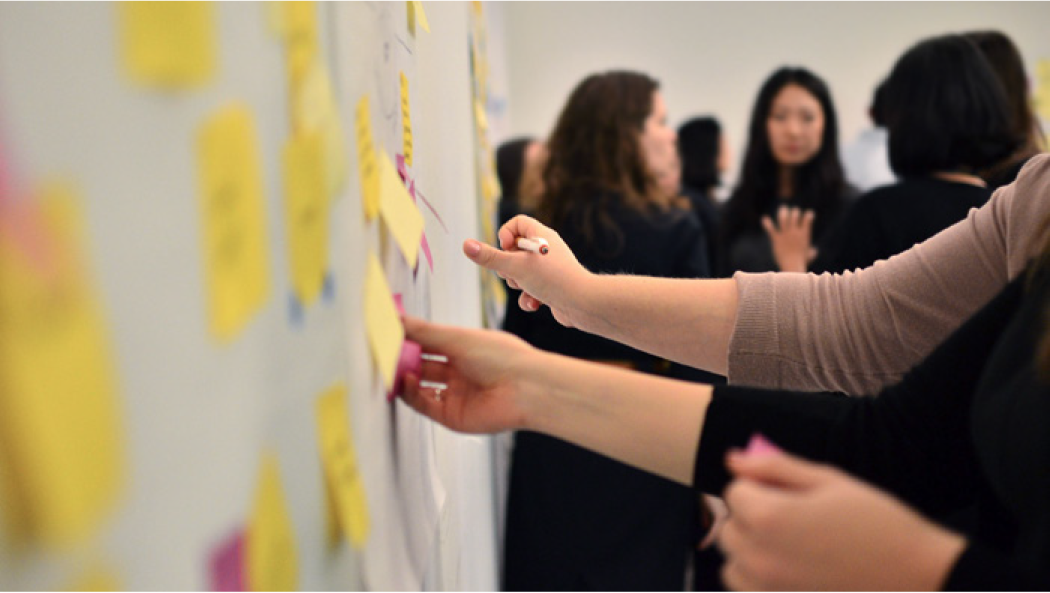

ACKNOWLEDGEMENTS
Mayor’s Sustainability and Resiliency Advisory Team
- Joshua Baumgartner
- Representative Kathy Castor
- Phil Compton
- Mallory Dimmitt
- Susan Glickman
- Dr. Yogi Goswami
- Lorena Hardwick
- Alexander Metcalf
- Chris Minner
- Lisandra Morales
- Ben Pratt
- Taylor Ralph
- Daane Reinking
- CJ Reynolds
- Bob Rohrlack
- Demetri Sedita
- Walter Smith
- Dr. Keith (Eric) Sommers
- Dr. Maya Trotz
Initiative Design Partners
- Christine Acosta
- John Antapasis
- Elie Araj
- Ashley Bauman
- John Bennett
- Stephen Benson
- Vik Bhide
- Pete Brett
- Eddie Burch
- Brandon Campbell
- Laura Cantwell
- Kim Christine
- Ginger Clark
- Nadeska Concha
- Anna Corman
- Michelle Cyr
- Abbye Feeley
- Douglas Griesenauer
- Calvin Hardie
- Gregory Hart
- Kayon Henderson
- Emily Hinsdale
- Al Hoel
- Mickey Jacob
- Danni Jorgenson
- Kim Jowell
- Julien Joy
- Sharon Lewis
- Det. Susan Libertz
- Milton Martinez
- Brenda McKenzie
- Michelle Midanier
- Brandie Miklus
- Sashy O’Connor
- Felicia Pecora
- Jeremy Rex
- Rob Rosner
- Sam Shaffer
- Mark Sharpe
- Lakshmi Shenoy
- Bemetra Simmons
- Rosemary Soto
- Michelle VanLoan
- Marley Wilkes
Resilient Tampa Workshop Participants
- Chris Ahern
- Carloa Aldazabal
- Beth Alden
- Rafaela Amador
- Ted Apelt
- Alexander Awad
- Bonnie Aylor
- Tee Bailey
- Kent Bailey
- Brad Baird
- Christina Barker
- Ashley Bauman
- Joshua Baumgartner
- John Bennett
- Stephen Benson
- Matthew Bernor
- Vik Bhide
- Peter Brett
- Keith Bruton
- Brandon Campbell
- Dr. Ginger Clarke
- Adri Colina
- Shawn College
- Sarah Combs
- Phil Compton
- Ernest Coney
- Chuck Conklin
- Russell Conn
- Brian Cook
- Christopher Cooley
- Jesse Coraggio
- Dexter Corbin
- Jon Dengler
- Alan Denham
- Janet Dougherty
- Jean Duncan
- Brooke Errett
- Katrina Erwin
- Mary-Elizabeth Estrada
- Abbye Feeley
- John Flanagan
- Joshua Frank
- Russell Giambrone
- Bill Gieseking
- Beau Giles
- Susan Glickman
- Randy Goers
- Getulio Gonzalez-Mulattieri
- Nicolas Gunkle
- Mark Hafen
- Calvin Hardie
- Catherine Hayes
- Julia Herbst
- David Hey
- Hank Hodde
- Miray Holmes
- Tyler Hudson
- Al Illustrato
- Sarah Kearney
- Afifa Khaliq
- Debbie King
- Karen Kress
- Ryann Lynn
- Heather Maggio
- Thomas Mantz
- Tim Marks
- Monica Martin
- Nicole McCleary
- Janelle McGregor
- Jan McLean
- Sheila McNamara
- Alexander Metcalf
- John Mitchell
- Amanda Moore
- Lisandra Morales
- TreBora Morales
- Kevin Moran
- Raquel Pancho
- Seung Park
- Michael Perry
- Dave Plusquellic
- Carole Post
- Taylor Ralph
- Michael Ramsey
- CJ Reynolds
- Rachel Rhode
- Lorena Rivas Hardwick
- Bob Rohrlack
- Rob Rosner
- Taryn Sabia
- Troy Salisbury
- Cara Serra
- Dawn Shirreffs
- Jeff Siddle
- David Sinclair
- Justin Smith
- Melissa Solberg
- Greg Spearman
- Jenna Stevens
- Carolyn Stewart
- Brad Suder
- Susy Torriente
- Gonzalo Valdes
- Roc Walker
- Chuck Weber
- Bart Weiss
- Ian Whitney
- Marley Wilkes
- Terri Willingham
- Justin Willits
- Irene Womack
- Ocea Wynn
- Allison Yeh
- Ashley Young
- Chris Zambito
- Andrea Zelman
- Melissa Zornitta
Resilient Cities Catalyst
- Anna Friedman
- Corinne LeTourneau
- Paul Nelson
- Alex Quinto
- Andrew Salkin
- Amelia Smyth
END NOTES
Introduction
- “Top 10 Metropolitan Areas in Numeric Growth: 2017 to 2018”. U.S. Census Bureau, . (https://www.census.gov/newsroom/press-kits/2019/metro-county-pop-estimates.html)
- “Tampa Ranks #4 in the U.S, for job growth since Great Recession”. Tampa Bay Economic Development Council, 18 April 2016, . (https://tampabayedc.com/news/tampa-ranks-4-in-the-u-s-for-job-growth-since-great-recession/)
- Hillsborough County Department of Public Safety. “COVID-19 Data Dashboard”. , Accessed Mar 2020. (https://www.hillsboroughcounty.org/residents/public-safety/emergency-management/stay-safe/covid-19-dashboard)
- Ibid.
- Ward, Brendan. "Yelp: Over 1,200 businesses closed in Tampa Bay between March and May". Tampa Bay Business Journal, 22 Jul 2020, . (https://www.bizjournals.com/tampabay/news/2020/07/22/yelp-over-1-200-businesses-closed-in-tampa-bay-be.html)
- Track the Recovery”. Opportunity Insights, (https://tracktherecovery.org/)
- Ibid.
- Hall, T.M., et al. "US tropical cyclone activity in the 2030s based on projected changes in tropical sea-surface temperature". J. Climate, 34, no. 4, . (https://journals.ametsoc.org/view/journals/clim/34/4/JCLI-D-20-0342.1.xml)
- Dahl, Kristina, et al. “Killer Heat in the United States: Climate Choices and the Future of Dangerously Hot Days”. Union of Concerned Scientists, . (https://www.ucsusa.org/resources/killer-heat-united-states-0)
- Climate Science Advisory Panel. “Recommended Projections of Sea Level Rise for the Tampa Bay Region (Update)”. 2019, . (http://www.tbrpc.org/wp-content/uploads/2019/07/CSAP_SLR_Recommendation_2019_Final.pdf)
- The Center for Neighborhood Technology. “Tampa”. H+T Affordability Index, . (https://htaindex.cnt.org/map/)
- Department of Housing and Urban Development. Location Affordability Index, . (https://hudgis-hud.opendata.arcgis.com/datasets/location-affordability-index-v-3)
- “Regional Equity Report”. State of the Region, Tampa Bay Partnership, . (https://issuu.com/tampabaypartnership/docs/2020_regional_equity_report)
- “National Equity Atlas”. PolicyLink and the USC Equity Research Institute, 2017 (www.nationalequityatlas.org)
- “National Equity Atlas: Equity Indicators for Tampa,FL”. PolicyLink and USC Dornsife Equity Research Institute, November 2020.
- “Regional Equity Report”. State of the Region, Tampa Bay Partnership, . (https://issuu.com/tampabaypartnership/docs/2020_regional_equity_report)
- “National Equity Atlas: Equity Indicators for Tampa,FL”. PolicyLink and USC Dornsife Equity Research Institute, November 2020.
- U.S. Census Bureau; American Community Survey. “Tampa city, Florida”. QuickFacts, . (https://www.census.gov/quickfacts/fact/table/tampacityflorida/POP010210)
- The Center for Neighborhood Technology. “Tampa”. H+T Affordability Index, . (https://htaindex.cnt.org/map/)
- Ibid.
- U.S. Census Bureau; American Community Survey. “Tampa city, Florida”. QuickFacts, . (https://www.census.gov/quickfacts/fact/table/tampacityflorida/POP010210)
- Ibid.
- Ibid.
- U.S. Census Bureau. “Age and Sex”. American Community Survey, (https://data.census.gov/cedsci/table?g=1600000US1271000&tid=ACSST1Y2019.S0101&hidePreview=false).
Opportunity for All Tampanians
- “National Equity Atlas: Equity Indicators for Tampa,FL”. PolicyLink and USC Dornsife Equity Research Institute, November 2020.
- “National Equity Atlas”. PolicyLink and the USC Equity Research Institute, 2017, . (www.nationalequityatlas.org)
- “National Equity Atlas: Equity Indicators for Tampa,FL”. PolicyLink and USC Dornsife Equity Research Institute, November 2020.
- “Regional Equity Report”. State of the Region, Tampa Bay Partnership, docs/2020_regional_equity_report. (https://issuu.com/tampabaypartnership/)
- “Fall 2019 Florida Kindergarten Readiness Screener”. Overtown children and youth coalition, . (https://overtowncyc.org/fall-2019-florida-kindergarten-readiness-screener-flkrs-indicator-data)
- “FLKRS Test Design Summary and Blueprint”. Florida Department of Education, . (http://www.fldoe.org/core/fileparse.php/18494/urlt/FLKRS-TDSBP.pdf)
- National Equity Atlas”. PolicyLink and the USC Equity Research Institute, 2017, . (www.nationalequityatlas.org)
- “Understanding Our Plans”. Florida Prepaid, . (https://www.myfloridaprepaid.com/resources/prepaid-vs-savings/)
- “National Equity Atlas”. PolicyLink and the USC Equity Research Institute, 2020.
- “Fast Facts 2021”. American Association of Community Colleges, . (https://www.aacc.nche.edu/research-trends/fast-facts/)
- Hunt-White, Tracy. “2015-2016 National Postsecondary Student Aid Study”. National Center for Educational Statistics,
Thriving Neighborhoods
- “Hillsborough Community College Overview”. U.S. News and World Report: Education, (https://www.usnews.com/education/community-colleges/hillsborough-community-college-CC03620).
- “National Equity Atlas”. PolicyLink and the USC Equity Research Institute, 2017, (www.nationalequityatlas.org).
- “Track the Recovery”. Opportunity Insights, (https://tracktherecovery.org/).
- “Coronavirus Stats: Impact on Local Small Businesses”. Homebase, https://joinhomebase.com/data/city/Tampa/.
- “COVID-19 Impact on Small-Business Revenue”. 2021 E-Insights Report, University of South Florida, (https://www.usf.edu/business/state-of-the-region/e-insights-2021/section-2-03-covid-19-impact-on-small-business-revenue.aspx).
- “The Impact of the COVID-19 Pandemic on Florida’s Small Businesses”. America’s SBDC Florida, Oct 2020, (http://www.floridasbdc.org/Reports/Publications/COVID%20Impact%20Survey_October.pdf).
- “About Homelessness in Hillsborough County”. Tampa Hillsborough Homeless Initiative, (https://thhi.org/about-homelessness/).
- U.S. Bureau of Labor Statistics. “Unemployment Rate in Tampa-St. Petersburg-Clearwater, FL (MSA)”. Federal Reserve Bank of St. Louis, (https://fred.stlouisfed.org/series/TAMP312UR).
- Wynne, Sharon K. “Food insecurity in Tampa Bay has doubled during pandemic”. Tampa Bay Times, 25 Nov. 2020, (https://www.tampabay.com/news/health/2020/11/25/food-insecurity-in-tampa-bay-has-doubled-during-pandemic/).
- Ibid.
- Ibid.
- Ibid.
- Ibid.
- Centers for Disease Control and Prevention. “Older Adults”. People at Increased Risk, 13 Dec. 2020, (https://www.cdc.gov/coronavirus/2019-ncov/need-extra-precautions/older-adults.html).
- City of Tampa, Florida. “Housing Affordability Advisory Team Recommendations and Final Report”. Transforming Tampa’s Tomorrow, 12 Feb 2020.
- The Florida Department of Health in Hillsborough County. “Hillsborough County Health Equity Profile”. June 2020, (http://hillsborough.floridahealth.gov/programs-and-services/community-health-planning-statistics/health-equity/_documents/health-equity-profile-web-2020.pdf).
- Brink, Graham. “Get used to long commute times, Tampa Bay”. Tampa Bay Times, 1 Oct. 2019, (https://www.tampabay.com/news/business/2019/10/01/get-used-to-long-commute-times-tampa-bay/).
- “Community Land Trusts (CLTs)”. Community Wealth, (https://community-wealth.org/strategies/panel/clts/index.html).
- “What is Vision Zero?”. Vision Zero Network, (https://visionzeronetwork.org/about/what-is-vision-zero/).
- Sidewalk Stompers, (https://sidewalkstompers.org/).
- “About Us”. Wellbuilt Bikes, (https://www.bikeshoptampa.com/about-us/).
- Onbikes, (https://www.onbikes.org/).
- Sidewalk Stompers, (https://sidewalkstompers.org/).
- “Health in All Policies”. Centers for Disease Control and Prevention, (https://www.cdc.gov/policy/hiap/index.html).
- “National Equity Atlas”. PolicyLink and the USC Equity Research Institute, 2020, (www.nationalequityatlas.org).
- “Florida Brownfields Redevelopment Atlas”. University of South Florida, (https://www.arcgis.com/apps/webappviewer/index.html?id=60b46851ca3d46fb96b2c0ac2fa2d2f2).
- “Heat Island Effect”. United States Environmental Protection Agency, (https://www.epa.gov/heatislands).
- Vaidyanathan A, Malilay J, Schramm P, Saha S. “Heat Related Deaths - United States, 2004-2018.” Morbidity and Mortality Weekly Report 2020, (https://www.cdc.gov/mmwr/volumes/69/wr/mm6924a1.htm#suggestedcitation).
- Dahl, Kristina, et al. “Killer Heat in the United States: Climate Choices and the Future of Dangerously Hot Days”. Union of Concerned Scientists, (https://www.ucsusa.org/resources/killer-heat-united-states-0).
- Landry S., Koeser, et al. “City of Tampa Tree Canopy and Urban Forest Analysis 2016”. City of Tampa, Florida, (https://waterinstitute.usf.edu/upload/documents/TampaUEA2016_FinalReport-lowres.pdf).
- “Saffir-Simpson Hurricane Wind Scale”. National Hurricane Center and Central Pacific Hurricane Center, (https://www.nhc.noaa.gov/aboutsshws.php).
- Kania, John and Mark Kramer. “Collective Impact”. Stanford Social Innovation Review, Winter 2011, (https://ssir.org/articles/entry/collective_impact).
Climate-Ready Infrastructure
- Climate Science Advisory Panel. “Recommended Projections of Sea Level Rise for the Tampa Bay Region (Update)”. 2019, (http://www.tbrpc.org/wp-content/uploads/2019/07/CSAP_SLR_Recommendation_2019_Final.pdf).
- Dahl, Kristina, et al. “Killer Heat in the United States: Climate Choices and the Future of Dangerously Hot Days”. Union of Concerned Scientists, (https://www.ucsusa.org/resources/killer-heat-united-states-0).
- Hall, T.M., et al. “US tropical cyclone activity in the 2030s based on projected changes in tropical sea-surface temperature”. J.
Growing and Connected City
- Cook, Brian, et al. “Hillsborough County Community Vulnerability Study: Vulnerability Report”. Plan Hillsborough, June 2020, . (http://www.planhillsborough.org/wp-content/uploads/2020/06/CVS-Vulnerability-Report-and-Map-Analysis_FCCDR_June-2020.pdf)
- Kahn, Matthew E., et al. “The Local Economic Impact of Flood-Resilient Infrastructure Projects”. John Hopkins University’s 21st Century Cities Initiative, American Flood Coalition, Dec. 2020, . (https://floodcoalition.org/resources/flood-infrastructure-and-job-creation/)
- “Tampa, FL”. Data USA, 2018 . (https://datausa.io/profile/geo/tampa-fl#about)
- United Way. “ALICE Threshold and Demographics, Florida, 2015”. . (https://uwbb.org/wp-content/uploads/2017/02/ALICE-Thresholds-and-Demographics-2017-ALICE-Report.pdf)
- U.S. Census Bureau; American Community Survey. “Tampa city, Florida”. QuickFacts, . (https://www.census.gov/quickfacts/fact/table/tampacityflorida/POP010210)
- Solar Energy Loan Fund, . (https://solarenergyloanfund.org/about/)
- Solar United Neighbors, . (https://www.solarunitedneighbors.org/)
- THAP Group, . (http://thapgroup.org/weatherization-assistance-program/)
- Smith, Kirk R. and Alistair Woodward. “Human Health: Impacts, Adaptation, and Co-Benefits”. Climate Change 2014: Impacts, Cambridge University Press, Cambridge, United Kingdom and New York, NY, USA, pp. 709-754.
- The Center for Neighborhood Technology. “Tampa”. H+T Affordability Index, . (https://htaindex.cnt.org/map/)
- “Hillsborough Area Regional Transit Authority 2019 Annual Agency Profile”. National Transit Database, . (https://cms7.fta.dot.gov/sites/fta.dot.gov/files/transit_agency_profile_doc/2019/40041.pdf)
- Brodd, Kristi. “Beneficial Buses: Electric Buses Bring Benefits to Businesses, Communities and Utilities”. Advanced Energy, 24 Feb 2020, . (https://www.advancedenergy.org/2020/02/24/beneficial-buses-electric-buses-bring-benefits-to-businesses-communities-and-utilities/)
- “Living Shorelines”. National Oceanic and Atmospheric Administration, . (https://www.habitatblueprint.noaa.gov/living-shorelines/)
- Allen, Thomas R., et al. “Linking Water Infrastructure, Public Health, and Sea Level Rise: Integrated Assessment of Flood Resilience in Coastal Cities”. Public Works Management and Policy, 2019, Vol. 24(1) 110–139.
- Slater, Sandy J., et al. “Recommendations for Keeping Parks and Green Space Accessible for Mental and Physical Health During COVID-19 and Other Pandemics”. Preventing Chronic Disease 2020, Centers for Disease Control and Prevention.
- The Florida Department of Health in Hillsborough County. “Hillsborough County Health Equity Profile”. June 2020, (http://hillsborough.floridahealth.gov/programs-and-services/community-health-planning-statistics/health-equity/_documents/health-equity-profile-web-2020.pdf)
- Landry, Shawn, et al. “City of Tampa Tree Canopy and Urban Forest Analysis 2016”. City of Tampa, Florida, . (https://waterinstitute.usf.edu/upload/documents/TampaUEA2016_FinalReport-lowres.pdf)
- The Center for Neighborhood Technology. “Tampa”. H+T Affordability Index, https://htaindex.cnt.org/map/.
- Department of Housing and Urban Development. Location Affordability Index, . (https://hudgis-hud.opendata.arcgis.com/datasets/location-affordability-index-v-3)
- “National Equity Atlas”. PolicyLink and the USC Equity Research Institute, 2017, (www.nationalequityatlas.org)
- Kliesen, Kevin L. and Julia S. Maues. “Are Small Businesses the Biggest Producers of Jobs?”. Federal Reserve Bank of St. Louis, April 2011, (https://www.stlouisfed.org/publications/regional-economist/april-2011/are-small-businesses-the-biggest-producers-of-jobs.)
- Kiva United States, . (https://www.kiva.org/lend?country=us)
- “Tampa Ranks #4 in the U.S, for job growth since Great Recession”. Tampa Bay Economic Development Council, 18 April 2016, . (https://tampabayedc.com/news/tampa-ranks-4-in-the-u-s-for-job-growth-since-great-recession/)
- U.S. Census Bureau. “Comparative Economic Characteristics”. American Community Survey, . (https://data.census.gov/cedsci/table?t=Employment%3AEmployment%20and%20Labor%20Force%20Status%3AIndustry%3AOccupation&g=1600000US1271000&tid=ACSCP1Y2019.CP03&hidePreview=true.)
- Krawcheck, Sallie. “All the Jobs Were Lost by Women of Color”. Ellevest Magazine, 12 Jan 2021.
- “Policy Brief: The Impact of COVID-19 on Women”. United Nations, 9 Apr 2020.
- Kashen, Julie, et al. “How COVID-19 Sent Women’s Workforce Progress Backward”. Center for American Progress, 30 Oct. 2020, . (https://www.americanprogress.org/issues/women/reports/2020/10/30/492582/covid-19-sent-womens-workforce-progress-backward/)
- U.S. Census Bureau. “Types of Internet Subscriptions by Selected Characteristics”. American Community Survey, . (https://data.census.gov/cedsci/table?q=internet&g=1600000US1271000&tid=ACSST1Y2019.S2802&hidePreview=false)
- Coffey, Lauren. “How Tampa Bay is pulling off the most high-tech Super Bowl yet”. Tampa Bay Business Journal, 2 Feb 2021, . (https://www.bizjournals.com/tampabay/news/2021/02/02/tampa-bay-super-bowl-tech.html)
- Coffey, Lauren. “Tampa Bay set to gain thousands of 5G-related jobs in the next decade, report says”. Tampa Bay Business Journal, 11 Feb 2021, (https://www.bizjournals.com/tampabay/news/2021/02/10/tampa-bay-5g-job-boost.html).
- The Center for Neighborhood Technology. “Tampa”. H+T Affordability Index, (https://htaindex.cnt.org/map/).
- Department of Housing and Urban Development. Location Affordability Index, (https://hudgis-hud.opendata.arcgis.com/datasets/location-affordability-index-v-3).
- Hanzlik, Mae. “The State of Transportation and Health Equity”. Smart Growth America, Dec 2019.